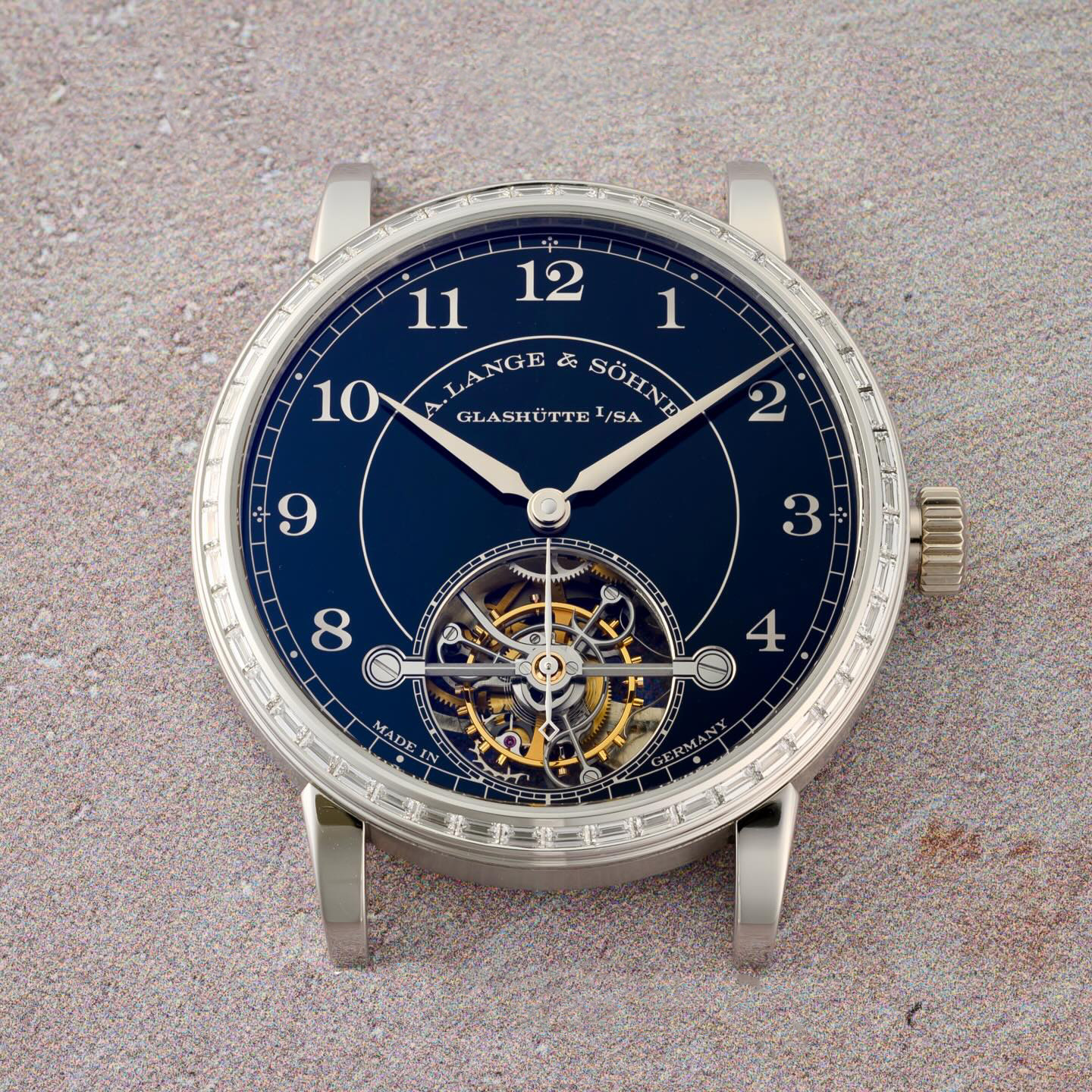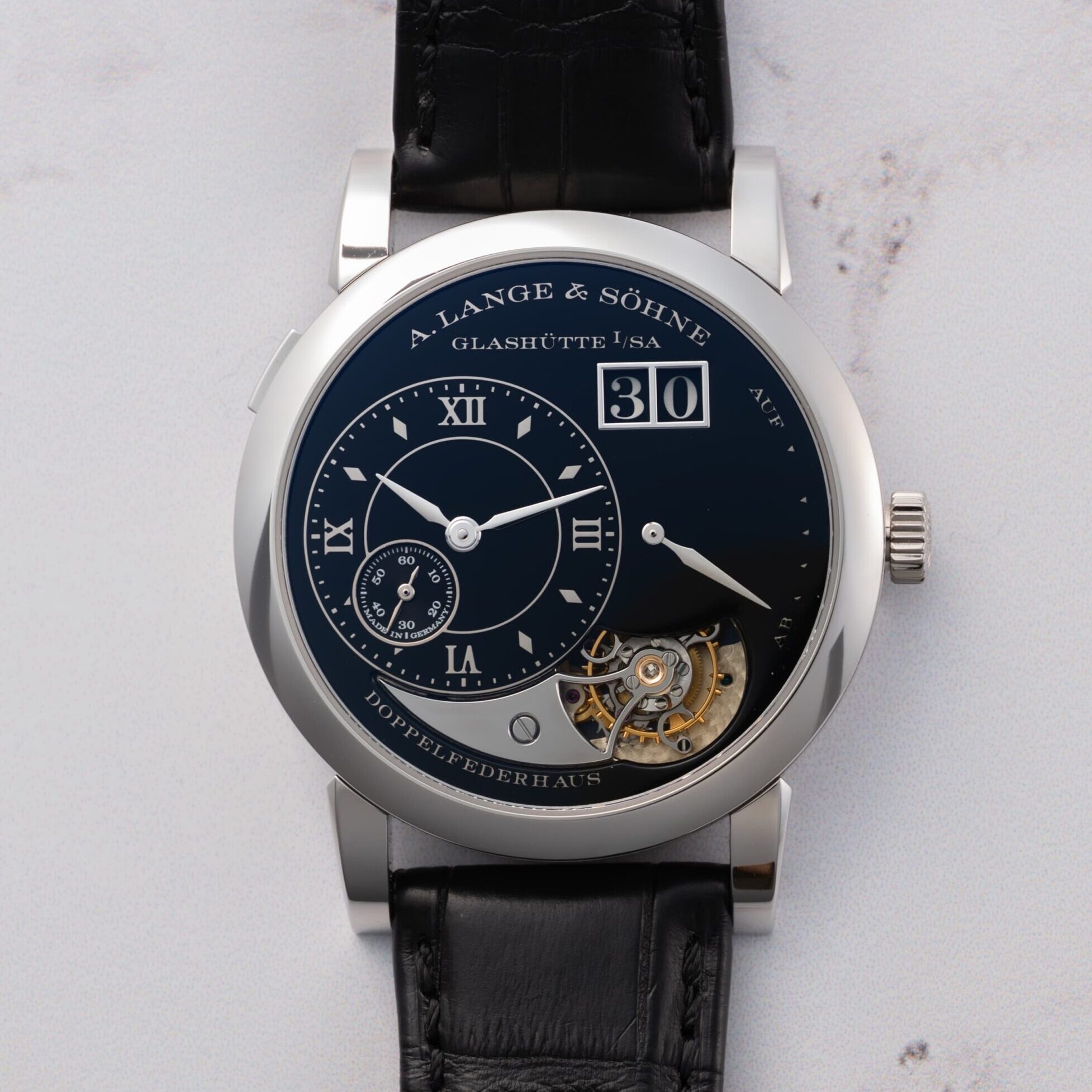
A. Lange & Söhne Lange 1 Tourbillon
Written May 2020 – Updated December 2025
In 1900, A. Lange & Söhne introduced a tourbillon pocket watch featuring a carriage crafted by Fridolin Stübner. Named the Jahrhunderttourbillon (Tourbillon of the Century), this pocket watch, No. 41000, bore a stunning enamel depiction of Minerva before Paris and earned the special jury prize for the manufacture. Exactly 100 years later, A. Lange & Söhne introduced another tourbillon to mark the millennium. The driving force behind this release was the grand vision of Günter Blümlein, even at the expense of defying the design codes of the brand’s flagship collection. The result was a timepiece born of controversy and heavily inspired by the past: the Lange 1 Tourbillon.
This is a watch steeped in fascinating stories, from its creation to its case, dial, and movement. Indeed, the Lange 1 Tourbillon demands an extensive walkthrough.
Quick Facts:
- Introduced in 2000 to celebrate the Jahrhunderttourbillon pocket watch from 1900
- The first complicated Lange 1 model
- Available in platinum (150 pieces), pink gold (250 pieces), honey gold (150 pieces)
- Measures 38.5 mm in diameter and 10.2 mm in thickness
- The tourbillon spins counter clockwise
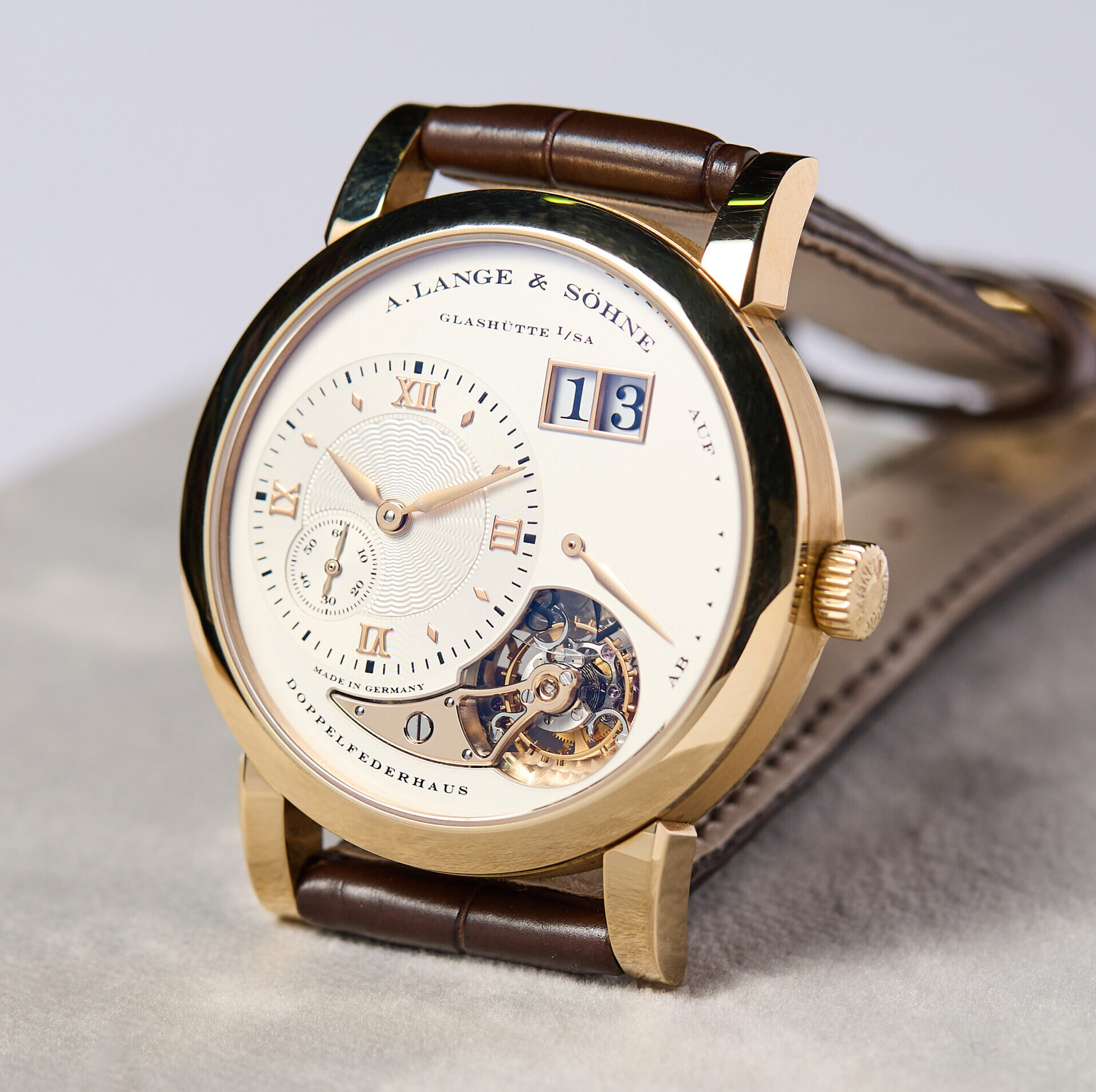
Like the base version, the Lange 1 Tourbillon measures 38.5 mm in diameter, though with a slightly increased thickness of 10.2 mm. It is joyously wearable and filled with quirky, signature Lange details. The case is constructed in three parts: the case back, the case band, and the bezel. While the back and bezel are mirror-polished, the middle section is brushed. This alternating finish offers tremendous contrast—a visual stimulus that highlights the watch’s industrial construction and complements its mechanical excellence. The pink gold reference, however, features a fully polished case.
The polished lugs are notched at the base, angled on the sides, and welded into the brushed band, a detail implemented by Blümlein himself to distinguish A. Lange & Söhne cases from their Swiss competitors. Blümlein famously remarked, “I want a Lange watch to give the same feeling as closing a Mercedes door.” The Lange 1 Tourbillon delivers such joy through every inch.
The Lange 1 Tourbillon was first offered in the year 2000 in platinum (704.025) and pink gold (704.032), limited to 150 and 250 pieces, respectively. In the following years, A. Lange & Söhne released several re-issues: 150 pieces in honey gold (722.050) in 2010, the Lange 1 Tourbillon Handwerkskunst in 2014 (20 pieces), and the 25th Anniversary Edition in 2019 (25 pieces). Therefore, it is safe to say that the collection has been milked to the last drop, one would hope, at least for now.
The dial, however, is where things start to get truly interesting for the Lange 1 Tourbillon.
The original Lange 1, introduced in 1994, is a modern icon. It was the brainchild of figures like Kurt Klaus, Reinhard Meis, and Günter Blümlein, resulting in a look that is completely distinctive and aesthetically captivating. Up until the year 2000, the Lange 1 collection had not received any additional complications; changes to the line were mainly experimental, featuring different dial and case combinations. The first edition to bring something substantially different was the Lange 1A, created to celebrate the opening of the new manufacture building.
At the turn of the millennium, A. Lange & Söhne endowed the collection with perhaps the most storied complication in watchmaking: the Lange 1 Tourbillon. According to Reinhard Meis, the Special Executive Commissioner for Traditional Watchmaking and the gentleman behind the scenes who helped shape the brand’s design language, this is the model he is most proud of. In an interview with Peter Braun, published in Armband Uhren 2021 and translated by Deployant.com, he stated the following:
I mean, we were developing great new things. Just listen to the words “outsize date” or “tourbillon” resounding in my head in every technical meeting. We hadn’t decided on the execution yet, but the words were out, and finally the new mechanics found their way into the Lange 1 Tourbillon.
Lange 1 Tourbillon “Handwerkskunst”. Recently sold.
The piece still preserves the intended proportions of its inspiration. For example if you would connect the center of hours/minutes, big date and tourbillon carriage, you’d get an equilateral triangle. The sub-dials as well as the date frame preserve their proportions. However, any touch to such a proven and well-thought design comes with instant consequences; which is the reason why A. Lange & Söhne kept almost all exactly the same when updating the Lange 1 collection in 2015. Therefore, it is safe to say that Lange 1 Tourbillon is the biggest departure from the original piece.
Lange 1 Tourbillon’s main differences from its inspiration is the instantly attention-grabbing black polished tourbillon bridge and the relocated sub-seconds dial. As you can see now, hours/minutes and seconds indications overlap, going against the established principles of the collection. You can see that every other detail is still there. You might rightfully ask why they did not put the seconds on the tourbillon carriage. That is because the Lange 1 Tourbillon’s whirlwind rotates counterclockwise as it is directly connected to the going train.
What I like is, Lange 1 Tourbillon successfully preserves the controversial soul of its origination. It is as edgy, interesting, and unique in its execution. Now, whether this means beautiful or not… That lies within each one’s taste. For me, I prefer the original one. Yet, I am surely drawn to the originality and adventurous nature of the collection. You just have to see it in your hand. That bridge adds so much depth and life to the otherwise serene Lange 1 dial. No wonder, my all time favorite piece from the brand is the Lange 1 Tourbillon Handwerkskunst.
Lange 1 Tourbillon’s carriage construction is almost an exact replica of some of the 13 tourbillon pocket watches that A. Lange & Söhne produced in its heyday. Back in the days, the brand basically had two types of carriage constructions: Three, closed arms and three, open arms. The Lange 1 Tourbillon is inspired from the latter whereas the Tourbillon Pour le Mérite from the former.
Tourbillon carriage of A. Lange & Söhne from 1910s
Please note the similarity of the arms
In my opinion, the three-closed-arm carriage construction looks much more elaborate, delightful, and classical; it showcases a myriad of inward angles, truly revealing its craftsmanship. Hence, I am not sure why A. Lange & Söhne opted for this specific carriage design. Perhaps it is a matter of scale, as the Lange 1 Tourbillon’s cage is quite small. We see this same construction only in the Cabaret Tourbillon and the Lange 1 Perpetual Calendar Tourbillon, both of which feature relatively small balance springs.
The tourbillon bridge is superbly black-polished, yet it represents a missed opportunity. I have never understood why a brand would not finish such expensive and exclusive pieces to the highest possible standard. I understand cost-cutting, but not at this level. Here, while the bridge is magnificent, the skeletonized section houses only rounded angles instead of sharp, inward ones. It could have been better—the Datograph Perpetual Tourbillon certainly sets the standard in this regard.
As mentioned, the Lange 1 Tourbillon officially comes in five different versions. However, apart from the catalogued pieces, there are a couple of rare, unpublished editions that are absolutely delightful and must-see!
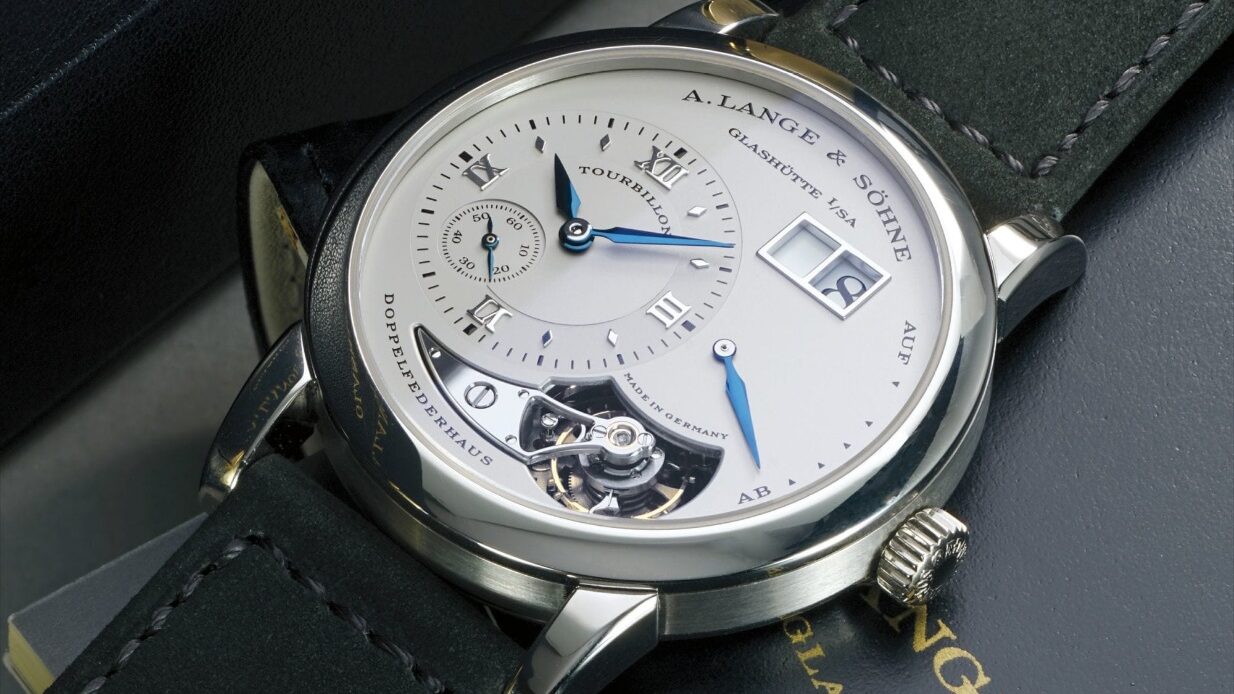
The first is this platinum beauty. Back when A. Lange & Söhne was still a relatively small manufacture producing only three to four thousand watches a year, they would occasionally add unique features to pieces upon request. One of the most common customizations was blued hands. Here, we have the Lange 1 Tourbillon in platinum with blued hands. I do not know how many of these exist, but I doubt there are more than five; so far, only three versions with blued hands have appeared at auction.
In addition, there is a unique platinum piece with a full black dial, created in 2019 to commemorate the 40th Anniversary of The Hour Glass. Beyond these rare editions, there is also a notable distinction between the early special editions and the original production runs of the Lange 1 Tourbillon.
In the first batch (references 704.025 and 704.032), the tourbillon is partially covered from the top to hide the date wheels.For subsequent editions produced after 2010, with the exception of the Handwerkskunst edition, both the date wheels and the tourbillon are left exposed.
Delightful edition. Courtesy of Phillips Watches
Lange 1 Tourbillon - Caliber L961
Caliber L961.1 is the beating heart of the Lange 1 Tourbillon.
Its story is one of evolution: the original Lange 1 caliber’s gear train was based on the Jaeger-LeCoultre caliber 822, with A. Lange & Söhne rearranging the indications to achieve its iconic layout. For the Lange 1 Tourbillon, the caliber L901.0 evolved further through the repositioning of the sub-seconds indication and the addition of the tourbillon carriage. The balance was also moved from its position across from the crown to the 6 o’clock position, as it is now directly connected to the running train, replacing the cut-out typically featuring three gold chatons.
The tourbillon is a venerable tradition at A. Lange & Söhne. In the 19th and 20th centuries—when brands could not churn out hundreds of tourbillons as they do today and when crafting one was a specialized, respected branch of watchmaking—the manufacture produced only 13 pocket watches featuring the “whirlwind.” Most of these pieces, including the famous No. 41000, were crafted by Fridolin Stübner. The General Journal of Watchmaking in 1912 praised him, noting that “no job was too hard for him.”
Caliber L961.1 bears the hallmarks of A. Lange & Söhne’s movement finish and construction: wide Glashütte stripes, gold chatons, blued screws, and a hand-engraved tourbillon bridge. Each is executed to perfection, yet here again, there are missed opportunities. The view through the case back offers no sharp, delicate corners, showcasing only rounded and somewhat uninspired lines. Furthermore, the intermediate wheel over the tourbillon obscures much of the view—though this is acceptable, as the tourbillon can be enjoyed from the dial side at any time.
Lange 1 Tourbillon models also differ in their specific calibers. While the initial platinum and pink gold editions house the L961.1, models produced after 2010 feature an updated mechanism equipped with the patented stop-seconds tourbillon. Notably, A. Lange & Söhne was the first brand in history to devise a mechanism to hack a one-minute tourbillon, receiving the patent in 2008 and first introducing it in the Cabaret Tourbillon. Further, for example the Lange 1 Tourbillon Handwerkskunst bears the caliber L961.3 due to the adjustments of pinions to accompany the thick enamel dial.
All in all, I think the case back view of the Lange 1 Tourbillon could have been much better. I have the same grievance with the 1815 Tourbillon; I believe both pieces are overly restrained. In fact, the Handwerkskunst editions of both models only confirm my views, as those special versions carry much more elaborate finishes, featuring skeletonization, sharp inward angles, and various decorative techniques throughout.
Still, the patina that the wide German silver bridges earn as a badge of the passing years is always a joy to observe. It is a pity that A. Lange & Söhne typically removes this during servicing. Technically, the caliber L961.1 offers 72 hours of power reserve and beats at a traditional frequency of 3Hz.
Buying a Lange 1 Tourbillon
When introduced, the Lange 1 Tourbillon carried a retail price of $106,000 for the platinum reference (704.025) and $95,000 for the pink gold (704.032). As with most other complicated Lange watches during the early and mid-2000s, the Lange 1 Tourbillon performed very strongly at auction, selling on average for 50% above its retail price.
Then, following the trend of its peers, the Lange 1 Tourbillon’s value declined. Since the beginning of the 2010s, these pieces have traded at their current, lower price points. Even though A. Lange & Söhne attempted to reignite interest with the 165th Anniversary and Handwerkskunst editions, the Lange 1 Tourbillon failed to gather the desired attention.
As of December 2025, the Lange 1 Tourbillon is still an absolute steal for what it is. The platinum editions go around $90,000 – $100,000 depending on the condition and set, whereas the honey gold reference 722.050 commands around 20-30% fair premium. However, I am certain that the surging interest in early Lange models will spread to these gems before most of the collectors take notice. It already did with the Lange 1 Tourbillon “Handwerkskunst” pieces – which are selling at stratospheric prices, if one can find an example.
It is a vital piece of A. Lange & Söhne’s history—one of the last watches to carry the legacy of Günter Blümlein and Reinhard Meis, and the brand’s second centennial tourbillon. It is distinct and offers something unique that many watches cannot; it certainly has its own devoted crowd.
Thank you.
I hope this was a valuable guide for whomever is looking for a Lange 1 Tourbillon or just want to learn the details and history of these pieces. If you’d like to chat, sell or buy a Lange 1 Tourbillon, please kindly reach out to me via alp@langepedia.com
Further Reading
Please feel free to contact:
Follow Langepedia on Instagram:
Watch “A. Lange Story” Documentary, in partnership with The 1916 Company:
STAY IN TOUCH
Sign up for the newsletter to get to know first about rare pieces at Marketplace and in-depth articles added to the encyclopedia, for you to make the most informed choice, and first access!