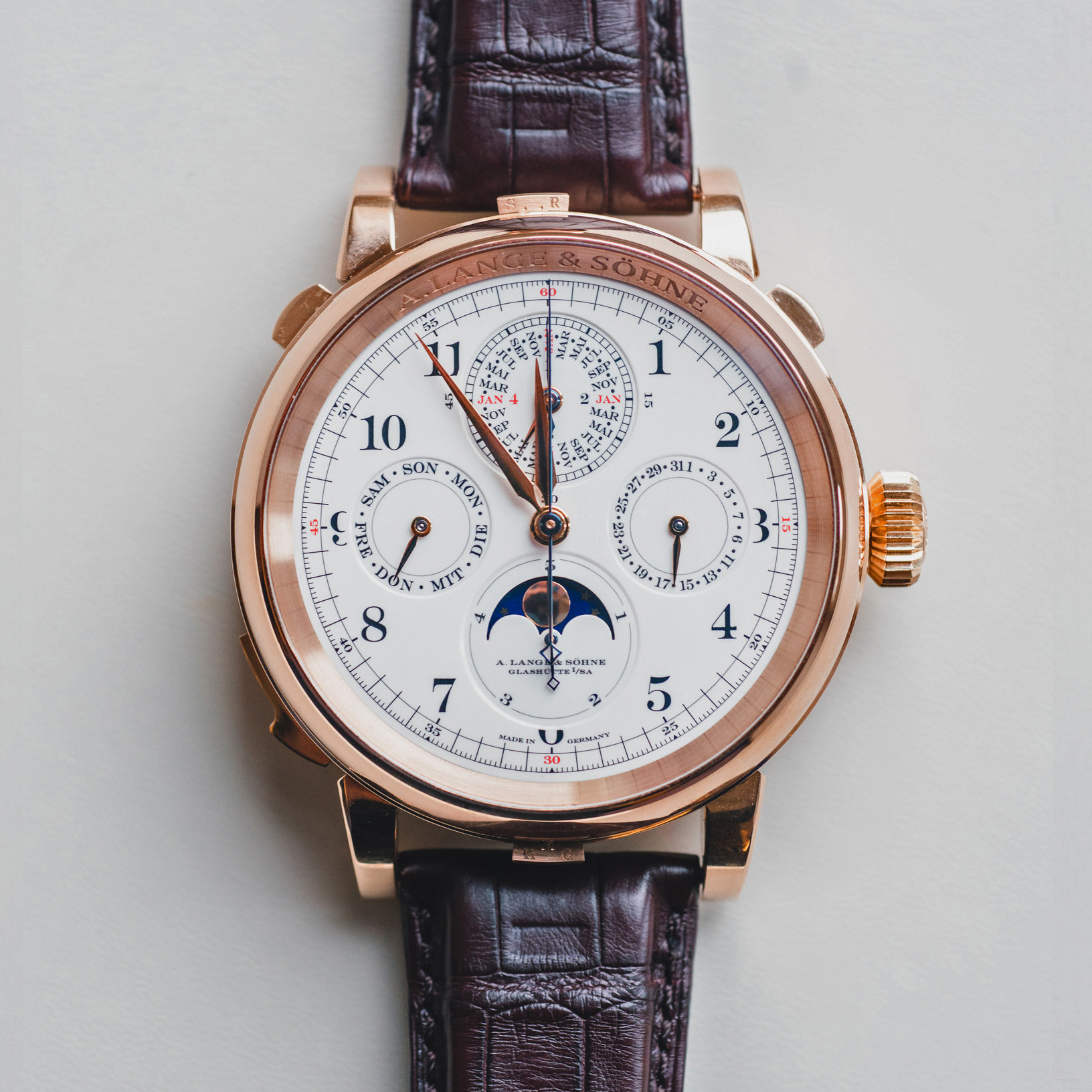
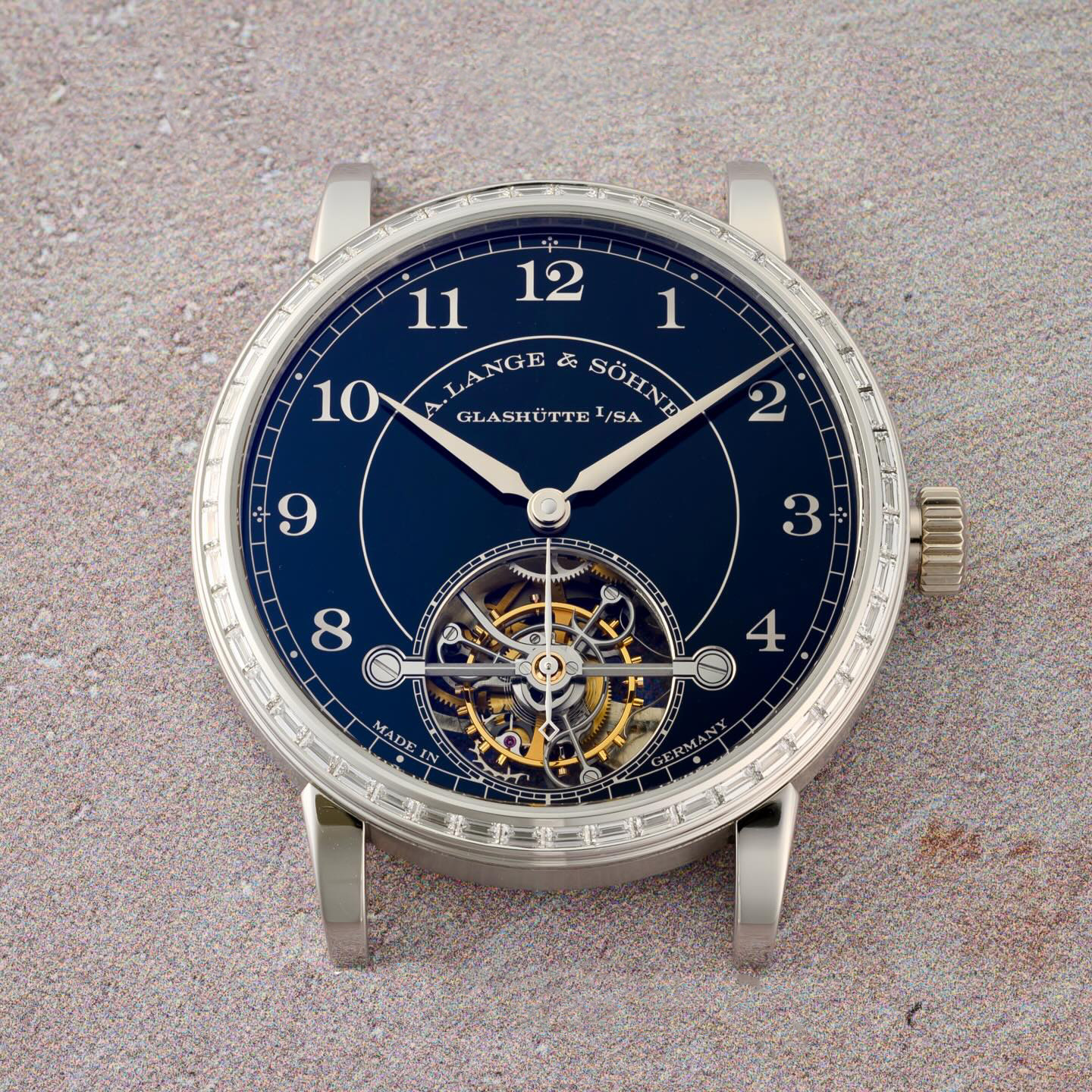
A small village with just above five thousand daytime population and formed by only two main streets between the green ore mountains against a lonely train station; Glashütte was finally breathing the freedom only for a year following the fall of the Berlin Wall in 1990. Yet, once the cradle of German Watchmaking and synonym for artistic crafts; it was far away from its former glory. All that’s left was a state-owned enterprise GUB which focused on mass production, despite its tremendous talent pool, ditching the region’s proud heritage on handcraft.
Looking back, Glashütte in 1990 seems to be the last place to give birth to a mechanical innovation, inspirational design and exemplary craftsmanship. However, thinking more about it; perhaps this deprivation and stark contrast to the region’s glorious past were the exact reasons that pushed Günter Blümlein and Walter Lange to register the A. Lange & Söhne trademark once again on 7 December 1990 and later drive the engineers and craftsmen to bring out some of the world’s most distinguished watches in 24th October1994. Although all special in their own way, one was in the highest order, as per its moniker: Tourbillon “Pour le Mérite”.
Swiss make the best watches – so do the Germans, says one early A. Lange & Söhne advertisement. The campaign was a result of Blümlein’s genius positioning strategy where he did not try to de-crown the popular king, rather attached the brand and the region to it. Yet, without concrete examples of such a claim, such campaigns are almost always entirely useless.
To that end, A. Lange & Söhne introduced Lange 1, Saxonia and Arkade alongside Tourbillon Pour le Mérite as the re-birth collection. Exceptionally finished, with attention to detail far exceeding almost any other piece in its price range at the time. But perhaps most importantly, all unique, enticing and characteristic pieces. Three of them were focused on design, backed by exemplary artisanship. One, however, was the backbone of A. Lange & Söhne’s illustrious claim, housing things that never been done before to substantiate the bold claim.

The Tourbillon Pour le Mérite Collection. Missing a couple.
The modern A. Lange & Söhne was claiming to live up to its former glory, to the least. Günter Blümlein often claimed that albeit they respect and abide the glory of the past days, they are not bound to it, and they must exceed it. Be it the design, the mechanics, the story… The brand embodied traditional elements to bridge the past but added incredible technicality and modern identity to prove that they are much more than a wind of a bygone era. Tourbillon Pour le Mérite is the result and embodiment of such ideology. At the modern brand’s debut in 1994, it was the sole carrier of A. Lange & Söhne’s technical claims, with a design borrowing from pocket watches, adjusted to be timeless.
The Pour le Mérite is an order of Merit, translates as For Merit, established in 1740 by the King of Prussia. Ranking among the highest orders of its time, it was an honor degree given both to military and civil services. Otto Von Bismarck, Erwin Schrödinger are some of the recipients. Today, the medal is still in active use. For Lange it is also a merit for watches with fusée and chain mechanism. Indeed, the Tourbillon Pour le Mérite is the first-ever wristwatch to combine the fusée and chain and tourbillon mechanisms in a wristwatch. As part of the debut collection. In 1994. Talk about grandiose.
The tourbillon craft was already embedded in Glashütte. In DUS (Deutsche Uhrmacher Schule) starting from early ‘20s to late ‘30s, one student would be allowed to work in his “masterpiece” with the guidance of Alfred Helwig, the inventor of the flying tourbillon. Those pocket watches are some of the most fascinating pieces one can gaze, and it is possible that Walter Lange and Günter Blümlein was inspired from such a strong heritage. It might also because the tourbillon, in the ‘90s, was still special. It was limited, highly respected. Today, every other brand has a standard offering of tourbillon in the catalogue. It might also because that A. Lange & Söhne has produced only 12 pocket watches with tourbillon in its existence from 1845 to 1939, and Blümlein & Lange duo wanted to finish the job.

The Centennial Tourbillon, courtesy of A. Lange & Söhne. Recommended Reading: A. Lange & Söhne Through 1845 – 1950
The Tourbillon Pour le Mérite Collection
In its lifetime, which extends until around 1999, A. Lange & Söhne created 200 pieces of Tourbillon Pour le Mérite. It was a limited piece from the beginning. Below are the full detailed list:
701.001: 104 pieces in Yellow Gold / Champagné dial (1 piece with blue dial: #103/150)
701.011: 23 pieces in Pink Gold / Black dial
701.007: 18 pieces in White Gold / Blue dial
701.005: 46 pieces in Platinum / Silver dial (1 piece with pink gold dial : #22/50)
701.008: Piece Unique in White Gold / Black dial (#101/150)
711.011: Piece Unique in Pink Gold / Black dial (36 mm, #89/150)
711.035: Piece Unique in Platinum / Black dial (36 mm, #45/50)
751.001: Piece Unique in Yellow Gold / Champagné Dial with Integrated Wellendorff bracelet
751.005: 3 pieces in Platinum / Silver dial with Integrated Wellendorff bracelet
701.301: Piece Unique in Yellow gold / Champagné dial with Wellendorff bracelet (#03/150)
701.006: Piece Unique in Stainless Steel (#149/150)
The Nr.1 was worn by Walter Lange. Günter Blümlein enjoyed the platinum, as often he was a fan of white metals. To my knowledge, the 701.301 is also owned by Walter Lange, and currently sits at the brand’s Stammhaus safe in Glashütte.
The Tourbillon Pour le Mérite was an instant hit. In one of the brand’s very early documents, Christian Hübner cannot contain his excitement, where he tells the story of how he wanted to order 50 of them. He could not get 50, but he got one in yellow gold and one in platinum for his personal collection. As with the all-debut pieces, the Tourbillon Pour le Mérite was instantly sold-out. The 1994 Catalogue only mentions the reference 701.001 (yellow gold) and 701.005 (platinum), and the rest followed in the coming years. The price at the time was 125,000 Deutsche Mark for the gold, and 140,000 DM for the platinum variant. For comparison, a classic Lange 1 in platinum was 39,000 DM. Dare I say, the Tourbillon Pour le Mérite was really a bargain!!
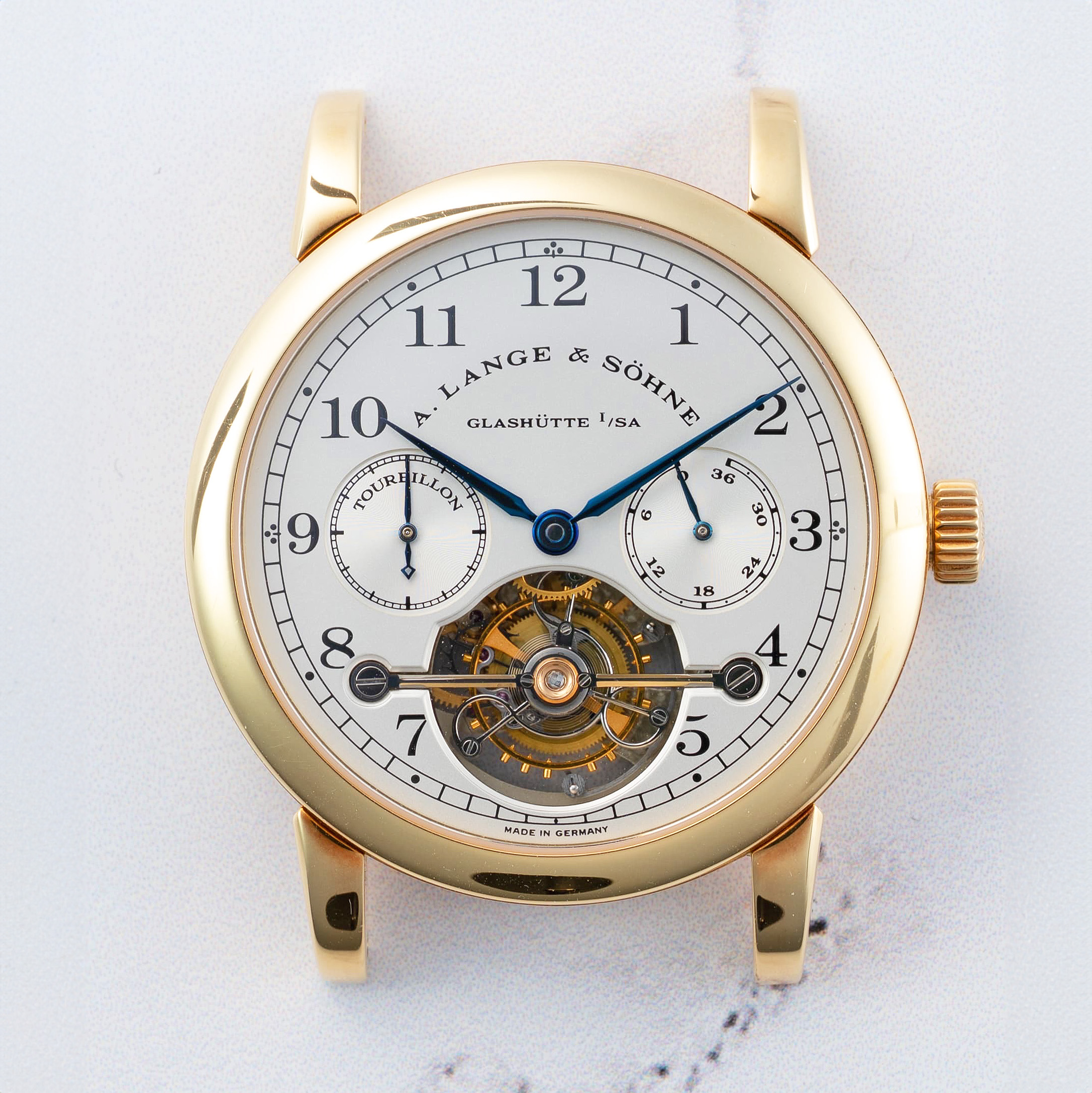
The Classic. 701.001 in Yellow Gold. Sold at The Selection
Measuring in 38.5 mms (there are two unique pieces one at 36.5 mms and one other at 36 mms) in diameter and 10 mms in thickness, Tourbillon Pour le Mérite is an exceptionally compact piece for what it houses; especially for 1994. The case structure follows the principle dictated by Günter Blümlein. The signature elements are the three-step structure with a brushed case band against polished bezel and case back as well as beautifully notched and strikingly detailed, welded lugs. This style is applied to all Lange models to give an instant recognizable look to A. Lange & Söhne watches. Rigid, defined, calculated as opposed to flowing, romantic, highly detailed Swiss. Works tremendously well on the case of Tourbillon Pour le Mérite, brings a beefiness to the otherwise compact case.
Curved lugs further improve Tourbillon Pour le Mérite’s presence on the wrist.
The transition from the brushed case band to polished and strong lugs is just a
joy to see and feel. The lug width for the regular models is 20 mms and 19 mms
for the unique 36 mms models with a buckle width of 16 mms. The same
measurement also applies to many other models such as Lange 1, Langematik
Perpetual thus the straps / bracelets are easily interchangeable.
Among all the production, my estimate is there are not more than 10 with integrated Wellendorff bracelets. The styles differ between mesh and these very rare pieces were offered only for platinum and yellow gold Tourbillon Pour le Mérite models starting from 1995 to mid-1998. Once again with the risk of giving someone a heart-attack, the price premium between of Tourbillon Pour le Mérite on Wellendorff was only 12%.
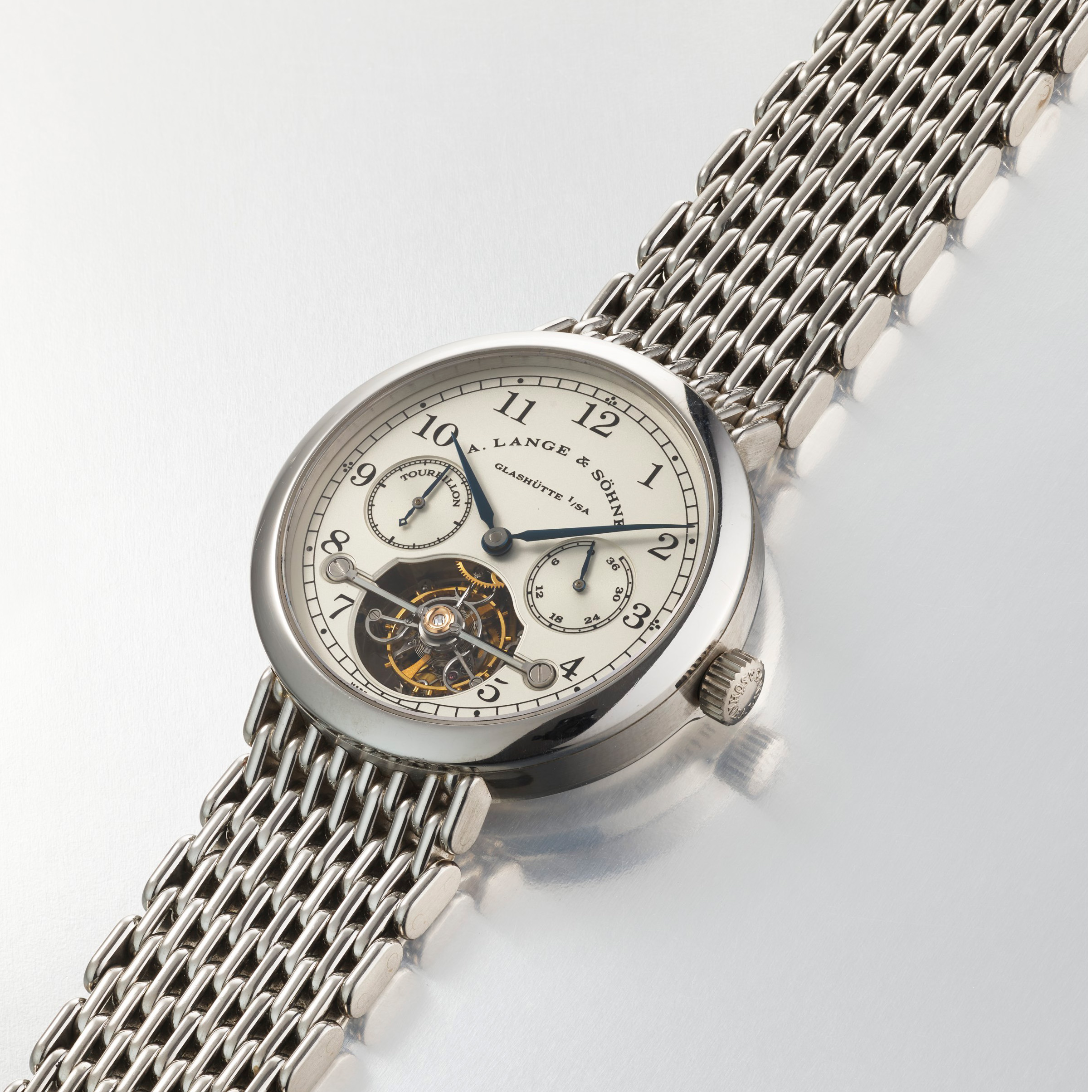
1/3 Tourbillon Pour le Mérite 751.005. Sold at Christie’s in 2021 for 500,000 CHF
The Creation of the 1815 Dial
The Tourbillon Pour le Mérite is the foreteller of the 1815 Collection. It is the one that A. Lange & Söhne showed us for the first time how it is going to incorporate its traces from the pocket watch era into modernity. Funny enough, they did it with a case and mechanism looking far into the future.
Looking at some elements, we see a railway minute-track covering the dial, an inspiration from 20th century pieces. Three-dots on each 15-minute markers are present, again a touch from the past. A. Lange & Söhne often used Arabic Numerals in pocket watches in Italic form, whereas here we see the modern brand decided to straighten them up, distancing itself from the “old” looks.
The sub-dials are placed exactly at the mid-section, further contrast given with concentric circle finish. On the right stands the power-reserve indication with 36 hours of straight torque and with mimicking rail-way track. On the left is running seconds, with each second marked. The logo arches at 12 o’clock and Glashütte In Saxony etched below with pride.
The dial design only differs in the pink gold Tourbillon Pour le Mérite with black dial (701.011) and the piece-unique reference 701.008 in white gold with black dial. With these two special references, A. Lange & Söhne diverts from Arabic Numerals and brings diamond-shaped indices. Furthermore, the sub-dials are contrasting against black dial and the running-seconds dial is inscribed with 10 seconds markers. The “Tourbillon” inscription is moved below the logo.

The Piece Unique 701.008 Sold at Langepedia.com. See here
At 6 o’clock sits the star. The tourbillon opening fixed with a black-polished three-faceted bridge, studded with a diamond end-stone. On multiple occasions I have had the chance to observe the tourbillon bridge stand-alone, and the precision on each and every one of them is just fascinating.
The tourbillon carriage is made of 84 parts. The cage is designed as a rim with three imperial sword-shaped to hold the screws. For the A. Lange & Söhne nerds out there, I am sure you are going to recognize this design from Fridolin Stübner’s Jahrhunderttourbillon – which won the Paris Grand Exhibiton Jury Award in 1900. The cage is exceptionally finished. Absolutely immaculate. Only such a craft could match the grandiose of the Tourbillon Pour le Mérite anyway. A myriad of sharp inward angles over a black polished and ridiculously thin metal cage. This craft is not unique to Lange, but you can see that it is very, very well done, in 1990s. Two inertia-balls are rotating with the cage, keeping everything in place. An application you are not going to see very often.

The Piece Unique with pink gold dial from 1996. Sold at Sotheby’s in 2013.
The First Tourbillon with Fusée and Chain L902.0
Turning the watch over, we are greeted with another traditional element taken to modernity and pushed to the extreme without losing its identity. But beyond visuals, we are in the presence of A. Lange & Söhne most important endeavor. This is the lock-stone on the brand’s roof. This watch, hence the caliber L902.0, laid the foundation of what was going to become an exceptional movement manufacture. (Any John Wick Fans?)
The creation process of this piece has never been repeated in the history of A. Lange & Söhne, ever. It is the first and the last time a movement development was outsourced from Glashütte. The caliber L902.0 is the brainchild of Günter Blümlein, Reinhard Meis, and Giulio Papi.
Reinhard Meis, a true legend, was A. Lange & Söhne’s director of product since the start. A very, very-well respected name in watchmaking, he is also the author of “Das Tourbillon” an incredibly well-written book documenting the development and details
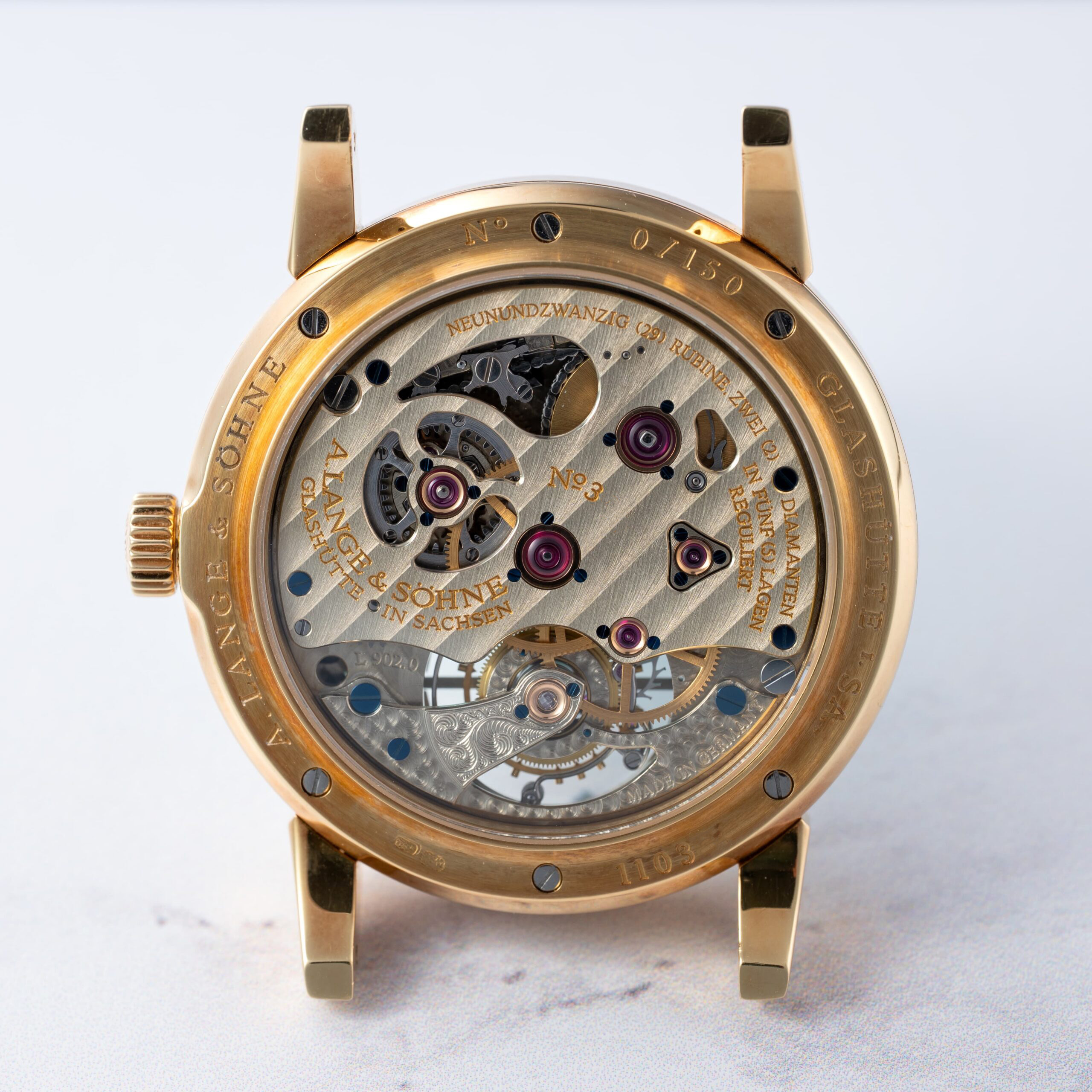
Tourbillon Pour le Mérite 701.001 caliber L902.0
The project L902.0, hence Tourbillon Pour le Mérite, was initiated in 1990, right after the trademark registration of A. Lange & Söhne. As mentioned, Tourbillon Pour le Mérite was conceived to be the first wristwatch caliber combining fusée and chain and tourbillon mechanisms; yet, there was neither enough know-how nor the time to build a mechanism of this magnitude without outside assistance. To make it more concrete, the project Tourbograph was also kicked-off in the 1990 but had to be cancelled because there was simply no time build it.
Thus, Blümlein reached out to an old friend of his, for one last job he says, possibly the widest known specialist in movement design to create this one of a kind movement: Renaud & Papi.
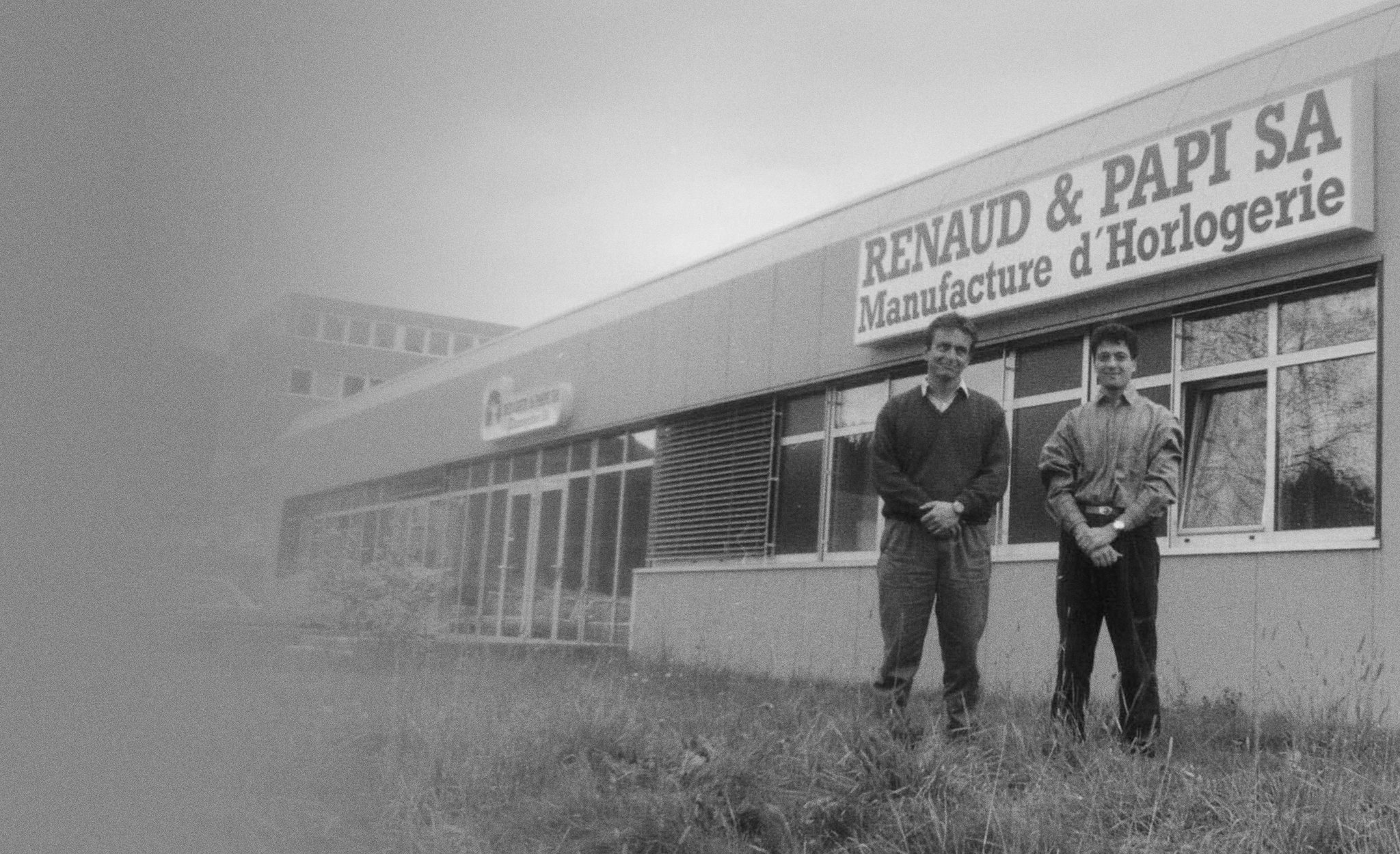
For those who do not know; Renaud & Papi is a movement specialist company founded by Dominique Renaud and Giulio Papi in Le Locle, Switzerland in 1986. Currently owned by Audemars Piguet, R&P is an extremely rich soil for that yields the best crops in the world. From Robert Greubel to Stephen Forsey to Andreas Strehler, Grönefelds, Anthony De Haas… All spent time in this distinguished atelier, learnt from the best before flying out to build / lead their own.
This is not just a commission, per sé. The relationship between Renaud & Papi and Blümlein goes back to 80s when IWC was a value brand for conniseurs and a flag carrier for the mechanical watch revolution from Schaffhausen. Blümlein was the first client of the company, ordered a minute repeater module for IWC Grande Complication. Blümlein was so important for the R&P, as with many other figures even today, later Dominique Renaud would say in an interview at thenakedwatchmaker:
“I can only pay tribute to Mr Günter Blümlein from IWC, without whom Renaud and Papi would not be what it is. Blümlein was the first to have faith in us in 1986, giving us the development of a modern minute repeater that had to adapt to an existing caliber, led to the IWC’s “Grand complication”. He entrusted us soon after all the production of the first calibres to relaunch Lange & Söhne, including the famous Tourbillon Pour le Mérite. Blümlein is one of the great visionaries of the contemporary history of watchmaking.”
Blümlein, Meis, and Lange had one question: How to erase the 50 years of inactivity of the brand? The idea was found in collaboration with R&P – an ambition that you would expect only from such a quartet. The development was given to Renaud & Papi, where De Haas, Grönefelds, Strehler, etc. worked on the concept, development and production. In the meantime, A. Lange & Söhne’s watchmakers was sent to Schaffhausen to further train with IWC watchmakers. Indeed, even Kurt Klaus was involved with some of the projects at A. Lange & Söhne.
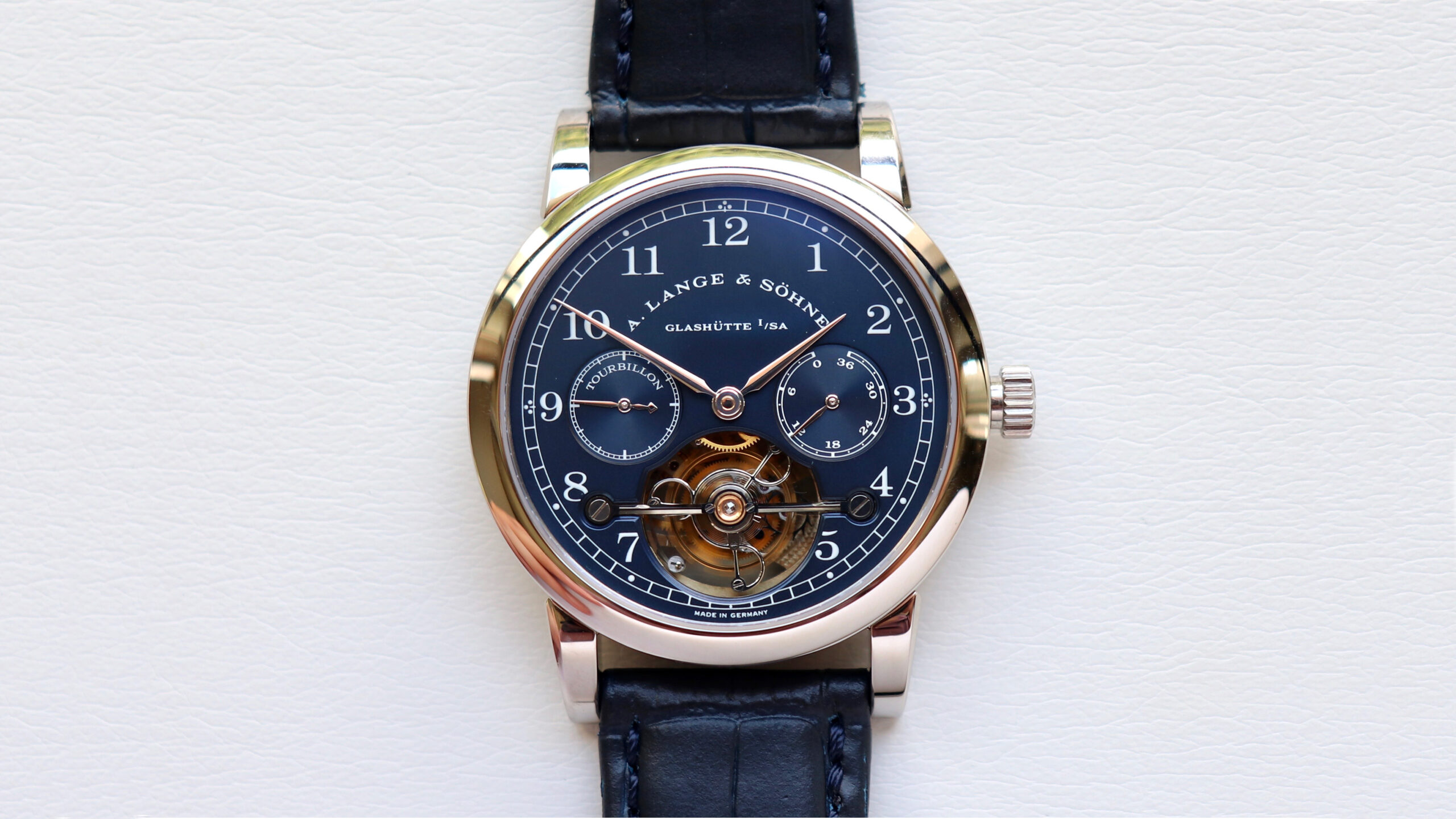
Tourbillon Pour le Mérite 701.007 in White Gold with Blue Dial
All 200 calibers were made, assembled in the ateliers of Renaud & Papi and the second assembly and finishing were done in Glashütte. A funny story is, when I was a trainee at A. Lange & Söhne in 2019, the lady who had worked on these movements back in the ‘90s was still constructing tourbillons. Everytime I give manufacture tours, it was just a special moment.
The architecture is beautiful. At the bottom, the tourbillon opening greets the owner with a diamond cap in the middle, held by the hand-engraved tourbillon bridge. The whole of the bridge is beautifully perlaged. Please note that the perlage in Tourbillon Pour le Mérite is much more concentric and smaller compared to other watches, which I find intriguingly beautiful. The three-quarter plate is deeply striped while carrying rather big jewels for the fuseé & chain transmission mechanism.
Visually, the only critique from my side would be the lack of skeletonization at such a high-end mechanism. I’d like to see some more opening with sharp angles… But then, the more I think of it, I find such an understatement much more suitable to A. Lange & Söhne rather than Swiss approach – hence, more coherent. Perhaps I am getting old? Nonetheless, Caliber L902.0 of the Tourbillon Pour le Mérite offers a view that one cannot get bored of… On the technical side, the caliber L902.0 measures 30 mms in diameter and 7.5 mms in thickness, comprises of 318 parts. Moreover, it offers an exceptional winding feeling and boasts a modest 36 hours of power reserve. However, as said many times, this movement is special because what it combines: a fusée and chain and a tourbillon.
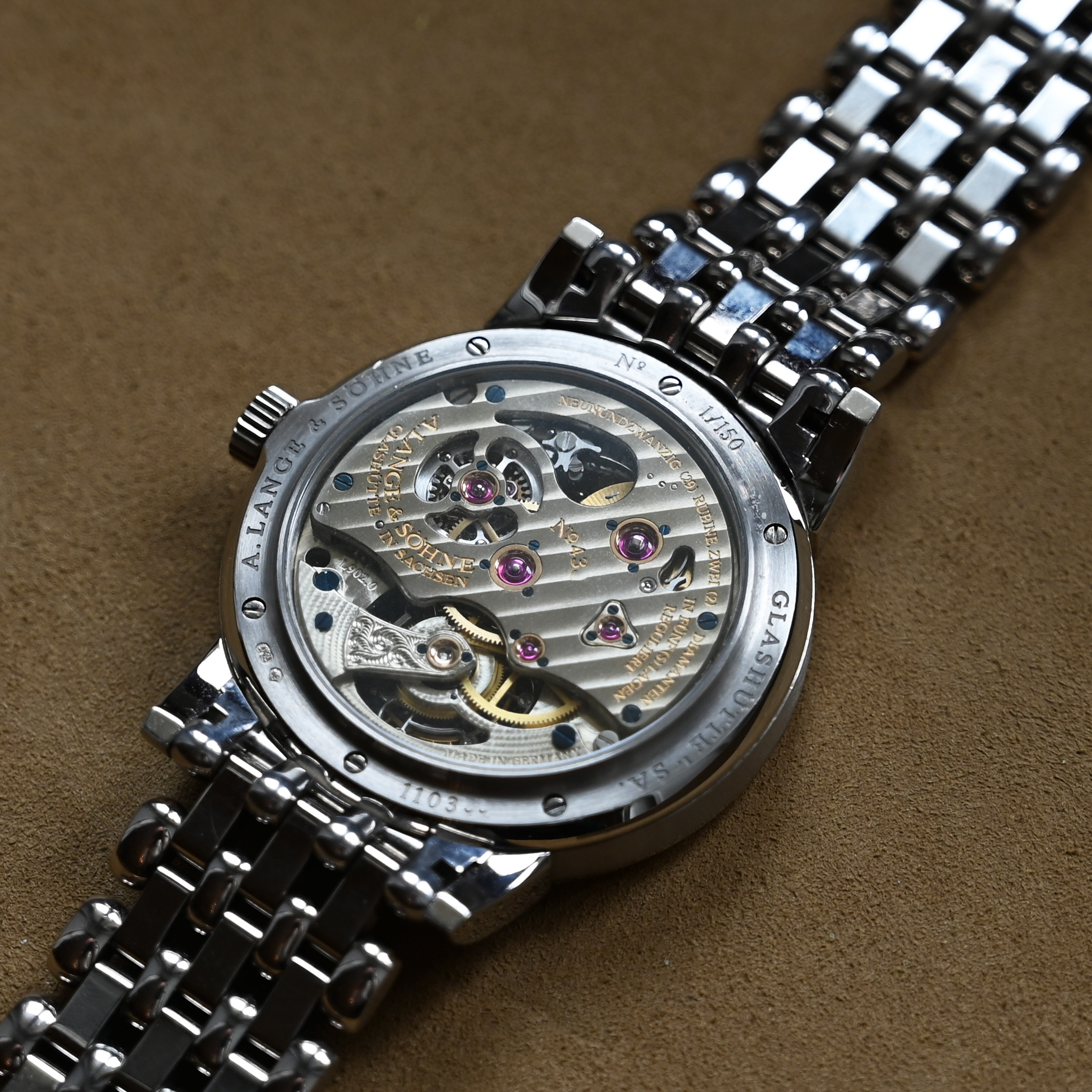
We know that the mainspring of a mechanical watch does not deliver the same torque throughout its power reserve. The power in the final phase of unwinding weakens and can cause rate inaccuracies. Hence the barrel and the fusée in the L902.0 are interconnected with a delicate chain consisting of 636 parts. Whilst the watch is wound using the crown, the chain is wound up on the tapered fusée and the spring in the barrel becomes taut. The spring’s power is delivered to the movement via the fusée with constant torque.
The Tourbillon “Pour le Mérite” relies on the lever and fulcrum principle discovered by Archimedes. When the mainspring is fully wound and exerts its full force, the chain pulls at the smaller circumference – or lever – of the fusée and when the mainspring’s power declines, it pulls at the larger circumference of the fusée.
This ingenious mechanism improves the rate accuracy of the watch across the entire power reserve range. A planetary gear train comprising 38 parts, with a diameter of 10 millimetres, found inside the fusée, keeps the movement running even while the mainspring is being wound. Each part of the chain measure 0.5 mms in width and accounts for 15 cms as a whole. Although the fully assembled chain weighs only 0.12 grams, it is strong enough to carry 2kgs.
Even today, producing, finishing and connecting the links is extremely hard and when Renaud & Papi developed the chain in 1990s, the technology was not as advanced as today. So, they inserted tiny piece of papers between each link to keep them in place during the assembly and after all done, they applied the only possible solution – burn them all. This was the only possible way to assemble 636 tiny parts.
Currently, to my knowledge, the chain is assembled in the finishing department
by only a couple of master crafts people.
As much as its advantages, the fuseé system also has its drawbacks. For
example it must never be fully unwound. Hence the security measures for this
mechanism are at utmost importance. Moreover, the power
transmission must be blocked after 36 hours to deliver the best torque
throughout the watch’s operation.
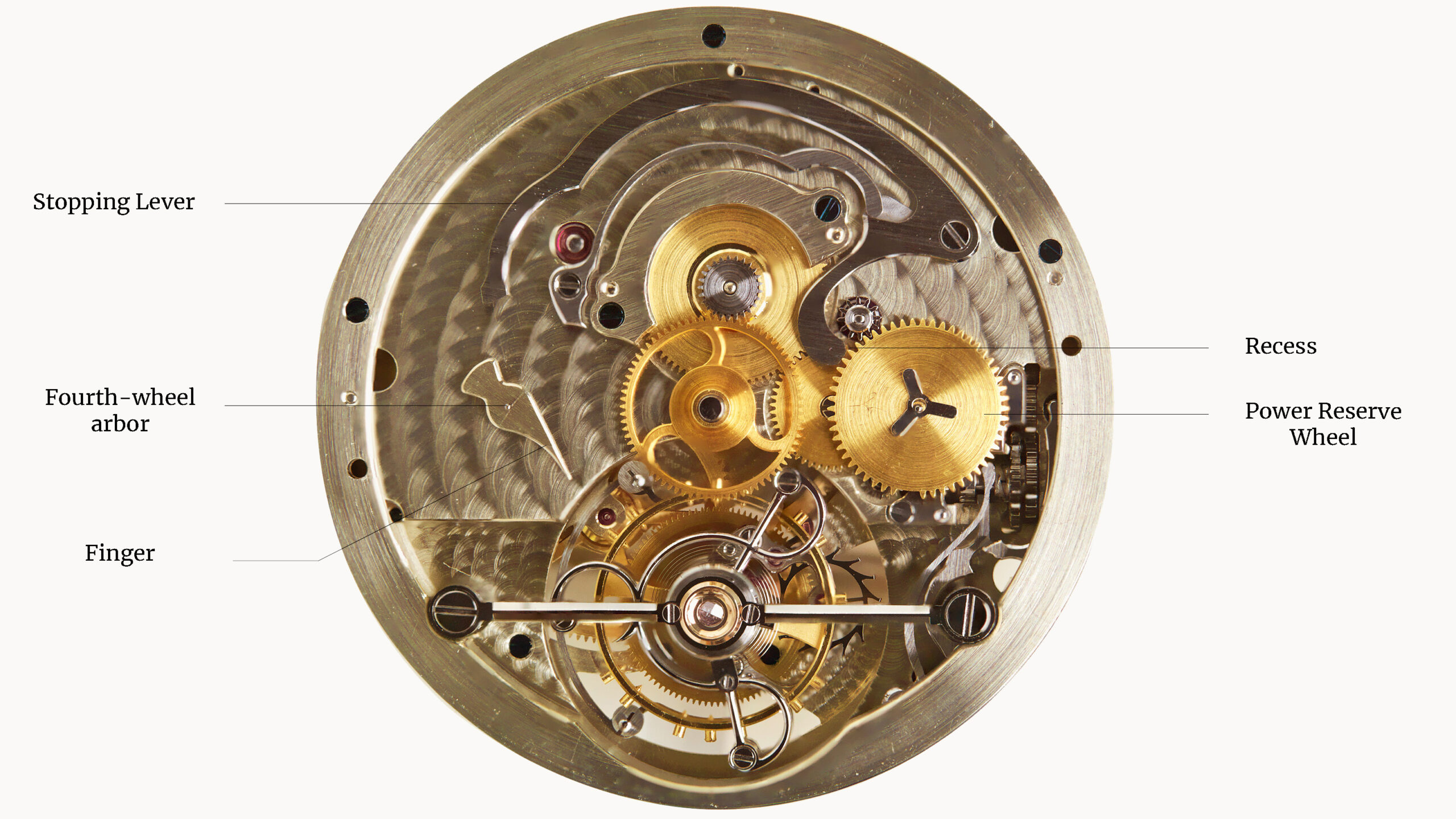
To prevent this from happening, the caliber L902.0 of Tourbillon Pour le Mérite
houses a blocking mechanism, which is utilized in all other Pour le Mérite
collection pieces as well. After exactly 36 hours, the lever drops into a recess in
the wheel. Assisted by a spring, the longer arm of the lever moves into the
engagement radius of a specially shaped finger seated on the fourth wheel
arbor. The arbor is stopped when the two elements make contact. The seconds
hand stays exactly at the 12 o’clock position.
One of the pecularities of the fuseé-and-chain transmission is that the fusée moves forward while the watch is running, but rotates backwards while the mainspring is being wound. Therefore, the fusée-and-chain transmission needs a construction to ensure that the transmission does not stop while the watch is being wound.
A complex planetary gearing inside the fusée preserves the power flow from the fusée to the movement during the winding phase. It consists of 38 tiny parts which the watchmaker must integrate in the fusée, a hollow cone with an inside diameter of merely 8.6 millimetres.
Tourbillon Pour le Mérite Price / Market
The Tourbillon Pour le Mérite checks all the boxes to be marked as collectible. It is exceedingly rare, a true icon symbolizing the re-birth of the German high-end watchmaking, most of them are kept in spectacular condition and perhaps the most importantly, they wear tremendously well and look brilliant on and off the wrist.
When A. Lange & Söhne first published the Euro prices in the catalogue in 1999, the price for the Tourbillon Pour le Mérite was €78k and €70k for platinum and gold versions respectively. This was only 5 times of a gold Lange 1. As a side note; please do not ask me what happened with the pricing along the way; especially with the $500k Tourbograph in 2010…
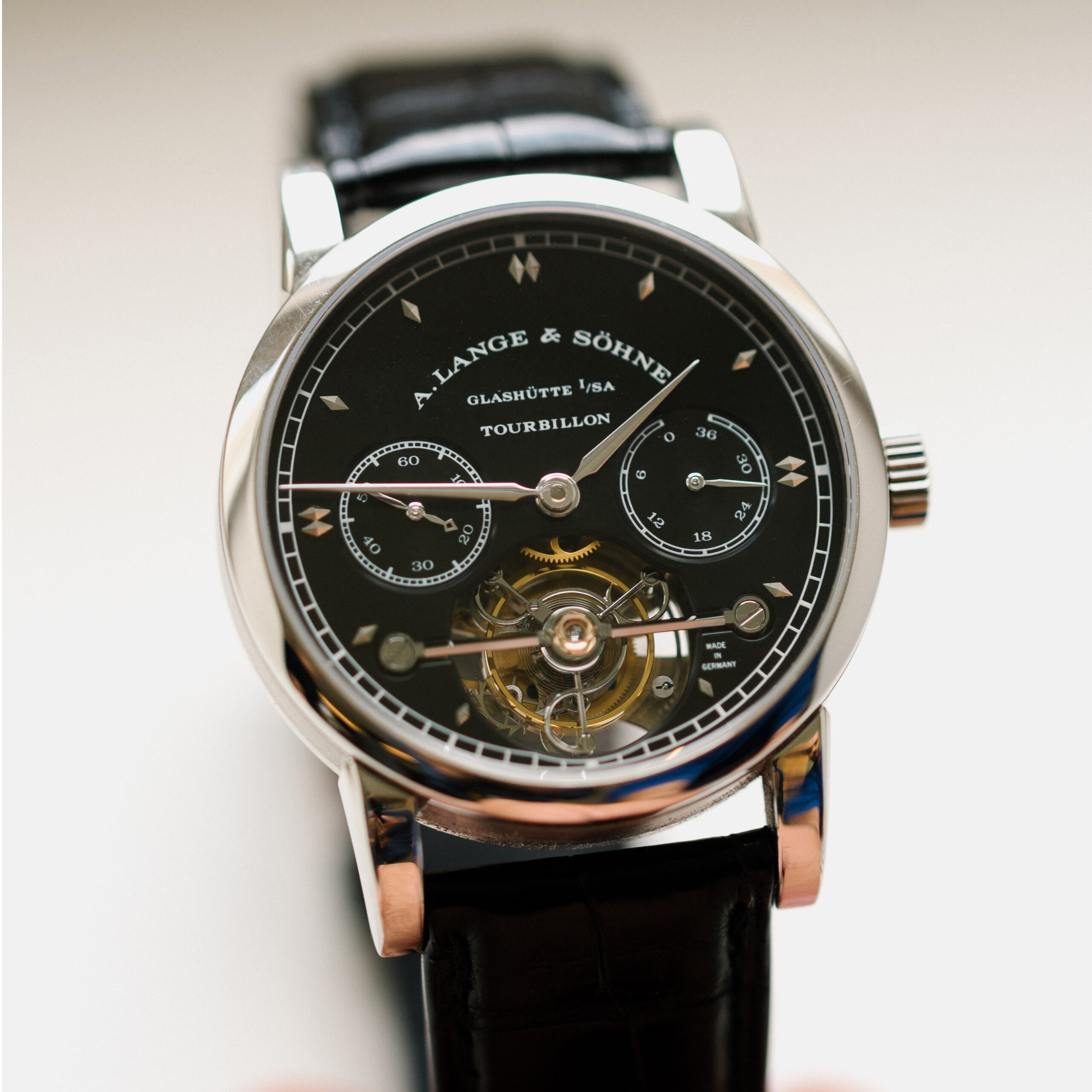
For me the Ultimate PLM. 36 mm Piece Unique Platinum.
Tourbillon Pour le Mérite appeared in an auction for the first time in 1999 at Antiquorum. The example was in rose gold and sold for around $99k. Only some years later, Antiuqorum also sold a platinum (701.005) for $203k. The leading auction house at the time continued to offer brilliant examples but the record came in 2007 with two platinum examples, each selling more than $320k. This growing graph reflected on the other editions and the Tourbillon Pour le Mérite market started booming. This attracted other prominent auction houses. Sotheby’s for example auctioned two stunning examples with matching bracelets and also a unique piece, again for great sums.
When I first wrote the article, I noted the following:
“Today, the gold versions trade around $150k (depending on the configuration). Since the platinum versions rarely make an appearance, I can say that they still keep their aura and momentum – at least relative to their gold counterparts. However, as of December 2020, I have a strong feeling that it is going to skyrocket soon enough.“
Well, this one aged well. Since 2020 December, we saw many Tourbillon Pour le Mérite variants across auction houses. Albeit the market stalled a bit during 2023 era, the latest results as of 2026 showing the appreciation these watches deserve. Yellow Gold reference 701.001 seem to climb up to few hundred thousands USD, while rarer editions command a very significant premium, upwards of 100% depending on the combination and condition.
The most important Tourbillon Pour le Mérite sold is the white gold reference 701.007 at Sotheby’s Hong Kong 2026 Auctions for a very strong $1,4m USD. To give you an idea how the market jumped in a span of a year, the piece unique Tourbillon Pour le Mérite reference 701.008 with white gold case / black dial was sold below that amount at Langepedia.com in late 2025.
For any A. Lange & Söhne and watch collector, Tourbillon Pour le Mérite is a must have watch. It is a true piece of history, touching every great there is in the watchmaking land, while staying universal with its size, restrained design, and impeccable craftsmanship.