One of the more curious inversions in horology is this: nearly two centuries after Abraham-Louis Breguet introduced the “Perpétuelle,” elevating the self-winding mechanism into one of watchmaking’s great inventions, the automatic movement, arguably the most practical, everyday complication, had, become almost too ordinary. It was the domain of large industrial brands, optimized for reliability and scale, and conspicuously absent from the upper tiers of haute horlogerie, where manual-wind calibers reigned as the purer expression of craft.
That orthodoxy has since been challenged, perhaps most visibly by F.P. Journe’s Octa line, which reframed the automatic as a canvas for technical and aesthetic ambition. Yet even before the Octa’s debut in 2001, a different answer had already emerged. In 1997, A. Lange & Söhne released the Langematik, quietly, almost contrarily, reasserting that utility and haute horlogerie need not be at odds, and that an automatic movement, treated with sufficient rigor, could belong unequivocally to the highest echelon of watchmaking.
When looking at A. Lange & Söhne today, one inevitably becomes exposed mostly to the headlines: the Lange 1, Datograph, Zeitwerk, and their various sub-collections. Dig a bit deeper, and you get to know the Tourbillon Pour le Mérite, the Cabaret, the Arkade, and so on. All of these share one common trait: they are manually wound. Whether out of a purist’s obsession or simply because they are viewed as more “analogue” per se, collectors often dismiss self-winding watches from high-end manufactures.
But there is often immense value hidden exactly where the collective gaze falters. Influencers rarely highlight them because they don’t generate the usual algorithm exposure, and collectors tend to fixate on whatever a few tastemakers post repeatedly. Because of this, one of the finest collections Lange has ever produced, and arguably one of its greatest value propositions, quietly sits in the background, waiting to be discovered. This is the story of the Langematik.
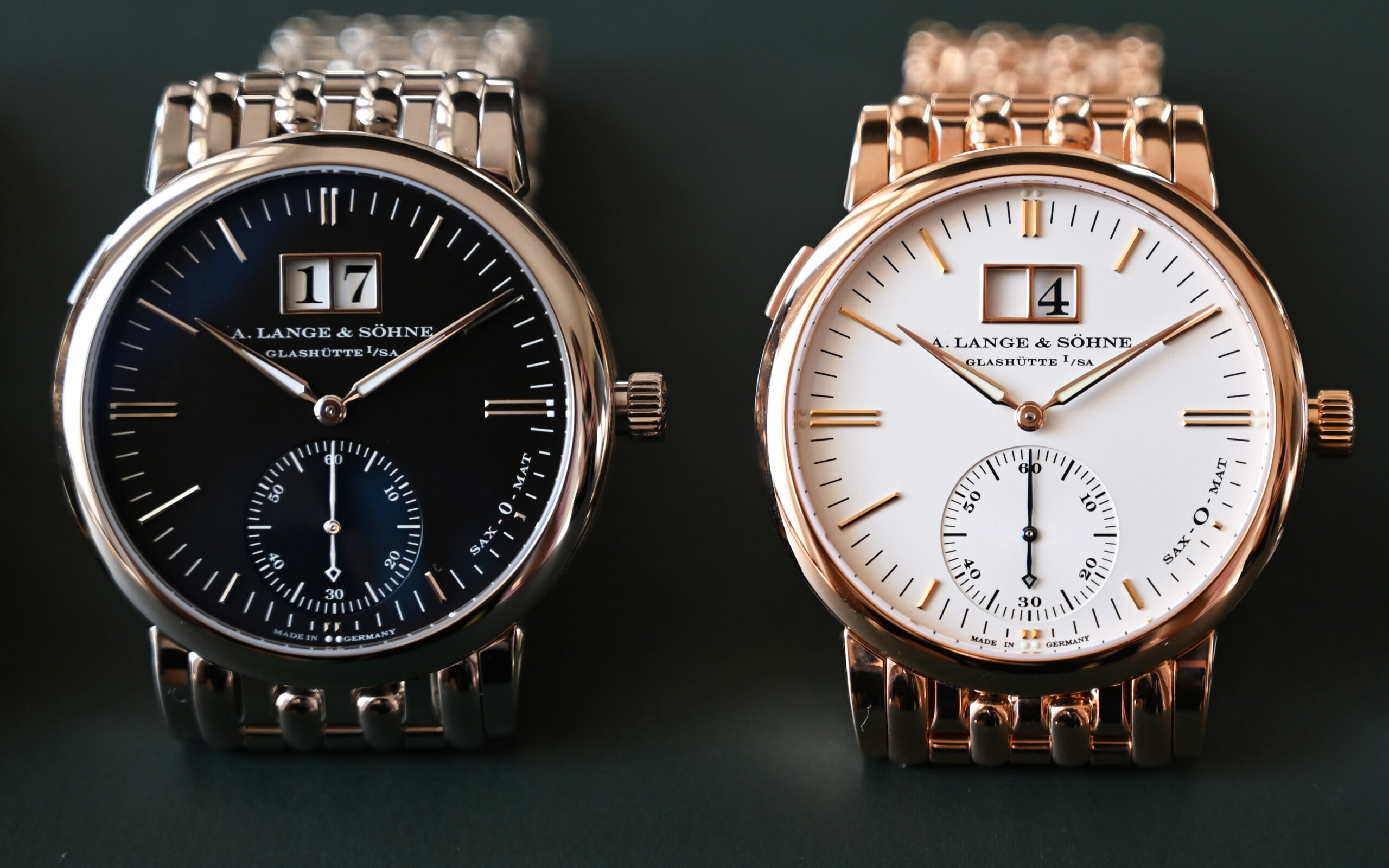
A pair of Langematik on Wellendorff. Part of the 6 piece set sold at The Selection.
You know, at some companies, there are just “do it” people. They take the initiative, go beyond their means, and create something out of pure passion. A. Lange & Söhne is full of stories like this, and the Langematik is the result of such genius and passion from Helmut Geyer.
Mr. Geyer was one of the first employees of the modern A. Lange & Söhne, part of the initial team who went to IWC for further training before returning to Glashütte to help with the brand’s reincarnation. Having been part of GUB since the 1960s, it is an understatement to say he knew his stuff. He was a perfect fit for A. Lange & Söhne’s and Günter Blümlein’s entrepreneurial, encouraging spirit at the time. Recalling his early days at Lange, Mr. Geyer noted: “I came as a designer, but one day Mr. Blümlein told me: ‘If something doesn’t work out here, then I’ll pull your ears.’ With that, I was the head of construction.”
While he was busy working on the Lange 1, Mr. Geyer started developing the caliber L922.1 on the side, the movement that would later become the Sax-0-Mat. The mechanism fascinated Mr. Blümlein, prompting Mr. Geyer and his team to further refine the caliber. Finally, in 1997, the Langematik was born.
The Original Langematik Line-Up
The Langematik line was offered as a standalone collection for the first time in the 1997/1998 A. Lange & Söhne catalogue, available with or without the big-date mechanism. It was initially introduced in white gold with a black dial (308.027), yellow gold with a champagne dial (308.021), and platinum with a silver dial (308.025), alongside integrated bracelet variants. The gold Langematik Big Date editions were priced at 26,800 Deutsche Mark, while the platinum model commanded 38,800 DM.
Below are all the Langematik Big Date references produced, excluding the Wellendorff bracelet variants:
308.021 (yellow gold / champagne dial)
308.025 (platinum / silver dial)
308.025x (platinum / black dial – about 4 pieces)
308.027 (white gold / black dial)
308.031 (pink gold / black dial)
308.032 (pink gold / silver dial)

The 358.031. Incredible watch. According to the owner, 5 pieces ever made.
The production of the Langematik collection spanned only about a decade across 10 different references, with the .031 and .032 discontinued after just a few years. Some Wellendorff bracelet variants, like the one above, are not even going to return a photo with a Google Search as they are unseen. It was possibly the most complicated self-winding watch of its time, and it remains a contender for that title today. Considering Lange’s always low production numbers and its ever-expanding catalogue, it is a safe bet to label the Langematik collection as a rare breed. Now, let’s look at the watch itself, and I hope you’ll come to understand the fuss I am making!
The Langematik Big Date measures 37 x 9.7 mm, offering quite compact and easy-to-wear dimensions. It is constructed in the classic A. Lange & Söhne fashion: a three-step case formed by a bezel, case-band, and case-back, featuring alternating brushed and polished surfaces; except for the pink gold references, which feature all-polished layers. The crown sits slightly below the center to accommodate the big-date mechanism. The bezel is precisely the right width, ensuring it neither suffocates nor overflows the dial. The welded, angular lugs stand out as the usual delight of A. Lange & Söhne pieces, putting the final touch on the Langematik’s proportions. On a 17 cm wrist, this watch wears perfectly, especially on the bracelet.
Looking at the 1997 catalogue, we see the Lange 1, 1815, Saxonia Big Date, Arkade, and Cabaret collections. The Lange 1 and Cabaret utilize diamond-shaped markers blended with Roman numerals; the 1815 draws inspiration from early pocket watches with Arabic numerals; and the Saxonia and Arkade reflect the classicism of their birthplaces with full diamond-shaped markers. Even the Lange 1, arguably the most groundbreaking watch design of the late 20th century, blends traditional elements into its presentation. The Langematik, however, forges a completely different path from all existing collections, fully embracing the modern façade of A. Lange & Söhne.
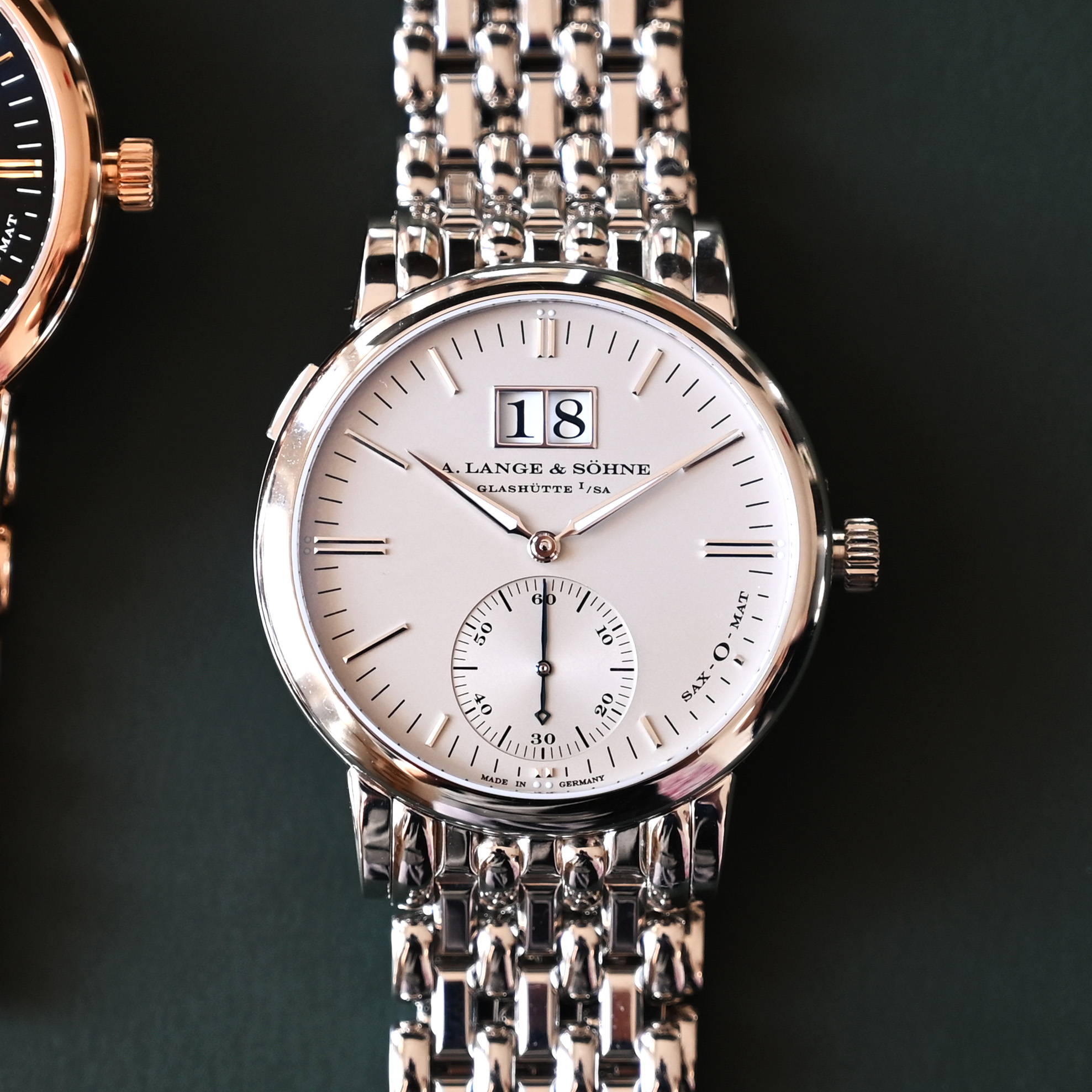
The 358.025. Possibly produced in single digits.
The dial is anchored by a perfect vertical axis: the iconic, gold-framed Outsize Date commands the 12 o’clock position, while the oversized sub-seconds register beautifully balances it at 6 o’clock. By using double batons only at the 3 and 9 positions, the design creates a subtle horizontal crosshair that draws the eye directly to the center pinion, making reading the time an incredibly intuitive experience.
The sharply faceted baton indices catch the light with brilliant precision, providing superb depth against the solid silver or black dials. Furthermore, Lange equipped these models with luminescent lancet hands and corresponding luminous pips along the outer railroad minute track. This was a rare, sporty concession for a brand so steeped in classical Saxon watchmaking, giving the Langematik an everyday versatility. I am almost tempted to say the Langematik was the Odysseus, before the Odysseus.
The Langematik was A. Lange & Söhne’s first take on an “everyday” watch. While it isn’t strictly meant to slide under a formal cuff—though it can do so perfectly—its quirks and courage make it an ideal constant companion. It serves as the perfect bridge between the Lange 1 and the 1815. The subtle curvature of the “SAX-0-MAT” text hugging the right side of the sub-seconds track is the final touch to this superb line, deliberately breaking the symmetry while flexing what lies under the hood: the caliber L921.
Langematik Sax-0-Mat
It has been 34 years since this movement was conceived, and 29 years since its introduction. Dare I say, to this day, it remains the finest self-winding movement A. Lange & Söhne has ever created. Given its craftsmanship, aesthetics, technical ingenuity, and historical mark on the brand, it will be quite hard to surpass.

During its pocket watch era, A. Lange & Söhne crafted about 38 watches with self-winding movements. Those historical movements followed the Breguet school of thought, utilizing a hammer-winding system (or bumper) that swung back and forth through a restricted arc. A modern reinterpretation of this style can be seen in Moritz Grossmann’s fantastic “Hamatic” collection. It is entirely possible that A. Lange & Söhne could have also brought this early design into modernity, especially since Jens Schneider, who built the Hamatic for Grossmann, worked in Lange’s prototype department at the time. However, the Langematik had to be entirely new and thoroughly modern.
The name “Sax-0-Mat” follows the proper German tradition of merging words to name things: Sax(onia) – 0 (zero-reset) – Matic. We see this elsewhere with the Datograph, Tourbograph, and so on. It was A. Lange & Söhne’s first modern self-winding movement, giving birth to the Langematik collection and later utilized in the Langematik Perpetual, Saxonia Annual Calendar, and others. A. Lange & Söhne discontinued the Langematik line in 2011, replacing it with the Saxonia Automatic, which featured a somewhat downgraded movement. I believe it is safe to say that the Sax-0-Mat was simply too good of a movement to be offered as a time-only piece.
The Langematik’s movement was designed around a fundamental question: How could the most prominent element of Glashütte watchmaking, the three-quarter plate, be integrated into a self-winding movement? They couldn’t just slap a rotor on top. Patek Philippe already had the magnificent caliber 240 with a micro-rotor and multi-bridges representing peak Swiss style. Lange’s answer was to integrate a 3/4-sized rotor directly into the 3/4 plate section of the movement.
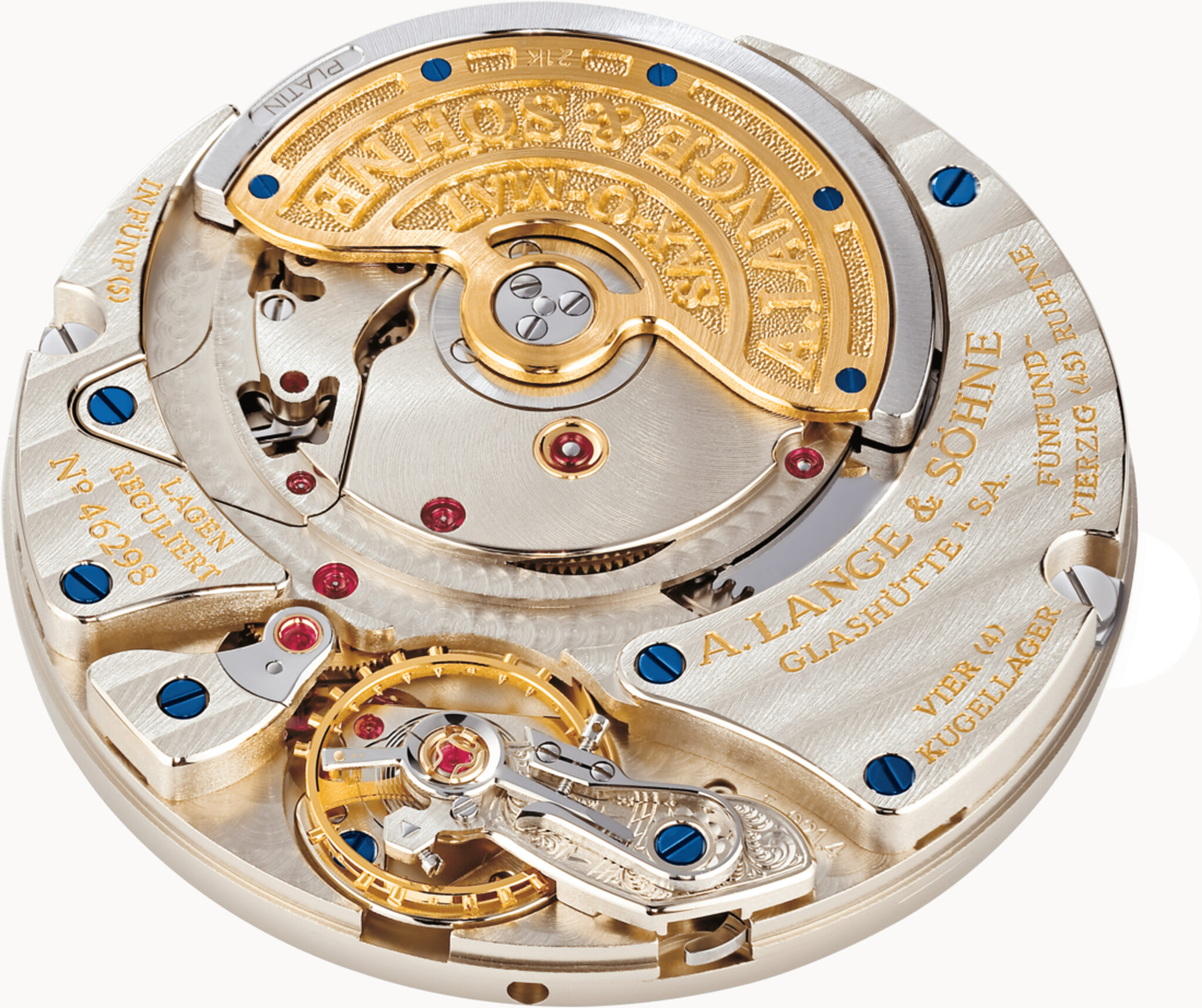
Looking at the movement, you immediately notice the three-quarter plate and the precise cut-out made for the solid gold rotor. All the traditional hallmarks are present: the blued screws, the hand-engraved balance cock, the gold chatons, and the separate escape wheel with a polished steel cap. The solid gold rotor is deeply relief-engraved with “Sax-0-Mat” over “A. Lange & Söhne,” and is beautifully polished on the edges. What the engraving doesn’t tell you is the structural discipline beneath it. The rotor assembly is a layered construction: the rotor plate is the engraved structural base, and the platinum centrifugal mass is mounted to it via exactly five individually torqued screws. The rotor shaft itself is then locked in place with three separate screws. That is eight fasteners for a component most manufacturers treat as a single unit. It is an obsessive approach to preventing any mechanical slop from developing in the rotor over decades of continuous wear.
The platinum centrifugal mass is there to add a bit more kick to increase winding efficiency. That efficiency, however, depends just as much on what happens after the rotor moves as on the mass itself. The winding train employs a dedicated Inversor, a bidirectional mechanism that converts both clockwise and counterclockwise rotor sweeps into a single direction of mainspring winding. What makes Lange’s implementation stand out is that the Inversor runs on a genuine rolling-element ball bearing, Not a jewel. The kind of detail you find in machinery rather than watchmaking. From there, two consecutive reduction wheels deliberately step down the rotational speed before energy reaches the mainspring barrel, protecting the spring from the shock of fast winding. The final transfer to the winding train is mediated by a rocker assembly with its own dedicated spring, a small but elegant coupler that ensures smooth engagement regardless of rotor direction.
The Caliber L921 measures 30.4 mm in diameter, filling the Langematik’s caseback wonderfully. It beats at a classic 3Hz with a 46-hour power reserve. Its signature element, however, is the zero-reset mechanism. Developed for precise time-setting, pulling the crown stops the balance and instantly resets the seconds hand back to zero. Furthermore, a patent registered by Lange Uhren GmbH and Helmut Geyer prevents the “startup delay” that typically causes the seconds hand to stutter for a second or two after the crown is pushed back in.
It is highly beneficial to look at this alongside the movement diagrams submitted for the patent. The following breakdown is summarized from that application. My deepest thanks to a friend who helped me constructing this explanation.
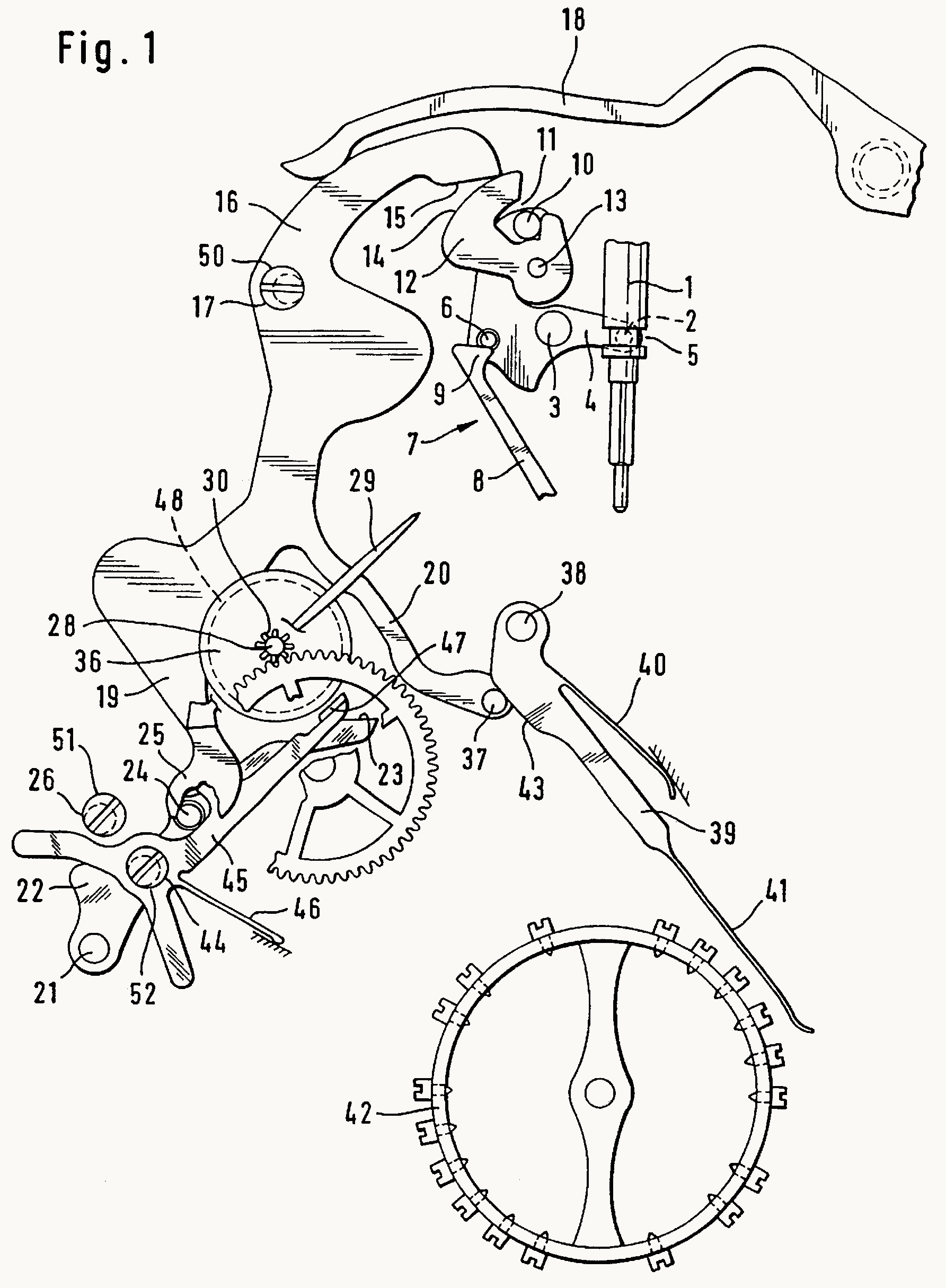
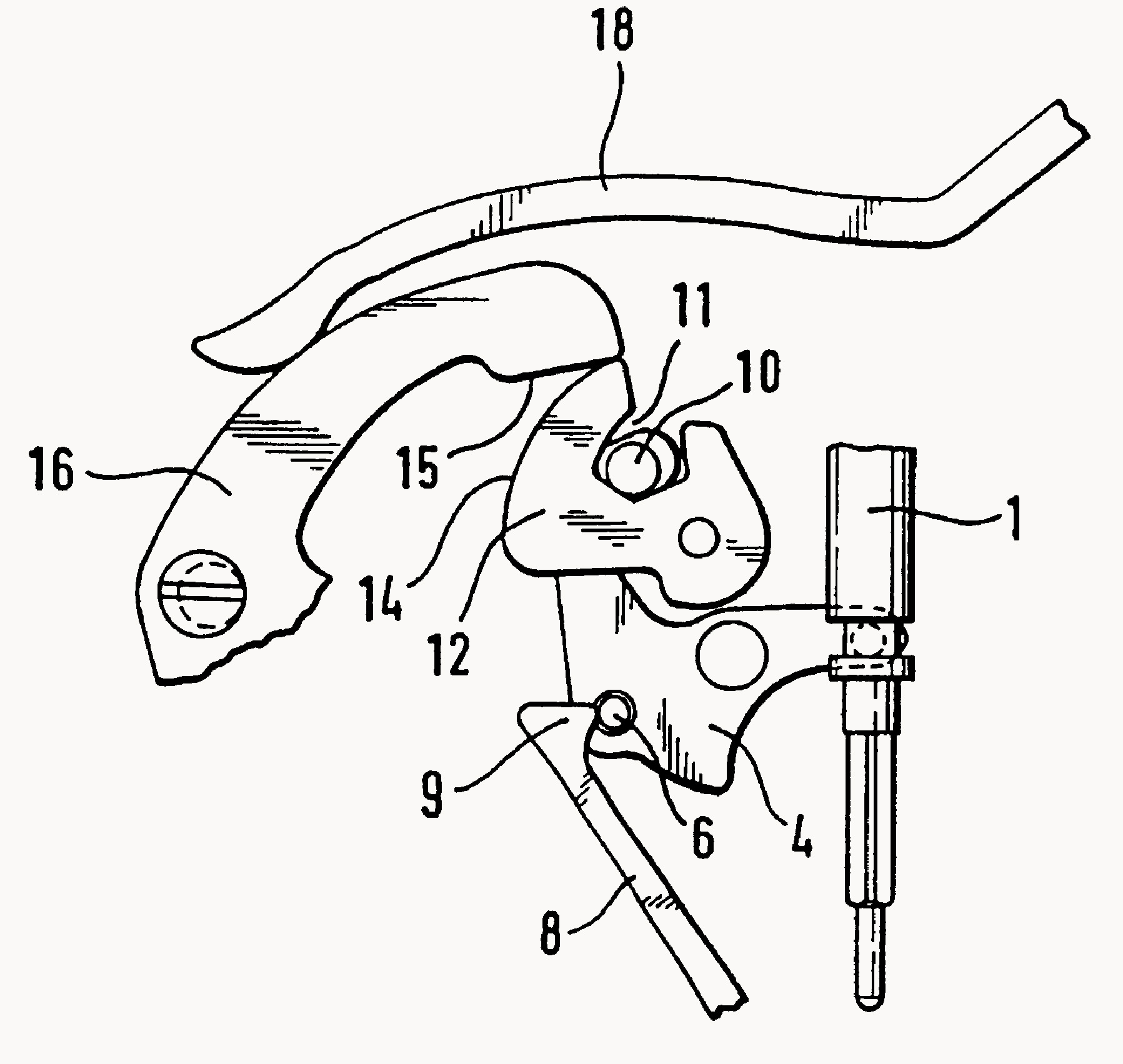
Phase 1: The Quiescent State (Fig. 1) In its resting state, the caliber operates normally. The Setting Stem (1) is in its “Home” position. The Control Plate (12) is positioned so that its curve (14) holds the Pivot Lever (16) back, compressing the powerful Spring Arm (18). The Zero Setting Lever (Hammer, 22), and the Blocking Lever (45) are held at a distance from the movement. The Stopping Lever (39) is held away from the Balance Wheel (42) by the pin (37) on the pivot lever’s arm (20).
Phase 2: Activation and the “Snap” (Fig. 3) When the user pulls the stem (1) to the setting position, the stem moves the Angle Lever (4) which rotates the Control Plate (12) via the stub (10). The Activation Surface (15) of the Pivot Lever slides along the Control Curve (14). Once it reaches the end of the curve, the “self-locking” geometry is released. The Spring Arm (18) forcefully snaps the Pivot Lever (16) forward. This ensures that the reset happens with a consistent, swift mechanical action regardless of how slowly the user pulls the crown.

Phase 3: The Critical Three-Step Sequence (Fig. 2) As the Pivot Lever (16) snaps forward, it executes three functions in a specific chronological order to preserve precision:
- Eliminating Backlash (The Block): Before the seconds hand moves, the Blocking Lever (45)—pivoting on spindle (44)—is released. Its V-shaped tip (47) drops into the V-groove (48) on the Seconds-Display Drive Gear (36). This immobilizes the entire gear train in its “engaged” state. By locking the gears before the hand is reset, the mechanism prevents the gear teeth from drifting, which is the root cause of the 1–2 second delay usually seen in hacking watches.
2. Zero-Resetting (The Hammer): The Zero Setting Lever (22), driven by the pivot lever’s fork (25), strikes the Heart-Cam (27). Because the drive gear (30/36) is now locked, the Seconds Stem (28) must be able to turn independently. This is made possible by the Coupling Spring (31), a friction clutch. The stem “slips” against the stationary gear, allowing the hammer to force the heart-cam (and the seconds hand) exactly to 12 o’clock.
3. Hacking (The Stop): Simultaneously, the Stopping Arm (20) releases the Hacking Lever (39). The spring arm (41) makes contact with the Balance Wheel (42), halting the oscillation of the movement.
When the stem (1) is pushed back in, the Angle Lever (4) rotates the Control Plate (12) back to its original position, forcing the Pivot Lever (16) to retract. The Zero Setting Hammer (22) lifts off the cam. The Blocking Lever (45) is lifted from the V-groove, and the Hacking Lever (39) releases the balance wheel. Because the drive gear (30) was held in place under tension and never allowed to lose its engagement with the train, the seconds hand begins moving the microsecond the balance wheel starts, ensuring “zero-latency” synchronization.
Langematik Big Date is truly a timeless watch. It is modern, perfectly sized, and houses a movement arguably ever-green and just above and beyond with every detail.
Langematik No-Date & Grand Langematik
The Langematik Collection also houses the Langematik “no-date” and Grand Langematik lines. The relation is much like the Datograph and 1815 Chronograph collections – we can say that the Langematik Big Date is the Dato and the No-Date is the 1815 Chronograph, both housing the same calibre, hence similar layouts. In Langematik’s case, they both are identical except the big date window and big 12, respectively.
Langematik “No-Date” lines was also introduced in 1997, with a retail price of 19,800 DM – a 26% discount compared to Langematik Big Date. Hence the reason, the no-date variant carries the caliber L921.2 as opposed to the big-date’s L921.4, symbolizing the missing big-date complication and the reduced thickness.
Grand Langematik is a more interesting story. At the beginning of the 2000s, A. Lange & Söhne possibly saw the need for a bigger dimension wristwatch trend and wanted to adapt. Thus, we start to see Grand Arkade in 2002, and the Grand Lange 1 Collection in 2003, introduced with the “Luna Mundi” series. Langematik collection was not immune to the buffed-up catalogue and the Grand Langematik arrived at 40.5 mm size and for some reason also with an added 1 mm thickness, totaling at 10.7 mm.

These two I see as experimental editions, both to revive interest and test the market. Grand Lange 1 is based on the Lange 1’s caliber L901.0 which was designed for a 38,5 mm case watch. This results in a compromise, to enlarge the sub-dial rings because otherwise, they just sit uncomfortably close in a 41.9 mm canvas.
Grand Langematik also suffers from the same shortcoming. The big-date and sub-seconds sit too close to each other, leaving a wide space across the rest of the dial. Lange’s solution was to create alternating hashmarks between the upper and lower halves of the dial. Alas, I am not sure how much it worked in both cases, as both lines were discontinued shortly after following a few bold experiments. I must admit though, Grand Lange 1 collection had some fun pieces!

Apart from the classic editions, the Langematik collection gave us two superb special editions:
Langematik Anniversary to mark the 10th year of the rebirth of modern A. Lange & Söhne. The first piece of the modern era with an enamel dial with a stunning red 12 at the top in a platinum case. Just an immaculate piece.
Große Langematik Gangreserve made for the 100th Anniversary of Wempe’s chronometer manufacture. Inspired by the marine chronometers, made in a limited series of 100 for yellow gold and platinum each, and 25 pieces for pink gold.
Parting Thoughts / Langematik Market
Langematik line is a tremendously well-made collection with signature A. Lange & Söhne elements and a great history behind it. From its design to craft to technicality and overall looks, it is well above and beyond of a simple time only watch with a self-winding mechanism.
When evaluating its current market, one must look at historical precedent. Ten years ago, the early automatic movements from independent masters (if any) were often viewed merely as quirky alternatives to their manual-wind counterparts. Consider the trajectory of the F.P. Journe Octa Réserve de Marche. I know, quoting a market performance from any Journe might be a reach, yet it does provide a valuable guidance. Introduced in 2001 with the brass Caliber 1300, it was Journe’s answer to the automatic paradox. As collectors finally “discovered” the historical importance, finite production, and sheer ambition of Journe’s early automatics, those same pieces vaulted to rival his signature complications. The market realized that early, over-engineered automatic calibers from master watchmakers possess a profound intrinsic value.
I vividly recall one great collector’s, who has been collecting Journe since 1999, “people often think the greatest achievement of Journe is the resonance or tourbillon. It is in fact the Octa Movement. How he managed to create such a base to serve on a perpetual calendar, chronograph, and a few others while boasting such power reserve and thinness is beyond me”.
Today, the Langematik sits exactly where the Journe RDM sat half a decade ago. It is the contemporary equivalent from Germany: introduced just four years prior, housing a wildly innovative, over-engineered automatic movement crafted by visionaries, and limited by a short production run, even for A. Lange & Söhne.
As of early 2026, Langematik collection pieces wander anywhere from $17,000 to $40,000 depending on the metal and combination, with the yellow gold / champagne dial being the most approachable, and going up towards the platinum / silver dial big date variant. Then there are references 358.xxx with integrated Wellendorff bracelets, and those are yet to be seen in the market following the bracelet-mania happening at the moment.
Still, I do not get my hopes up much. The production numbers for the bracelet variants remain incredibly low, for example only 4 pieces with the “Darth” combination platinum and black dial, very low two-digits for the pink gold / black dial variants, and so on.
Surely there are going to be signature collections that brands are known for, and the majority are going to understandably chase them. But watches often offer tremendous value for collectors who can look beyond the noise. The Langematiks, especially the ones on Wellendorff bracelets, are exactly that.


