Ever since its pocket watch days, handling an A. Lange & Söhne timepiece has delivered a singular sensation: a profound, unmistakable heft. It is a presence that surprises you, prompting the question: “Is there an additional gold or metal hidden somewhere in this watch?” When the brand was reborn in 1990 and the first collection debuted in 1994, a quote by Günter Blümlein perfectly defined the tactile identity of a Lange wristwatch: “I want people to get the feeling of closing a Mercedes door.” From the Lange 1 and the Datograph to the Double Split and even the simplest Saxonias, that overwhelming presence—at times even heavy, has been the ultimate signature of the three-part A. Lange & Söhne case. People rightfully called them hockey pucks, after all, what else could you call a Lange 31? Then, in 2011, the manufacture did the unexpected by making sleekness its new distinguished mark: the Saxonia Thin.
The beginning of the 2010s was a transition period for the brand. Fabian Kröne, the CEO of the mid-2000s, departed following the financial crisis, with Jerome Lambert briefly steering the ship until a permanent replacement arrived. Under Mr. Lambert, the winds of design change began to blow, leading to an overhaul of signature collections like the Datograph and 1815 Chronograph, alongside the introduction of ground-breaking gems like the Zeitwerk. On a more basic level, the 1815 and Saxonia collections also underwent subtle changes (detailed here and here, respectively). The arrival of the Saxonia Thin represented the brand’s entry into a new segment at a more accessible price point, stripped of even the seconds hand.

37 mm (left) and 40 mm Saxonia Thin. Courtesy of Lange Uhren GmbH
Introduced in 40 mm with a thickness of only 5.9 mm, the Saxonia Thin somehow retained the signature three-step case construction. The lugs remained notched at the base, forming that famous angular structure. Following traditional Lange logic, the pink gold edition (Ref. 211.033) carried a fully polished case, giving it a “one-block” appearance. In contrast, the white gold version (Ref. 211.027) featured an alternating finish, with a polished bezel and case back sandwiching a brushed case band. Consequently, the white gold variant appeared even thinner than its monochromatic pink gold sibling.
Despite being the most unadorned A. Lange & Söhne, the Saxonia Thin has evolved through several variants and generations. The first editions mimicked the 2011 Saxonia collection: short baton indices complemented by small dots at the top of each hour, perhaps intended to add complexity to the simplest dial the brand had ever produced. However, in 2015, the entire Saxonia line was revamped; the dots were removed, and the aesthetic leaned further toward pure simplicity. It was also in 2015 that Lange introduced the 37 mm version (Ref. 211.026 and 211.032). In my opinion, the 37 mm case carries this essential dial much better than the 40 mm edition due to its more balanced negative space in the bottom half of the dial.
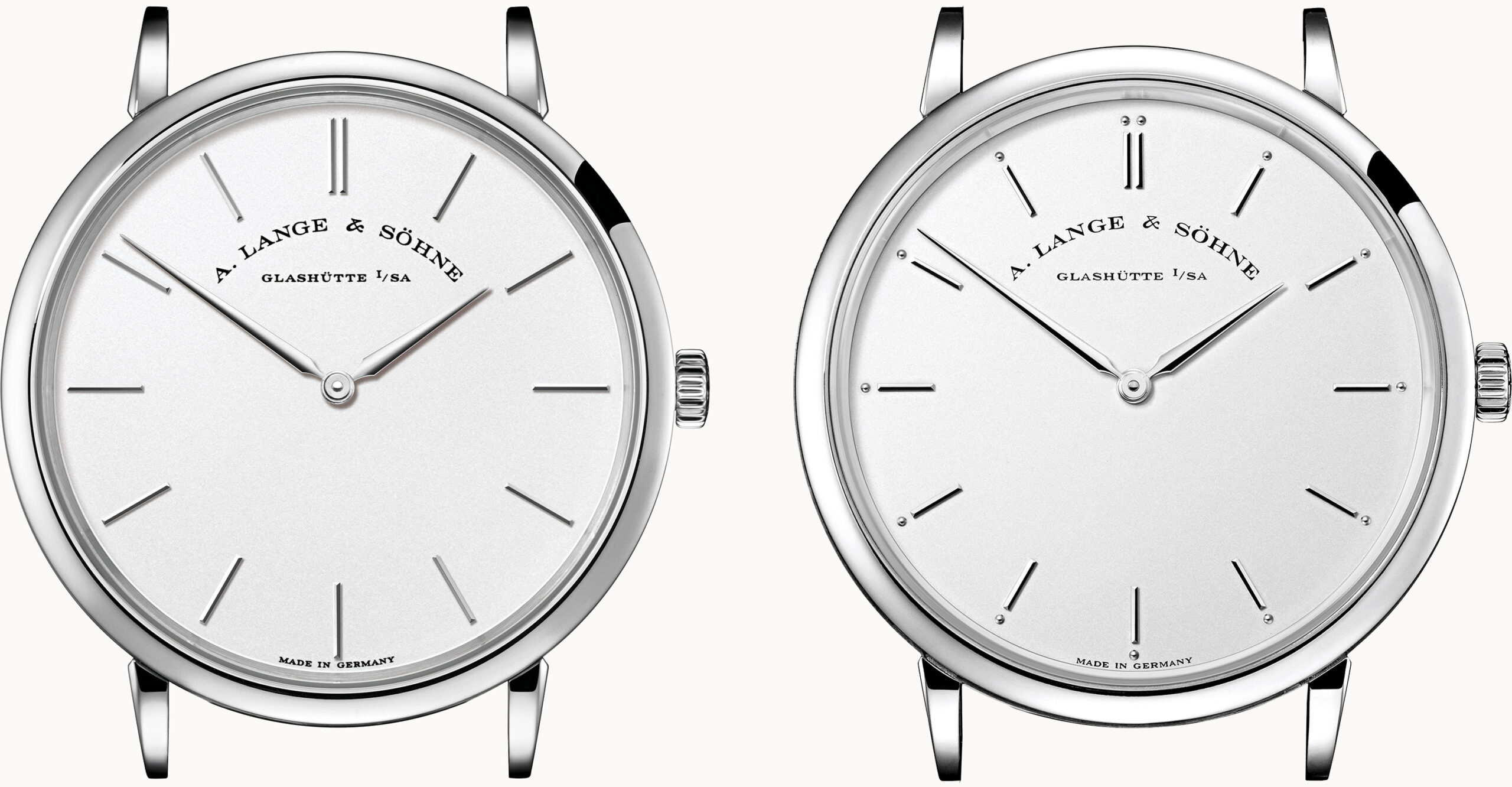
211.027 (left) and 211.026 (right).
The Saxonia Thin is a brilliant piece precisely because its simplicity allows delightful details to shine. It possesses a candor that reflects character and functionality through a myriad of textures, specifically the multi-faceted, masterfully beveled, and polished baton markers. This is a no-nonsense watch. There is nothing to distract the eye except the allure of light catching those sharp indices.
The arched logo, rendered in custom typeface, sits in the top half with a flat-top ampersand to balance its curvature. The only other text is the small “Made in Germany” inscription below 6 o’clock; frankly, I would much prefer that detail on the case back to keep the dial pristine. The slim, sword-shaped hands are perfectly proportioned, the hour hand barely grazes the indices, while the minute hand seamlessly overlaps them. Most importantly, if you were to remove the logo, the watch would still be instantly recognizable as a Lange. That is the definition of successful design.
Saxonia Thin “Aventurine” and “Onyx”
In 2018, however, Lange sought more excitement for its purest collection, introducing one of their most ornate creations: the Saxonia Thin with a “Gold-flux coated Copper Blue” dial. Measuring 39 mm by 6.2 mm in white gold (Ref. 205.086), it remains one of the most captivating pieces the brand has released in recent years. For the first time in a long while, excluding the Handwerkskunst lines or rare ladies’ pieces, we saw an exotic dial in a regular production model. The dial is crafted from solid silver and coated with Aventurine (goldstone) glass, which contains copper oxide crystals. Legend says 17th-century alchemists discovered Aventurine while trying to produce gold, though its roots trace back to 13th-century Persia. The process involves melting silica with copper and other metal oxides in a sealed vat, maintaining a precise temperature that allows metallic crystals to precipitate without melting.

Saxonia Thin Aventurine courtesy of The 1916 Company. Sold at The Selection
Lange watchmakers have repeatedly told me that this material is extremely sensitive and difficult to work with, which naturally limits production. However, the result is worth the labor. I do have an interesting anecdote regarding these “Gold-Flux” editions. While they are low-production models, I have seen far more “Aventurine” editions on the secondary market over the last five years than the standard variants. My takeaway is that the Saxonia Thin “Aventurine” is like a high-carb meal. It is exciting and indulgent, sending your insulin through the roof. But once the sugar crash hits a few hours later, you feel hungry again, and perhaps a bit guilty for eating that Nutella-filled waffle. There will always be a market for that waffle, but once you’ve had one, you usually need a three-month break. It is a deadly exciting watch with an incredible night-sky dial, yet that excitement can fade. My advice: sleep on it. There are enough of them in the world that you won’t miss out if you take your time.
Following the blue gold-flux, Lange introduced a black gold-flux variant (Ref. 205.087), limited to 50 pieces each in white and pink gold, also in the 39 mm case. The final two editions arrived in 2025, testifying to Lange’s newfound affinity for Onyx following the 30th Anniversary Lange 1 Onyx Set. These dials feature deep black Onyx stones that bring a much-needed dimensional depth to the collection. With references 211.062 and 211.052, we saw the introduction of platinum and Honeygold—Lange’s proprietary, scratch-resistant alloy—to the line, with the size returning to 40 mm. Each is limited to 200 pieces and remains available as of April 2026.

Saxonia Thin Onyx Set. Courtesy of @singaporewatchclub
Caliber L093.1 – The Thinnest A. Lange & Söhne
Under the hood lies the Caliber L093.1. Miniaturization has always been a vital part of movement construction, there is a reason why Philippe Dufour is Dufour, being able to concept, create, and actually produce a Sonnerie movement in wristwatch size for the first time. As Tony de Haas, Director of Product Development at Lange, often says: “We didn’t do it that way because it would increase the thickness.” In the end, these need to be worn!
Lange’s focus has often been on showcasing engineering for complexity, think of the Triple Split, Terraluna, or the Lange 31, which led to the “hockey-puck” reputation. The L093.1 arrived in 2011 as the thinnest movement ever to leave the manufacture at 2.9 mm. It isn’t a groundbreaking movement in construction or architecture, after all, how many ways are there to create an extra-thin time-only movement? But like all entry-level Lange calibers, it punches well above its weight.
The L093.1 is built in classic Lange fashion: a three-quarter plate, hand-engraved balance cock, gold chatons, blued screws, and a flat-polished escape wheel cap. Crucially, it manages a 72-hour power reserve. As an extra “sauce,” the ratchet wheels are exposed, which gives the movement a distinct identity. With such a pure dial, giving a bit more “lift” to the movement was definitely the right choice; kudos to Lange. It fills the case back beautifully, though I must reiterate that the caliber looks much more proportional in the 37 mm version than in the 40 mm.


One thing that has buffled me is why A. Lange & Söhne decided to expose ratchet-wheels with sunray finish, but keep them hidden for the 1815 Collection? In fact, it would be more suitable for the base 1815 pieces as most 1A quality pocket watches had the same structure. Anyway, just a nerdy nitpicking here. Both movements’ workmanship is above and beyond of what one would find from the usual names from Switzerland, and just because of that, the Saxonia Thin and the base 1815 worthy of praises.
Concluding Thoughts / Saxonia Thin Market
Upon its debut in 2011, the 40 mm variant of the Saxonia Thin was priced at $19,800, positioning it more or less on par with the time-only 1815 Collection. It took another five years for the catalog to find its coherence when the 37 mm variants arrived, priced in the $15,000 range. Predictably, the gold-flux “Aventurine” line carried a premium, retailing around $24,000 in 2020 (with 37 mm variants sitting near $18,000).
As of April 2026, the 37 mm Saxonia Thin collection retails for approximately $26,000, while the gold-flux Ref. 205.086 has climbed to $31,000. The limited-edition Onyx references, 211.052 and 211.062, command a higher $47,900 entry—an understandable jump given the platinum and Honeygold cases.
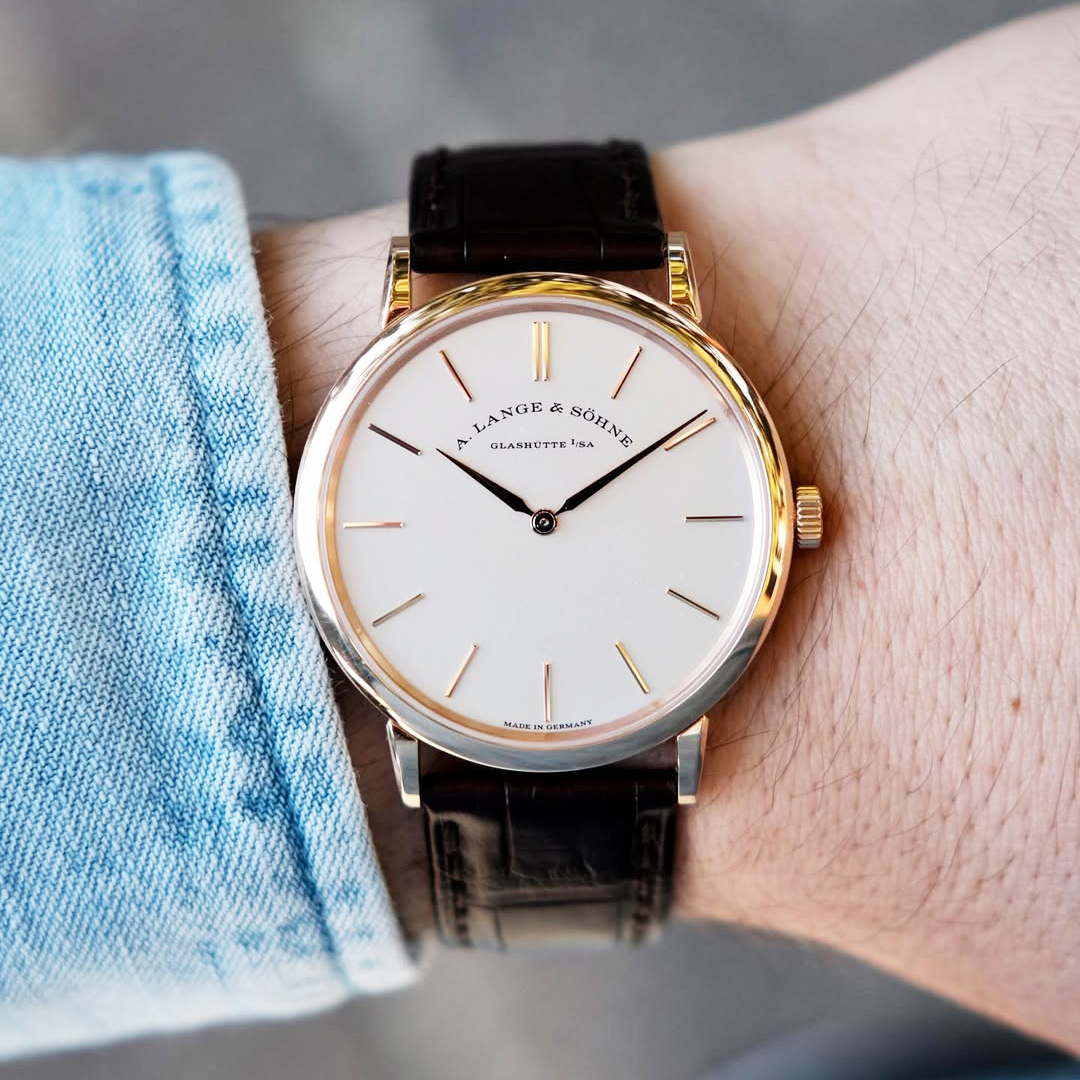
37 mm Saxonia Thin. Courtesy of @betweenthelugs
Whichever edition you seek, the Saxonia Thin is relatively accessible on the pre-owned market. Transaction data indicates that the 37 mm examples are notably rarer than the 40 mm variants, likely due to a shorter production window. As noted, you will encounter a surprising volume of the blue gold-flux Aventurine (Ref. 205.086) while searching. Interestingly, there is no significant secondary price gap between the 37 mm and 40 mm variants; a blue Aventurine can typically be found in the low-to-mid $20,000 range.
The black dial Ref. 205.087 (limited to 50 pieces), however, asks a significant premium over the regular-production blue version, often found in the $40,000 region. A few examples recently changed hands at The Selection at this price point. My guess is that the Onyx variants will eventually trade close to their MSRP, as the competition in the brackets above them is incredibly intense.
I hope this article has been a valuable guide for collectors eyeing a Saxonia Thin and an enjoyable read for those who already have one on the wrist.
Thanks for reading.