Langematik Perpetual Pink Gold Bracelet

A. Lange & Söhne Langematik Perpetual

The Collector’s Guide – November 2020 / Updated June 2025

There are gems in many brands’ catalogues that are overlooked for decades and there are numerous reasons for this happening. Sometimes it is because they are simply ahead of their time and sometimes because they bring out such a strong character and diversion from the consuetudinary, it takes time to sink in. Here such a watch from A. Lange & Söhne: Langematik Perpetual calendar.

Quick Facts:

  • Introduced in 2001
  • Available in platinum, gold
  • The first perpetual calendar from A. Lange & Söhne
  • Measures 38.5 mm in diameter and 10.2 mm in thickness.
  • The first perpetual calendar with the big date indication
/

A. Lange & Söhne was re-founded in 1994 with the respect to its past but never was binded by it. This is well obvious when one takes a look at the first collection. A masterful blend of tradition (Saxonia) with a search for modernity and distinction (Lange 1)… Blümlein summarizes the philosophy as follows:

“The 1994 A. Lange & Söhne wristwatches and all upcoming models are anything but epigones of watchmaking legends. Take our big date in the “Arkade,” Lange 1 “and” Saxonia “. It is not our intention to celebrate traditional craftsmanship or to compete for the most complicated clock. One of our goals is watchmaking beauty and perfect craftsmanship. On the other hand, innovations and differentiating design are important parameters for us.”

The Glashütte power house led by Blümlein set out to sail with a 100% freedom principle in regards to movement development. Hence freedom to reflect exactly what is in the mind at the right time without constraints of outsourcing – with the exception of Lange 1’s L901.0 which is based on JLC’s 822, and Tourbillon Pour le Mérite’s l902.0 which was developed with the help of Renaud & Papi.


All of the initial movements were absolutely phenomenal. However, all were also handwound – perhaps simply because there is no meaningful self-winding movement heritage in A. Lange & Söhne. Yet, you are nothing if you do not improve on the past. Hence, in order to fully adapt to modernity, A. Lange & Söhne needed an automatic caliber and this came from one man’s genius and his free-time work (more on that on the Caliber L922.1 – Sax-0-Mat section).

By the year 2000, A. Lange & Söhne introduced a tourbillon and a chronograph; yet, the brand lacked a calendar piece. A perpetual calendar to be exact, which is one of the must have grand complications in watchmaking. And, it was only logical to implement a perpetual calendar module, on such a stunning automatic movement. Hence born the Langematik Perpetual.

Langematik Perpetual

A. Lange & Söhne always tried to, and mostly succeeded, create different designs for established complications. For example the original chronograph – big date layout with Roman Numerals of the Datograph in 1999. Already having the momentum since its re-birth, the second original interpretation of a centuries old complication – the perpetual calendar arrived in 2001 with the Langematik Perpetual.


The brand introduced the Langematik Perpetual collection in platinum (310.025) and yellow gold (310.021) cases. The watch measures at 38.5 mms in diameter with a sleek 10.2 mms in thickness and the delicate touches start from right here, the case.

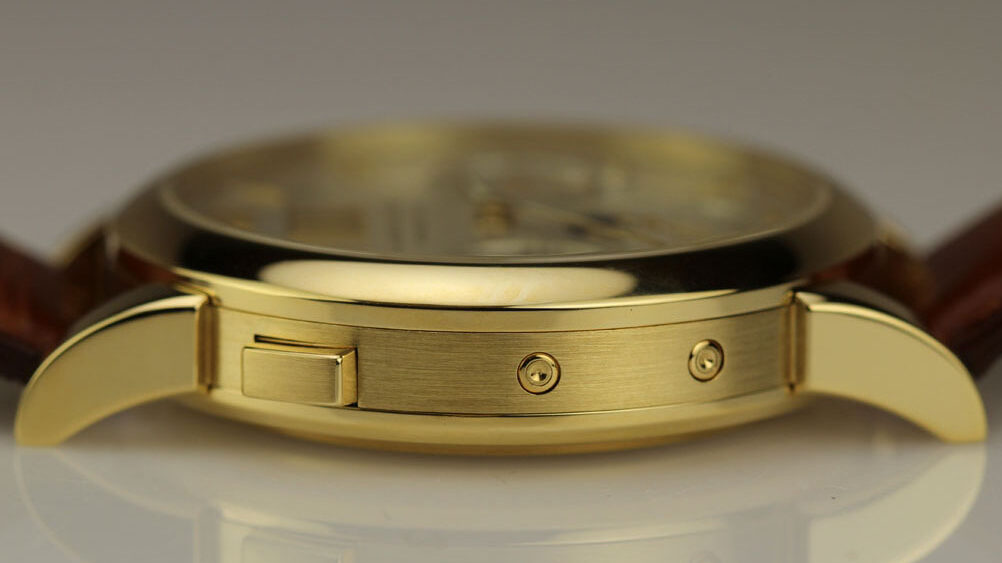
A. Lange & Söhne’s case structure is a concrete example of differentiation on design. Constructed on three levels with alternating finishes as polished and brushed, it appears and feels heavily engineered. Implemented By Blümlein himself as another point of distinction from its Swiss counterparts, the lugs are notched and mirror finished at the base and screwed into the case. They do not flow through the case, but rather forms its own structure and gracefully tapers towards the strap. The sum of these small details form a character; a character that is apparant even at a glance, one that lets you know it is something different.

Every Langematik Perpetual houses a corrector pusher. It simply advances all indications by one increment, thus you do not need to worry about setting the calendar after leaving the watch in the safe for a while – a superbly user friendly feature.


So, first Langematik Perpetual cases featured a rectangular corrector pusher at 10 o’clock and three recessed pushers for individual adjustments. However, after 2005-2006 Lange changed the corrector pushbutton from the protruding rectangular to a round recessed due to accidental activation by the owners. So, if you’re in the market for a Langematik Perpetual, it would be helpful to check the pusher to determine its period.

The famed Wellendorff produced the bracelets for a short period of time (indicated above). In my opinion, Langematik Perpetual’s bracelets are some of the best in business.

Focus on the Date

Up until Langematik Perpetual’s arrival, throughout the rich history of the perpetual calendar complication there has been dominant designs so to speak. The ones who make it better than any other perhaps.


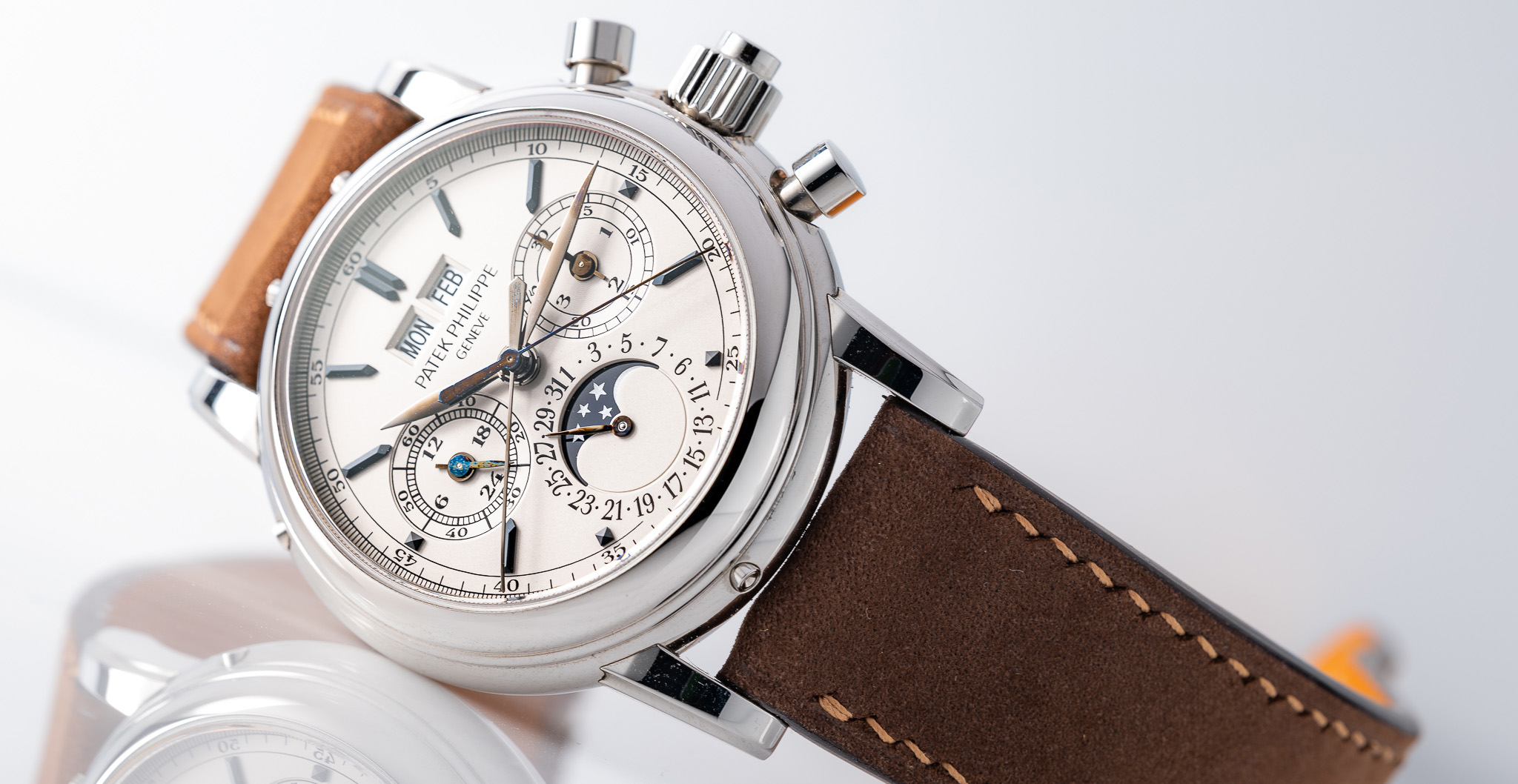
It was Patek Philippe who put the perpetual calendar in a wristwatch for the first time in 1925 with the reference 97975. Again Patek Philippe in 1937 with the ref. 96 created the world’s first perpetual calendar wristwatch with retrograde date – which was sold at Antiquorum for over 1 million CHF in 2002. Finally, it was Patek Philippe again who conceived the world’s first serially produced Perpetual Calendar in 1941 with the reference 1526; which established the brand’s signature perpetual calendar layout with two apertures and a central sub-dial. Possibly the most optimal design for calendar both for aesthetics and legibility point of view…

Indeed, the design was so dominant and successful, many brands started to copy the layout. Yet there were also outliers with characteristic designs such as Audemars Piguet’s famous 5516 – first perpetual calendar wristwatch with a leap year indication. Although some original designs emerged, most were incremental on the template, indicating date via hand.


Langematik Perpetual’s design philosophy takes inspiration from a Bauhaus originated design principle – information hierarchy. It is possible to decipher the layout as follows: The date is the most important piece of information of the perpetual calendar as well as the most needed one by the user; thus, it should be at the most prominent position. Although this philosophy causes illegibility in more complicated pieces such as Datograph Perpetual, it works tremendously for Langematik Perpetual.

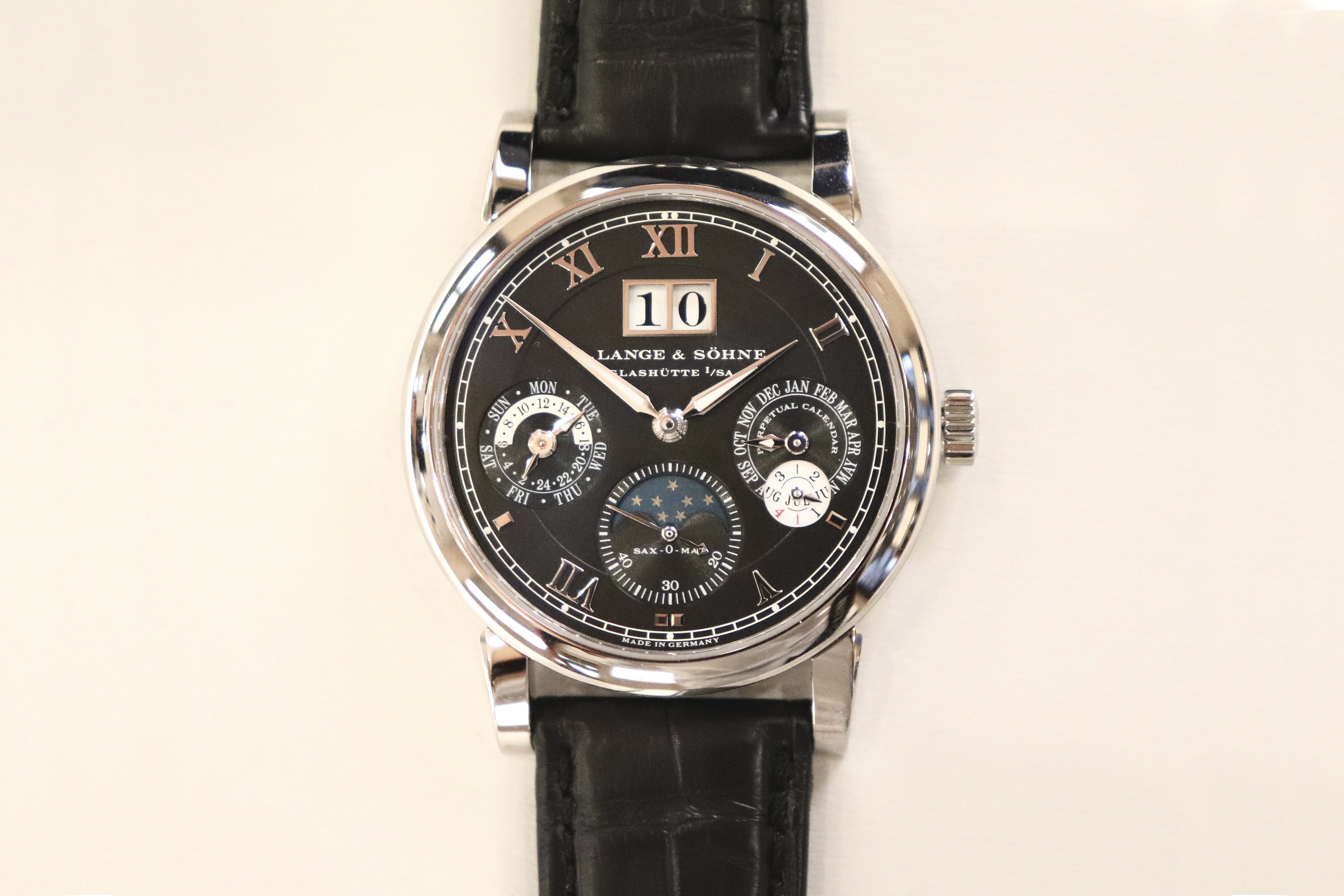
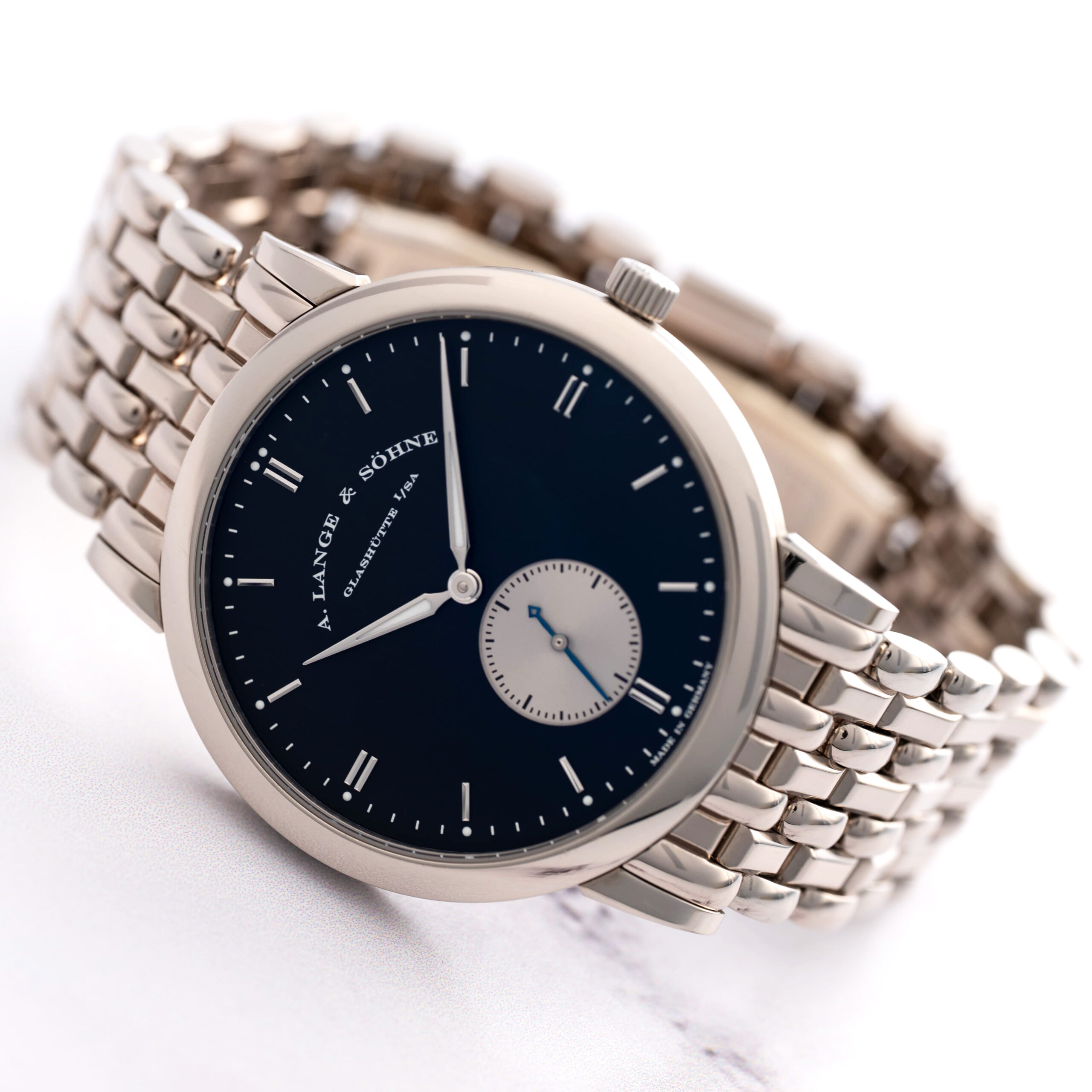
A rarely seen 310.026 with black dial. Sold at Langepedia Marketplace.

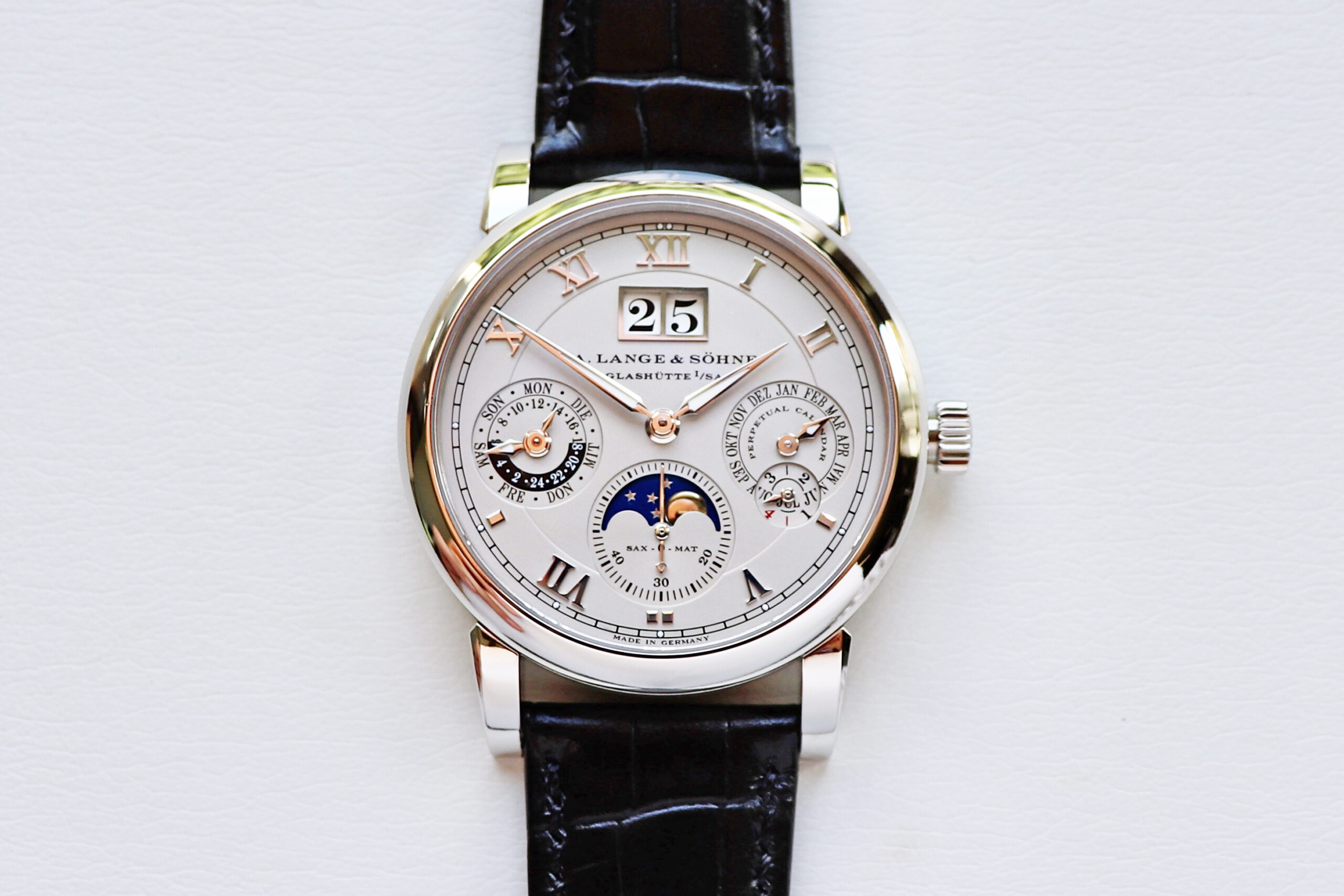
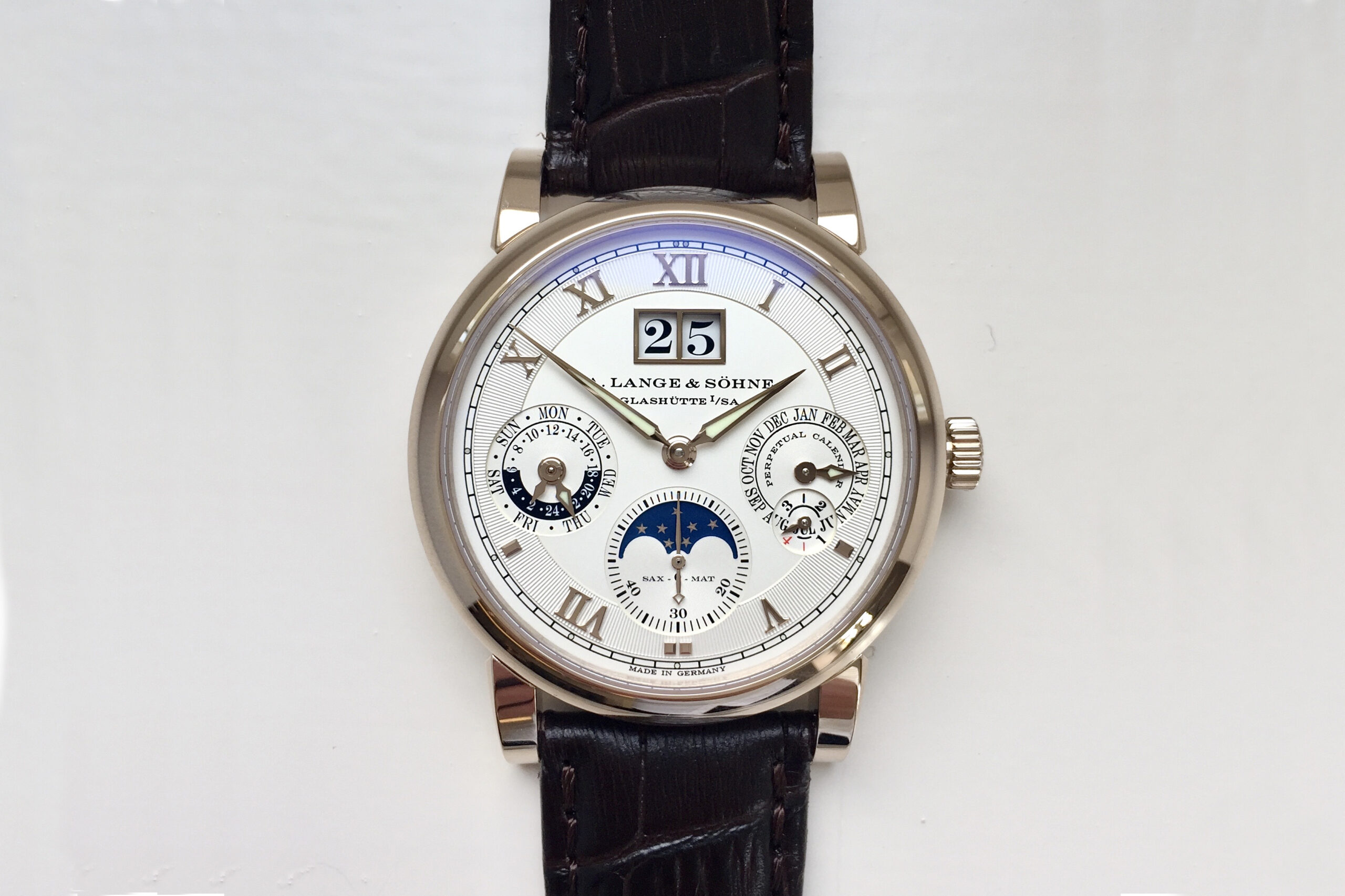
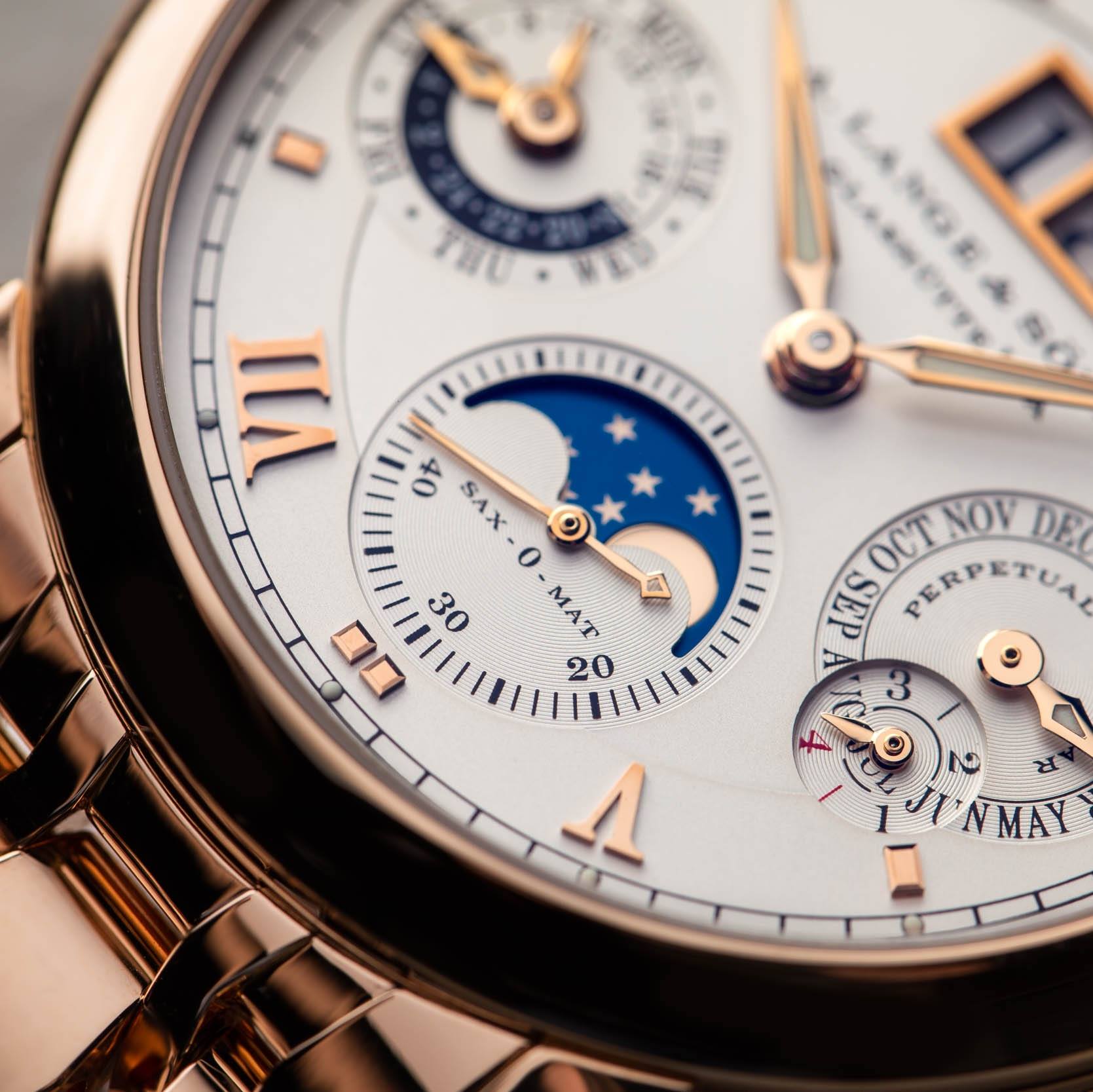
A railway minute track surrounds the legible Langematik Perpetual dial. Applied Roman numerals sits a bit above the main dial, separates itself from the calendar indications with success thus causes no confusion. The big date sits at the forefront, days and day/night indicators at 9 o’clock, month and leap year at 3 o’clock and small seconds as well as Moonphase sub-dials at 6 o ‘clock. The information is delivered in a clear manner and it is possible to read the dial at a glance. Moonphase disc is made of solid gold and on continuous move. Lume plots above each Roman Numeral helps with the legibility at night, albeit offers nothing extraordinary.


All Langematik Perpetual editions apart from the limited edition honey gold version carries a plain hours ring. Whereas the limited honeygold version has a guilloché (stamped) pattern which in my taste superbly done and brings a whole new aura to the watch. It helps to separate the indications from the hours/minutes markers, hence creates a much organized and more legible dial design.


All said, Langematik Perpetual’s dial has a soul. It is neither a derivative nor an inspiration from the past. With Roman numerals, the brand’s custom typeface as well as signature outsized date, it successfully creates its own aura and diverges from the crowd.


One pet-peeve I have is about the leap year indication, which breaks the whole symmetry. It might be appealing to some as it brings liveliness to the dial. However, I wish it was placed within the months sub-dial and not break the focal point. Moreover, the “perpetual calendar” inscription within the sub-dial also would be gone with such exercise.

Langematik Perpetual Caliber l922.1

The beating heart of all Langematik Perpetual watches since 2001. Based on the original, ingenious Sax-0-Mat caliber L921.2 with a perpetual calendar module added on top, this is the automatic movement to get from A. Lange & Söhne.


The caliber L921 series, which was utilized in all automatic watches of the brand until 2011 was developed by possibly the most famous, and rightfully so, movement designer of A. Lange & Söhne, Helmut Geyer. It is said that Geyer worked on the movement in his spare times and later showed the sketch to Blümlein whether he’d like to develop such a calibre. Amazed by its beauty, Blümlein gave the project a go and Sax-0-Mat was born in 1997.

Langematik Perpetual Movement

Langematik Perpetual’s L922.1 brews historic aesthetics such as three-quarter plate with modern technicality, and the result of such synthesis is something inimitable and nothing but exceptional. The aesthetical harmony formed by a myriad of finishing techniques as well as color palette created by gold chatons, blued screws and German Silver is a joy to see. Further, the solid gold and deeply-engraved rotor with platinum weight is a brilliant touch; increasing both the wrist presence as well as adding more flair to Langematik Perpetual.


Made of 478 individual parts, caliber l922.1 offers 46 hours of power reserve, beats at 3Hz and carries a Moon phase mechanism with extra gearing that offers precision to a day for 122.6 years.


Overall, Sax-0-Mat is a remarkable achievement. I cannot think of any other modern A. Lange & Söhne caliber that is so distant to the brand’s heritage but as brilliantly infused as this one. Indeed, Lange had only a handful of automatic pocket watches back in the days and thinking that they were gone after 1945, there was no modern example for inspiration. Geyer managed to transform this unrelated part of the brand’s history to something entirely A. Lange & Söhne – from visuality and finish to technical innovation. As a result, the L921 series, utilized in Langematik Perpetual, stands as unique in the ocean of calibers of Lange.

As it is in the name, Langematik Perpetual offers a perpetual calendar complication as well as the zero-reset mechanism. Therefore, before moving onto the market section I’d like to go over the working principles of these two mechanisms – simply because I love watches more when I understand them and I think you might too.


A perpetual calendar is simply a mechanism that gives the day, date, month and often the moonphase while automatically calculating the length of each month and leap years until the year 2100. Because Gregorian Calendar ignores the leap-year in 2100; thus the owner has to adjust the mechanism him/herself.


Perpetual Calendar was invented by Thomas Mudge – the inventor, the horologist. The father of quite possibly the most important invention in watchmaking, the lever escapement as well as couple of others like the first remontoir in the gear train, possibly the first watch with equation of time and as a topic of the page: The Perpetual Calendar. Though the perpetual calendars were present in various clocks prior to his arrival, he is the one who adapted the principle to a watch in 1762.

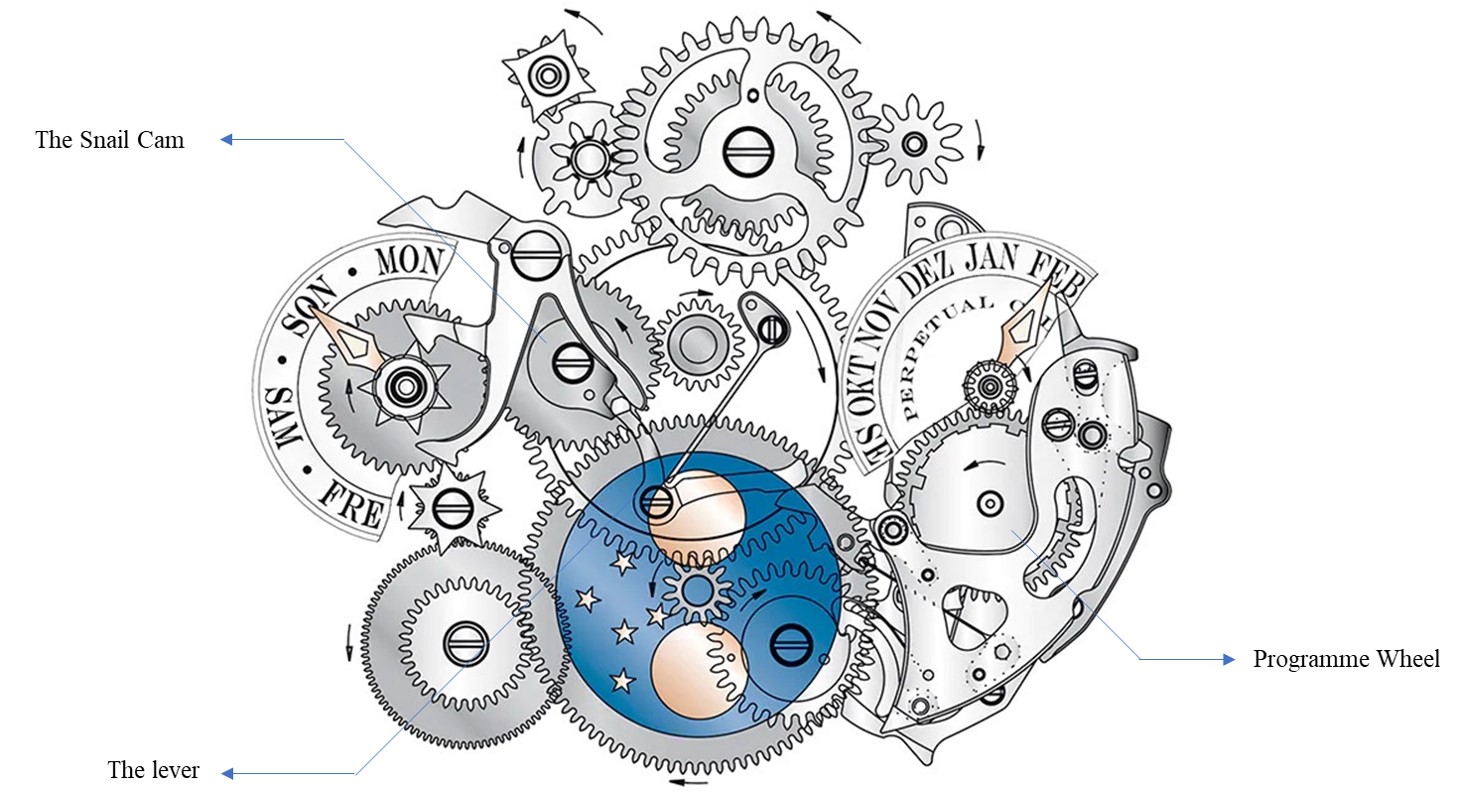
The principal part of the perpetual calendar mechanism (there are others but Langematik Perpetual is a classic styled one) is the programme wheel or the cam of 48 with each step representing a month. It features four different recesses: The lowest recesses represent February 28, second lowest for February 29, third lowest for the months with 30 days and the shallowest ones for 31 days. This wheel makes one full turn in four years.


The programme wheel is the brain of the Langematik Perpetual. A finger, attached to a lever, glides through the cam and controls the rest of the movement parts. The lever is connected to the star wheel with 31 (days) teeth. Imagine the finger is in the deepest recess, at February 28. Every night the lever retracts from the deepest recess and drives the star wheel via a click by one step.

The 31 teeth cam carries a snail shaped cam and a click. Until the 28th of February, the click still resides on the snail. At midnight, the click falls behind the snail because the lever resides at the deepest point of the programme wheel, hence its tail, too. Through this recess, the click is going to push the snail by 4 days – to the first day of the next month and so forth.


Difference with Langematik Perpetual is the big-date mechanism as it has “tens” and “ones” wheels but the basic principle remains the same.


Langematik Perpetual’s calendar indications do not jump instantenously and the visible switching process takes about an hour. So, please do not mess with your watch from 10 PM to 2 AM while the gears are at their most fragile positions.

Langematik Perpetual houses another ingenious complication that is the zero-reset. When the owner pulls the crown, a series of levers interact and resets the seconds’ hand to zero for precise time setting. A. Lange & Söhne utilized this in all Sax-0-Mat based pieces, alas ditched it with the introduction of the new Saxonia Automatics in 2011.

Under the seconds hand, there are two levers positioned over each other. When the crown is pulled, the lever (braking disc) on the top grips the brake disc and stops its movement. Since the disc is connected to the seconds hand, its movement stops. Moreover, there’s a heart-shaped cam attached to the seconds’ hand. When the first lever of the two touches the heart cam, thanks to the cam’s asymmetric rotation and the shape, it always travels back to its final position when touched. Hence, the seconds hand jumps back to zero. Moreover, another lever gently contacts the balance wheel and keeps it from moving. When the crown is pushed back, the levers return to their resting position and movement starts again.

Langematik Perpetual Price / Market

For 20 years, as the only stand alone perpetual calendar watch in the catalogue, Lange launched many iterations of Langematik Perpetual. From the classic yellow gold and platinum references to the rather rarer and short lived pink gold and white gold references, and finally to limited editions with blue dials as well as in honey gold case. Before moving onto the Langematik Perpetual prices, below please find a comprehensive look at the collection and production dates.


  • 310.025 – Platinum case, rhodium dial – From 2001 to 2017.
  • 310.225 – Platium case, platinum bracelet – From 2001 to 2003
  • 310.021 – Yellow gold case, champagné dial – From 2001 to 2007.
  • 310.221 – Yellow gold case, yellow gold bracelet – From 2001 to 2006
  • 310.026 – White gold case, black dial – From 2014 to 2017
  • 310.032 – Pink gold case, silver dial – From 2007 to 2017
  • 310.232 – Pink gold case, pink gold bracelet – From 2007 to 2012
  • 310.050 – Honey gold case, argenté dial – 2019 – in production, limited to 100 pieces
  • 310.028 – White gold case, blue dial – 2021, limited to 50 pieces
  • 310.037 – Pink gold case, blue dial – 2021, limited to 50 pieces
Langematik Perpetual Blue Dial

Langematik Perpetual Blue Dial 310.028. Sold at Langepedia x The 1916 Company Marketplace.

The Langematik Perpetual was removed from the catalogue in 2024 with the sale of the final pieces. At its time of discontinuation, the retail price for the last, limited gold pieces were about $99,000. As the usual mark up for the platinum is around 15% we could say that the reference 310.025, should it be in production, would set one back of about $115,000 in 2024.


The pre-owned market prices however, as usual, is a different story. Putting the limited and bracelet variants aside, we can say that for the Langematik perpetual the pricing goes from low $40,000 to high $60,000 from yellow gold to pink gold, to platinum and finally the white gold variant versions. The rarity plays an important role here as the reference 310.026 offers a significant rarity aspect over the others. The range of course depends on the set and condition as usual.


The honey gold and blue dial variants on the other hand are rather closer to the retail prices at discontunation, though still a tad below. They bless the market rather infrequently, hence it is important to continually observe the availability. The range seems to be somewhere around high $70,000 to low $90,000 depending on the set and condition.

I hope this was a valuable guide for whomever is looking for a Langematik Perpetual or just want to learn the details and history of these pieces. If you’d like to chat, sell or buy a Langematik Perpetual, please kindly reach out to me via alp@langepedia.com

/

Please feel free to contact:

/

Follow Langepedia on Instagram:

Watch “A. Lange Story” Documentary, in partnership with The 1916 Company:

STAY IN TOUCH

Sign up for the newsletter to get to know first about rare pieces at Marketplace and in-depth articles added to the encyclopedia, for you to make the most informed choice, and first access!