Brands structure their product portfolios to reach the widest possible client base, aligning each collection with its intended audience. A clear example is Patek Philippe’s Nautilus line: prices begin around €30,000 and rise step by step through various complications and metals, culminating in the elusive reference 5740 at the top end. In a similar spirit, A. Lange & Söhne’s Zeitwerk debuted in 2009 and, buoyed by a cult following, expanded rapidly until 2015. Yet the gap between the standard model and the Striking Time, about $40,000, left space for an intermediate offering. It was only logical for Lange to fill that void, and ten years later they did so with the Zeitwerk Date.
The Zeitwerk Date measures 44.2 mm across, 2.3 mm larger than the original, yet it stands just 12.3 mm thick, an impressive 0.3 mm reduction from the first-generation original despite a doubled power reserve, a feat explained in the movement section. These revised proportions register immediately on the wrist, making the watch feel markedly slimmer than its earlier, chunkier siblings. True to A. Lange & Söhne tradition, the white-gold case is robust and deliberately engineered rather than fluid, perfectly matching the Zeitwerk Date’s futuristic, industrial character. Its three-part construction, case back, band, and bezel, alternates polished and brushed surfaces, and the harmony between brushed white gold and the grey dial is superb, putting this reference aesthetically ahead of the rest of the collection. Notched, separately finished, and soldered lugs curve generously, so even at 44.2 mm the watch hugs the wrist comfortably.
Two pushers at 4 and 8 o’clock advance the hours and date, respectively. Unlike conventional press-to-activate buttons, these engage upon release, ensuring that the switching force is always consistent and insulated from accidental pressure. Introduced at SIHH 2019, the Zeitwerk Date represents the family’s first “mild” complication—”mild” only in comparison to the chiming mechanisms of the Striking Time and Minute Repeater. In reality, the watch ushers in significant improvements in movement architecture and user experience, thoroughly justifying its place in the collection and the detailed attention it commands.
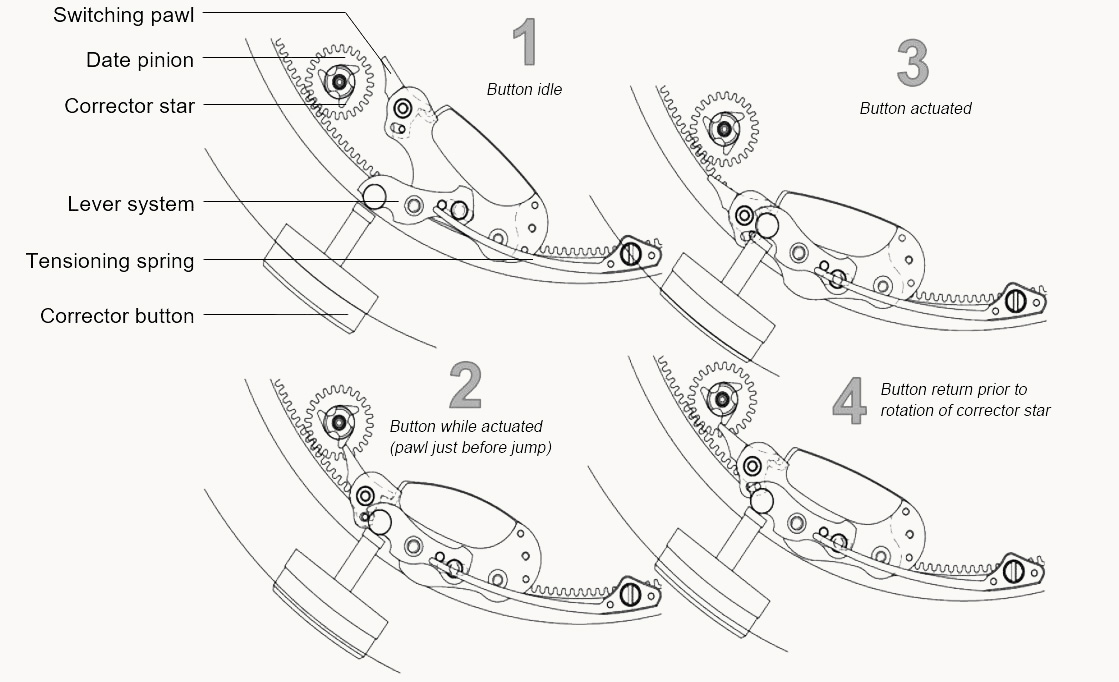
So how does a release-actuated pusher advance the date without ever jarring the movement? The sequence is easiest to follow in stages.
In the first diagram, the system is in its idle position. When pressing (2), the spring is tensioned, the lever system is activated, and the pawl slides over the corrector star without moving it. When the button is fully actuated (3), the pawl sits behind the corrector star. Only when the button is released does the tensioning spring reset the system, with the pawl advancing the corrector star to move the date indication, which brings us to the Zeitwerk “Date.”
Upon hearing the rumors of a Zeitwerk Date, I started to wonder how it would even be possible: there could not be any digital numerals on the dial due to lack of space, and it would be utterly confusing. Perhaps a hand could have been added within one of the sub-dials, yet that felt too “cheap” an upgrade for Lange, or for the Zeitwerk, for that matter.
Well, trust Lange to find the best approach: a peripheral date ring. The added complication does not disturb the proportions of the main dial (which are kept exactly the same) but instead enhances and accentuates them. The balance struck on the Zeitwerk Date is astonishing. The date ring is made of sapphire glass with cut-out numerals, and a red marker beneath the ring is connected to the discs, switching to the next date simultaneously and instantly with the hours and minutes discs. The precise nature of the Zeitwerk is in safe hands.

The Zeitwerk Date is the first regular-production model in the line to wear a grey dial. Lange had already paired grey dials with white-gold cases on the Datograph Perpetual and Triple Split, yet the Zeitwerk family had been restricted to silver or black, apart from one little-known outlier: a unique grey-dial Zeitwerk made in 2011 for the Kids Horizon charity auction in Singapore.
Across the range, Zeitwerk models, whatever their complication, have always presented a strictly monochrome palette of rhodium, white, and black, the only exception being the Handwerkskunst edition. The Zeitwerk Date breaks new ground by introducing a touch of red on the power-reserve indicator and the date display, a change I enthusiastically applaud.

I am equally taken by the brushed German-silver time bridge. Although it is fundamentally a functional component, Lange’s designers have folded it into the overall aesthetic so gracefully that it feels predestined to sit there, perfectly proportioned and ready to complement even the line’s most elaborate chiming mechanisms.
On July 25, 2025, A. Lange & Söhne further expanded the Zeitwerk Date collection with a new addition in a pink-gold case, carrying the same striking grey dial. The inspiration comes from the early Lange 1 (101.033, 116.033) and Langematik collections, which featured the same livery. It is the first time we see the Zeitwerk in such an assertive pairing, and I love where this goes!
Zeitwerk Date Caliber L043.8
Almost every Lange watch is a treat on both sides, and the Zeitwerk Date, through both what it shows and what it does, perfectly upholds the brand’s reputation as a true movement maker. The latest member of the family carries the splendid caliber L043.8, the eighth evolution of the original L043.1, and it arrives with a myriad of upgrades. Lange’s engineering is a gift that keeps on giving, and this movement is the latest proof.
Caliber L043.8 is not confined to what you see through the case-back. As noted earlier, the dial-side time bridge and the peripheral date mechanism are integral parts of the movement, each deserving close attention. Visually, the new caliber remains rooted in the original L043.1, yet its most striking departure is the remontoire bridge: formerly a curved shape, it is now streamlined, lending the movement a more balanced, contemporary look. This bridge houses the power-train components while showcasing exceptional hand-finishing, the hallmark of haute horlogerie, where aesthetic refinement never compromises function. To highlight the brushing on the remontoire bridge and the raw German-silver plates, the neighboring bridges are intentionally left without beveling or polish, creating deliberate contrast.
The mainspring barrel has also evolved. Freed from the Maltese-cross stop-work system, it now sports an elegant sun-ray finish. Altogether, the flowing curves, distinctive architecture, and judicious finishing of caliber L043.8 make it a marvel to study from the back. Yet the real intrigue lies in how it works, and how it improves upon the original design.
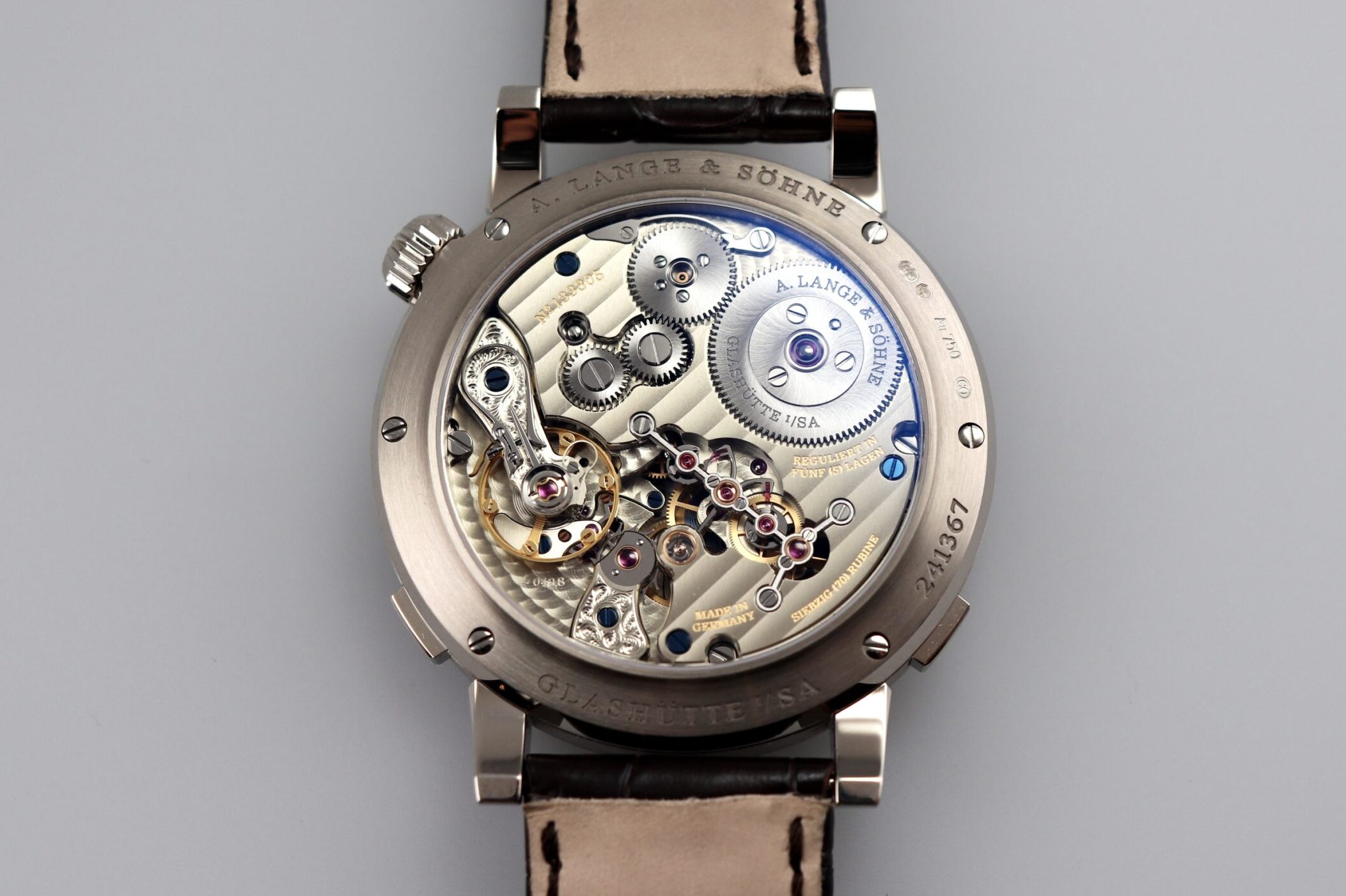
The new caliber l043.8.
As is well known, the Zeitwerk Date displays time with three discs, hours, minute-tens, and minute-units. In a conventional analog watch, the relatively light hands require little energy to move. The Zeitwerk, by contrast, must muster considerable power to snap all three discs forward simultaneously, or at least once per minute for the minutes disc. The remontoire is the mechanism that makes this happen with perfect precision every sixty seconds.
A pre-tensioned remontoire spring receives uniform pulses of energy from the mainspring through the center wheel. The third-wheel pinion stores a reserve of that energy while the lower, driving third wheel remains locked in place. The remontoire spring then transfers its freshly absorbed energy to the upper, driven third wheel, from which it continues toward the escapement through the rest of the gear train.
During this interval, the lower third wheel is alternately restrained by two control pinions. At their upper ends, each pinion carries a blocking disc and a blocking finger that, in turn, rest against one of the pallet stones on the Y-shaped control lever. This coordinated dance ensures that torque is released in perfectly metered increments, allowing the discs to advance crisply and precisely at the start of each new minute.
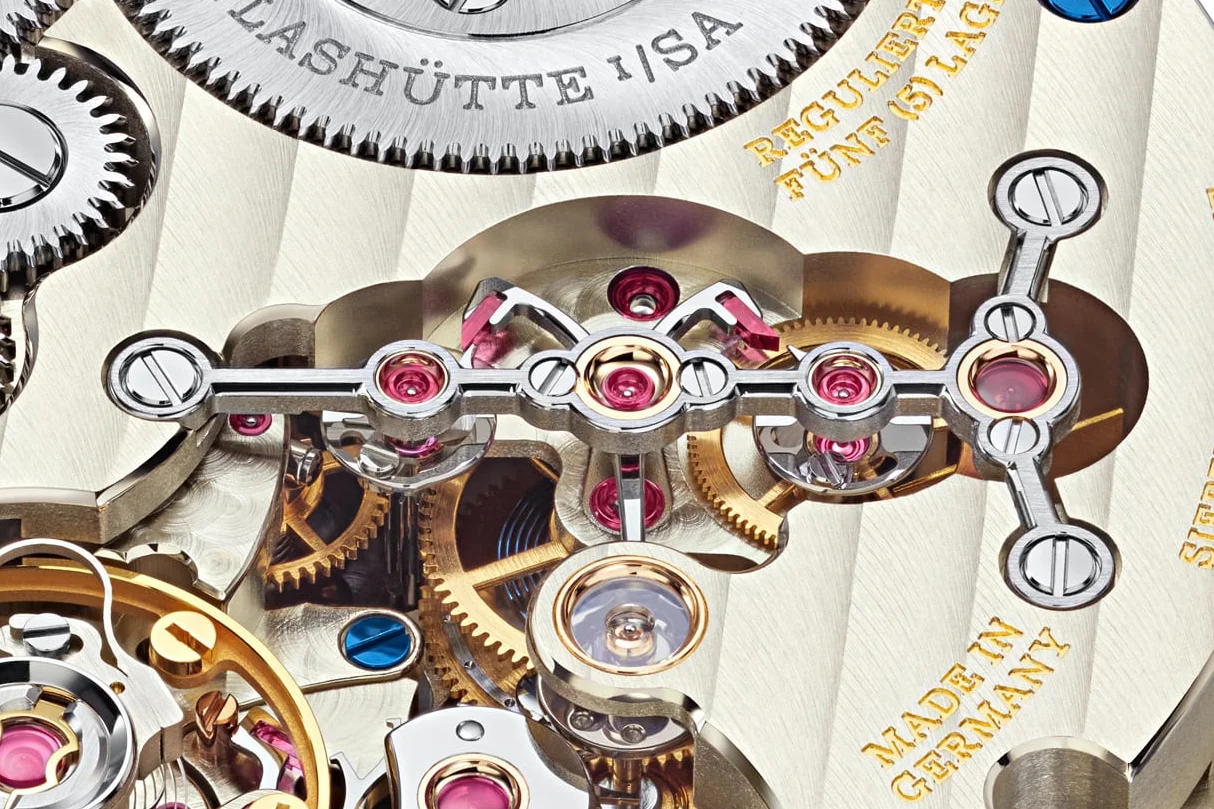
Every 60 seconds the lower (driving) third wheel is freed by the slight rotation of the control pinions, releasing an energy pulse that advances the Zeitwerk Date’s disc mechanism. This sequence is governed by the control lever, whose cyclical pivoting comes from the fourth wheel: as that wheel, and the eccentric roller on the same arbor, completes one rotation per minute, it rocks the control lever back and forth.
So far, the process is identical across all Zeitwerk models. The Zeitwerk Date, however, adds a patented double-barrel system that doubles the power reserve to 72 hours, even with the extra date mechanism, and still manages to make the movement thinner than the original. The secret lies in the construction of the mainspring barrels and in meticulous fine-tuning.
Turning the crown tensions both mainsprings simultaneously, and they unwind together while the watch runs. The two mainsprings are connected in series by the upper barrel core [1] and the lower barrel drum [4]. During winding, the floating upper barrel drum [3] rotates twice as fast as the lower drum; when the watch is running, the situation reverses: the lower barrel core [2], together with the barrel wheel [5], now turns twice as quickly as the lower barrel drum and the upper barrel core.
This arrangement reduces friction losses at the lower barrel core’s jewel bearings while the watch is in operation, optimizing energy use and extending the maximum power reserve.
Note that the Zeitwerk Date eliminates the Maltese-cross stop-work used in earlier generations, as torque distribution is now handled far more effectively.
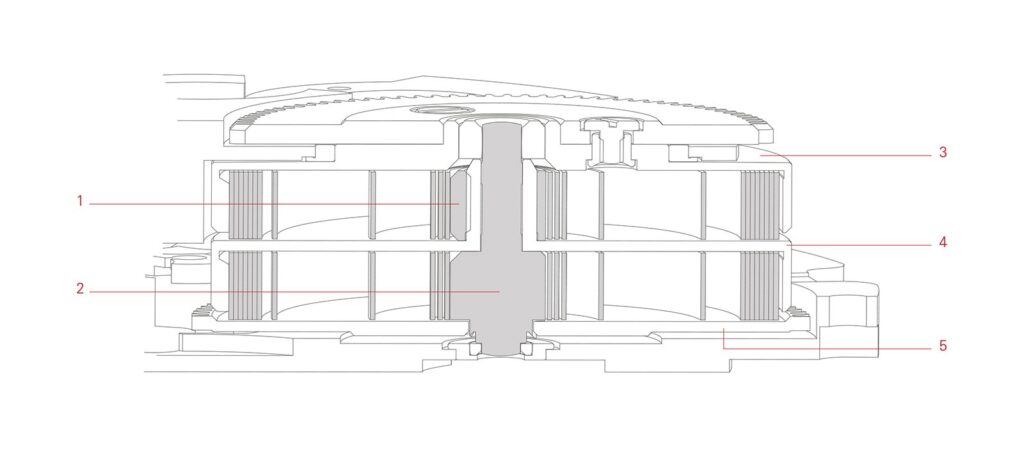
Caliber L043.8 in the Zeitwerk Date packs two of the longest mainsprings Lange produces, replacing the single, shorter spring found in earlier versions. To create space for the extra spring, the engineers redesigned the barrel so that both springs are stacked vertically. The remontoire mechanism and the balance system were then subtly re-engineered, with a lighter balance wheel and a thinner remontoire spring, to handle the increased torque.
This mind-bending blend of engineering and fine-tuning lets the discs jump with split-second precision at the top of every minute—1,608 times each day across all three discs, or 4,824 times over the watch’s full three-day power reserve.
Buying an A. Lange & Söhne Zeitwerk Date
When introduced in 2019, A. Lange & Söhne’s Zeitwerk Date was priced at a rather decent $96,200; for comparison, the base Zeitwerk models were at $79,000. Accounting for the significant movement upgrades as well as the date complication, I think the premium was very much deserved and reasonable. This was also the era when A. Lange & Söhne was transitioning toward a boutique-only model. The sales squeeze, coupled with the production time required for the Zeitwerk Date and its attractive price, fostered a strong pre-owned market right after launch. A Zeitwerk Date in white gold was even sold at $97,200 including premium at an auction. Alas, with subsequent price increases and the brand’s somewhat fading interest compared to the Covid boom era, the gap between retail and pre-owned prices for the Zeitwerk Date widened significantly.

Come August 2025, as with the majority of the A. Lange & Söhne catalog, the Zeitwerk Date’s price has climbed substantially. Today, both the white-gold and the recently introduced pink-gold models are priced at $142,500. However, the piece can be found on the pre-owned market anywhere between $85,000 and $110,000, depending on condition, set, and availability.
Following the introduction of the pink-gold Zeitwerk Date, it is only logical that production of the white-gold version will be diminished significantly, which could help clear up the pre-owned market and sustain pricing. As of August 2026, however, I still see the piece as a complete bargain, just like the rest of its family.