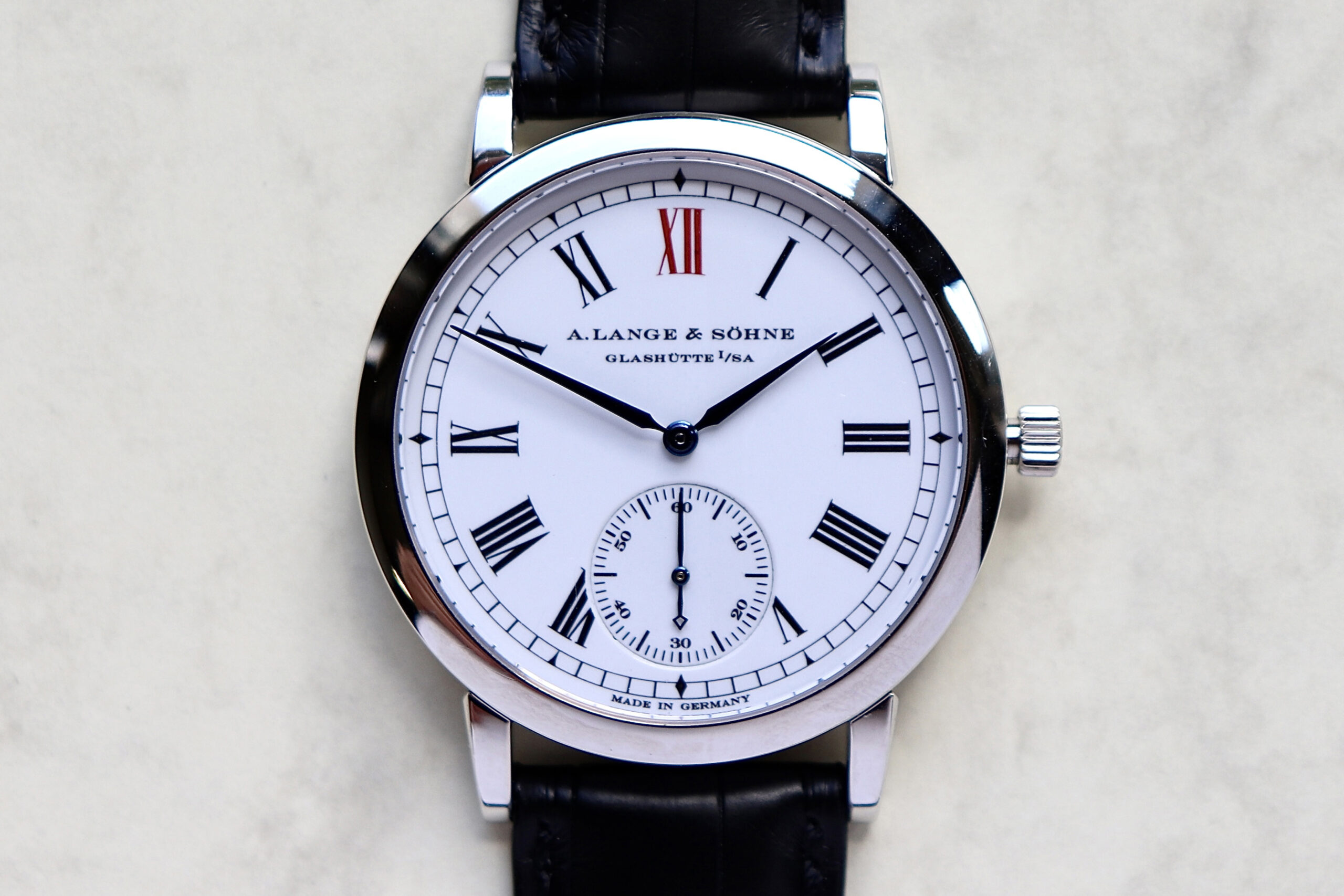
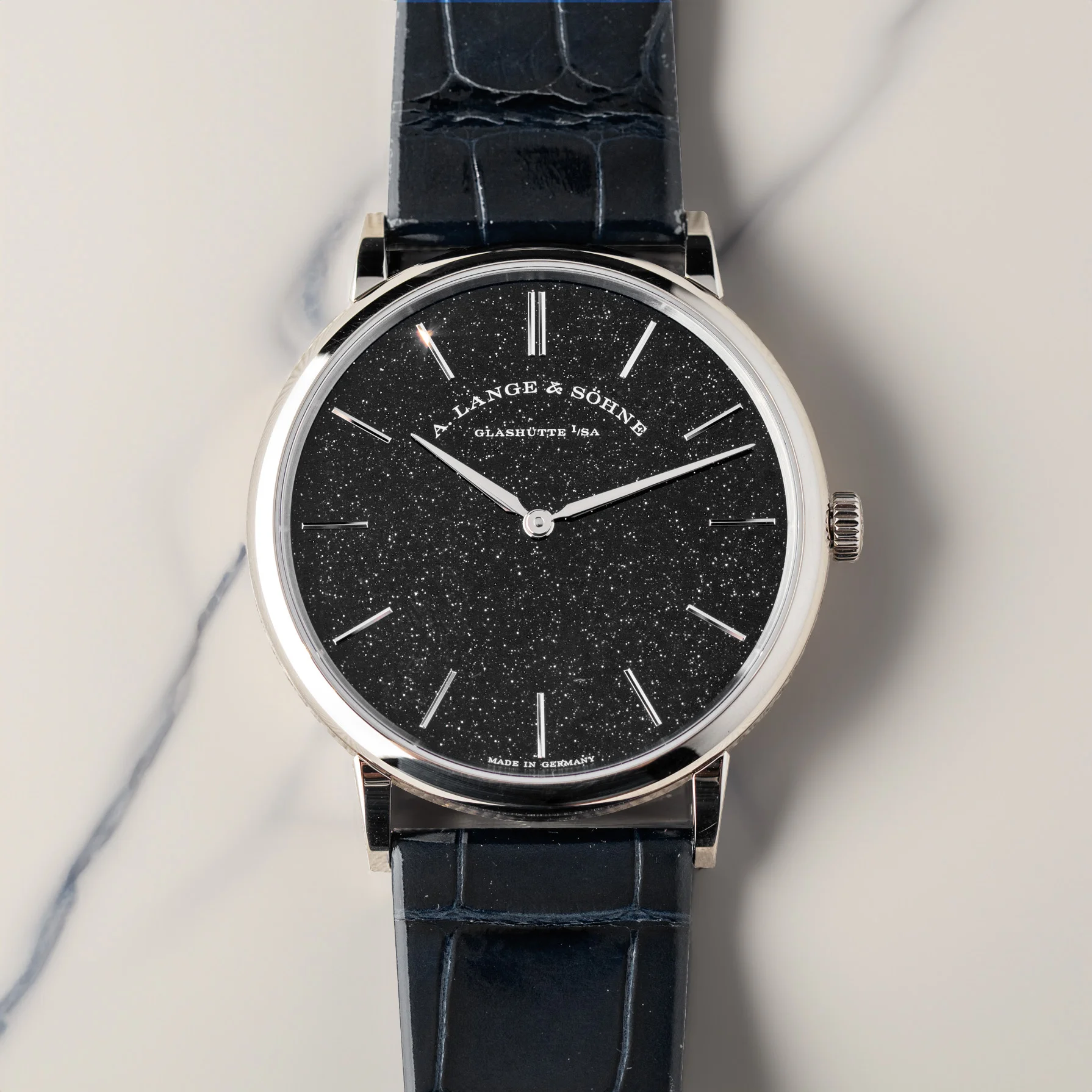
As I listen to Richard Wagner while writing this article, it becomes increasingly clear why A. Lange & Söhne chose his homeland to name their most reserved, yet profoundly engineered collection. Much like Wagner’s music, the Saxonia is filled with regional leitmotifs, “carriers of emotion,” as he called them. And like his dramas, the original Saxonia collection is minimalist in its elements, yet every detail is an inseparable part of the whole. 1994 marked a revolution in German high-end watchmaking; there could be no more appropriate way to celebrate it than by honoring Saxony, Germany’s historical engine of art and science.
The following article explores the evolution of the collection from 1994 onward, covering the Saxonia, and Saxonia Automatic. For an in-depth walkthrough of the Langematik, please refer here, and for Saxonia Thin, here.
1994 & Saxonia with a Hidden Back
The Saxonia was introduced alongside the Arkade, the Lange 1, and the Tourbillon “Pour le Mérite” in 1994. Interestingly, next to the avant-garde Lange 1 or the feminine Arkade, the Saxonia stood as the most classical pillar of the catalog until the arrival of the time-only 1815 models. Although the name suggests a tribute to the past, the collection is actually a masterful blend of tradition and modern, functional innovation. Günter Blümlein explained this philosophy best:
“The 1994 A. Lange & Söhne wristwatches and all upcoming models are anything but epigones of watchmaking legends… It is not our intention to celebrate traditional craftsmanship or to compete for the most complicated clock. One of our goals is watchmaking beauty and perfect craftsmanship. On the other hand, innovations and differentiating design are important parameters for us.”

First generation Saxonia on Wellendorff Bracelet. Sold at The Selection
The inaugural Saxonia (Ref. 102.001) was launched in yellow gold, featuring a case diameter of 34 mm and a thickness of 9.1 mm. As Walt Odets famously noted in his brilliant essay, Personal Musings on Saxonia, the watch “looks like a biscuit” from the side. The signature Lange three-step case structure is prominent here, featuring notched lugs screwed into a brushed middle section.
In 1994, it was the industry norm to use solid case backs, excepting the Tourbillon “Pour le Mérite.” Consequently, the Saxonia hid a secret behind its thick layer of gold. As a visionary manager, Blümlein knew that collectors were growing weary of 40 mm watches housing tiny 20 mm movements. Thus, a founding principle of the brand’s rebirth was “one watch, one movement.” While Lange frequently used this for marketing and PR in the years that followed, they actually broke their own code right at the starting line.
The first Saxonia references, 102.001 and 102.002, were powered by the Arkade’s caliber, the L911.3. While it was a technically impressive feat, integrating an Outsize Date into a movement of that size with a 42-hour power reserve, it meant the Saxonia lacked a unique caliber of its own.
Years later, when Peter Chong asked Blümlein if they would continue to develop a new movement for every model, Blümlein’s response was so firm one might think the Saxonia/Arkade overlap never happened: “Yes. All our product developments are running under this rule. You may expect some more surprises in the future.”
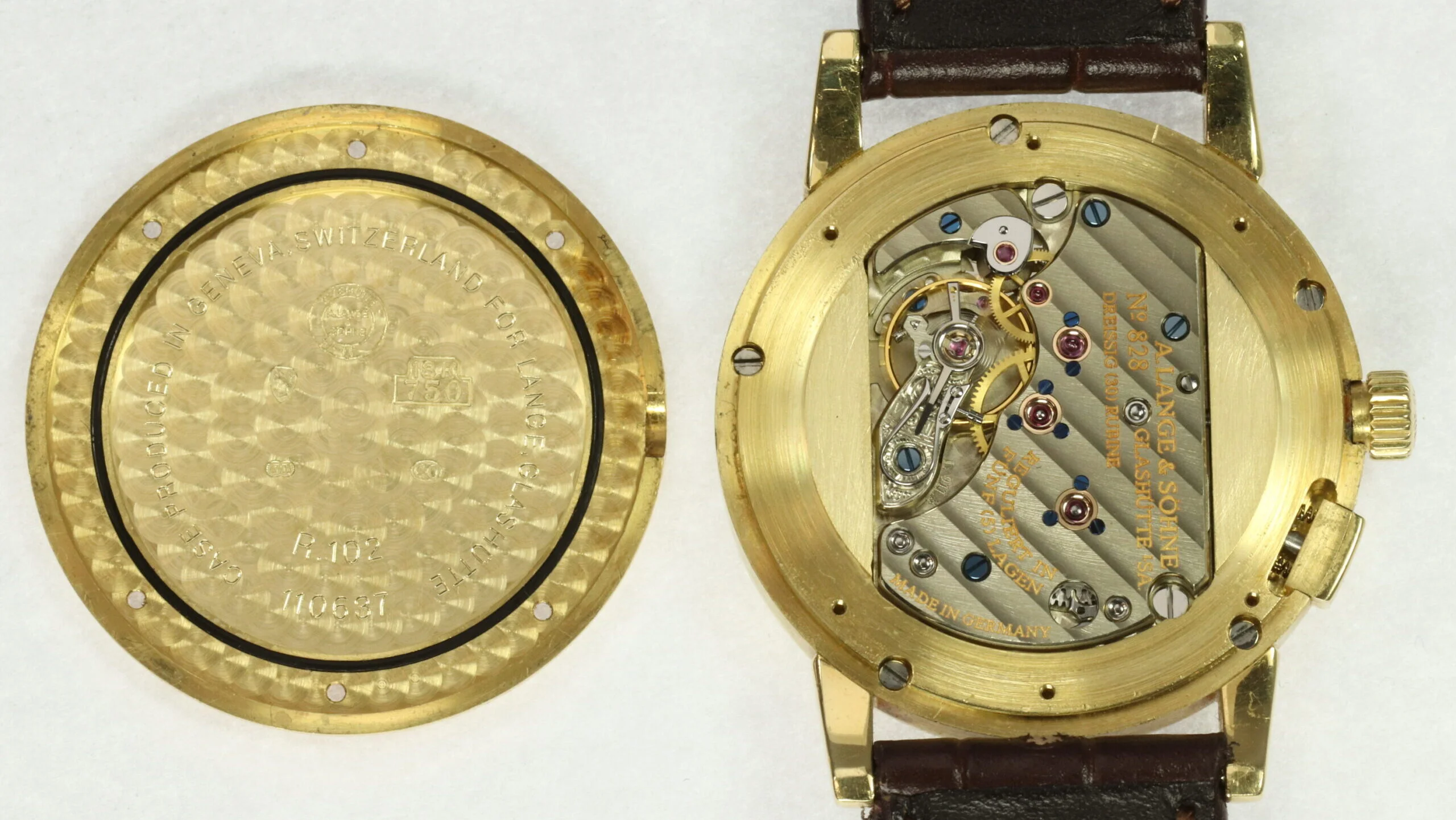
What’s behind the Saxonia 102.001
Yet, this is nothing but the growing pains of a venture. And isn’t collecting all about such quirks? Today, I would value a 102.001 much higher than its 105.001 sibling, simply because it tells the story of early A. Lange & Söhne, its daring spirit, like none other.
These first references were priced at 16,900 Deutsche Marks in 1994, which adjusted to approximately €10,000 by the year 2000.
1997 & The Round Movement
Saxonia with solid case back remained in the catalogue with the rectangular movement L911.3 for three years. Only in 1997, the collection received a round movement, caliber L941.3 based on the 1815’s caliber L941.1. Following, the reference numbers were re-adjusted as 105.021 and 105.022. Although the one movement one watch principle was broken once again, it was still a huge step forward.
With the arrival of the new caliber in 1997, A. Lange & Söhne aggressively expanded the Saxonia collection with platinum and white gold cases as well as bracelet and gemsetted versions, while still preserving the case dimensions at 33.9 mm x 9.1 mm.

Caliber L941.3 consists of 164 parts, beats at 3Hz and offers 45 hours of power reserve with a diameter of 25.6 mms and thickness of only 3.2 mms. Finished with usual Lange quality and featuring traditional Glashütte watchmaking hallmarks such as three-quarter plate, gold chaton and hand-engraved balance cock, it is one of the signature movements of the brand. No wonder, even after 23 years, it still powers the current Saxonia collection.
Even today, I would easily argue that it is one of the best movements one can get for its price range; at least from the big companies and not counting independents such as Kudoke, Dornblüth, Laine…
Lange kept the 34 mm Saxonia models in catalogue until the introduction of the updated versions with 37 mms in 2007. Through its 13 years of lifetime, especially after 1997, Lange introduced many diamond pavéd editions of the 34 mms Saxonia family. As I see it, Blümlein noticed the trend towards the bigger watches among men; thus, wanted to capitalize the small Saxonia models over ladies by transforming the collection as well as to reap off the initial investment.
Below, please find the first generation, 34 mm Saxonia references and production dates, excluding the gem-set, bracelet and pavé variants:
- 102.001 – Yellow gold/champagne dial – solid case back with L911.3 (1994 – 1996)
- 102.002 – Yellow gold/champagne – solid case back with L911.3 (1994 – 1996)
- 105.021 – Yellow Gold/champagne – new caliber (1997 – 2007)
- 105.025 – Platinum/silver (1997 – 2007)
- 105.027 – White gold/blue (1997 – 2002)
- 105.022 – Yellow gold/argenté (1998 – 2004)
- 105.035 – Platinum/black (1998 – 2002)

The Saxonia 105.027. Recently Sold at The Selection
2007 - Saxonia to 37 mm
By 2007, A. Lange & Söhne presented a second generation that felt like a complete departure from the 1994 DNA. The line received a radical size update to 37 mm, and while it kept the caliber L941.3, almost every visual link to the debut models was severed. The “biscuit” look was gone, with thickness reduced by nearly 2 mm down to 7.3 mm, fundamentally changing how the watch sat on the wrist.
This generation arrived with a completely modernized façade that traded character for a more sterile, “appropriate” elegance. The diamond-shaped hour markers, a quirk of the early era, were replaced with multi-faceted batons, and the minute chapter markers were notably shortened. Most importantly, the Big Date, which had been the defining (if controversial) feature of the original, was removed entirely. Without the date, the dial became much more open, and the seconds sub-dial finally sat in a technically correct position—neither crowding the center nor interfering with the 6 o’clock marker.
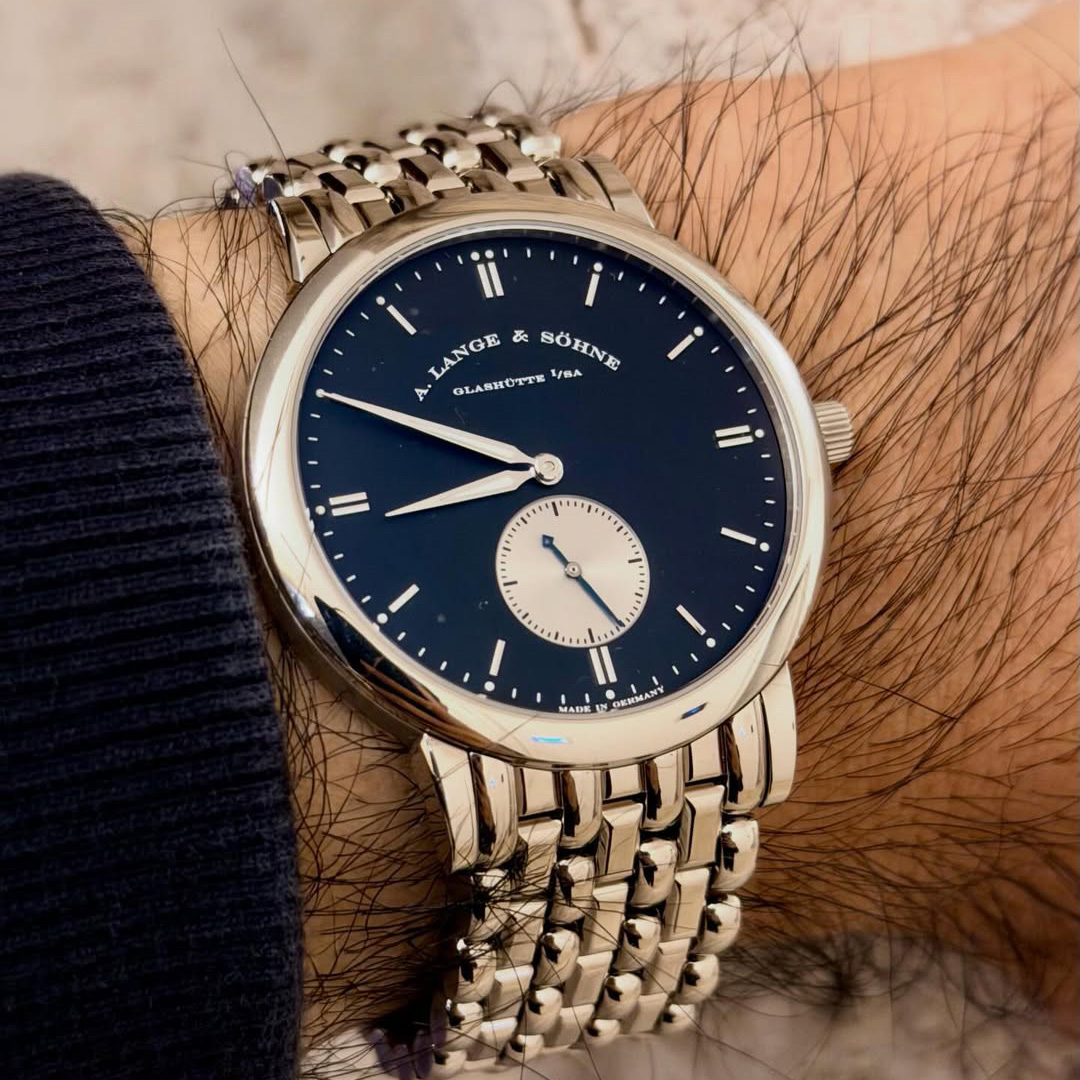
By shedding the date, perhaps the mandatory “Lange Signature”, I think A. Lange & Söhne displayed immense confidence. It proved that a Lange is defined by its architectural finish and inherent proportions, rather than just its complications. This omission allowed the dial to “breathe,” creating a sense of Ma—the Japanese concept of negative space where the emptiness is as important as the objects within it.
It transformed the Saxonia into a watch that was arguably more classic and “reserved,” but it also made it a much safer design. By removing the clutter, the dial lost the specific “drama” that defined the brand’s rebirth. Perhaps it was needed, as A. Lange & Söhne also was not the brand it was 13 years ago. To me, these 2007 pieces represent the moment the collection re-identified itself. While the standard versions in yellow (215.021), white, and pink gold (215.032/215.033) became the new face of the line, the true outlier remains the reference 215.049—the 25-piece white gold edition made for a Japanese collector that stripped the design down even further.
Below please find production references:
215.021 – Yellow gold / Champagne (2007 – 2011)
215.026 – White gold / Argenté (2007 – 2011)
215.029 – White gold / Black (2007 – 2010)
215.032 – Pink gold / Argenté (2007 – 2011)
215.033 – Pink gold / Grey (2007 – 2010)
2011 – The Third generation
In 2011, Lange entered a new era for the Saxonia with three core references in yellow, white, and pink gold. On paper, very little had changed; the movement remained the caliber L941.1 and the case size held steady at 37 mm. Yet, as is often the case with Lange, subtle modifications had a significant impact on the collection’s visual identity.
The most immediate change was the introduction of a connected minute track. This new perimeter track creates a defined border for the dial, offering a more formal and restrained aesthetic compared to the open-ended markers of earlier generations. Additionally, the double-baton indices at the quarter hours were removed, pushing the dial toward a more singular, stripped-back simplicity. It was with this collection that the Saxonia began its transition into the design language we recognize today.

The Saxonia Mother of Pearl Dial. A quirky rarity. Sold at The Selection
However, this iteration was short-lived, discontinued in 2015 after just four years. Given that Lange is not a brand to refresh a line so quickly if it is performing well, it’s reasonable to assume that a lukewarm reception necessitated the quick renewal. While the 2007 update was a pivot, the 2011 version felt like a search for an identity that hadn’t quite landed with the traditionalists or the new guard.
216.021 – Yellow gold/champagne (2011 – 2013)
216.026 – White gold/argenté (2011 – 2015)
216.032 – Pink gold/argenté (2011 – 2015)
2015 – The Current Saxonia Collection
In 2015, A. Lange & Söhne made the somewhat unexpected move of decreasing the case size for the hand-wound Saxonia collection by 2 mm, bringing it down to 35 mm. On the dial, the baton and minute markers were lengthened, and the removal of the minute chapter ring created a look that slightly echoed the 2007 collection. While all appliques remained solid gold, the hands were updated to rhodiumed gold, adding a cooler, sharper contrast to the face of the watch.
While the retreat to 35 mm might seem counter-intuitive in a market generally favoring larger diameters, a glance at the 2015 catalog reveals the commercial logic at play. Alongside these manual versions, Lange introduced the new Saxonia Automatic references 380.033 and 380.027. Because the manual and automatic lines shared such a similar design language, offering them at the same size would have been an exercise in self-cannibalization. By positioning the manual Saxonia at 35 mm and the automatic at 38.5 mm, the brand created a clear hierarchy and a distinct choice for the collector.

In the years following that update, from the introduction of blue dials to vibrant boutique editions and mother-of-pearl versions, Lange offered a wide array of variations on the 219.xxx reference. However, while these watches are undeniably finely made, they often lack that “special touch” found in the brand’s earlier, more experimental years. They are beautiful, certainly, but perhaps not as defining for the brand’s identity. This evaluation is reflected in the brand’s own sales strategy: the straightforward 35 mm models were available through retailers, while the 37 mm hand-wound versions with more expressive dial colors were strictly reserved for boutiques.
Technically, the 35 mm case size provided a distinct advantage for the movement. The caliber L941.1 fills the case back much more effectively than it did in the 37 mm housing, offering a more balanced and honest view of the Glashütte finishing. This era of the Saxonia finally came to a close in 2025, when the 35 mm hand-wound collection was discontinued to make room for the 34 mm “blue series” 1815 line, a move that suggests Lange is once again shifting the goalposts for its entry-level manual dress watches. I can almost say that the shift was more about segmentation, rather than offering an exciting line.
However, the story of the Saxonia is not purely a manual one. If the hand-wound models represent the intimate solo of a Wagnerian ritual, the collection eventually expanded to include both a broader orchestration of self-winding calibers and an even more distilled expression of minimalism. For those interested in the most pared-back version of this design language, I have covered the Saxonia Thin in a separate, dedicated article.
The year 2007, which saw the birth of the 37 mm manual generation, also marked a profound structural shift for Lange’s self-winding offerings. It was the year the curtain fell on the legendary Langematik collection, leaving a void that the brand chose to fill by absorbing the automatic complication into the Saxonia family. I highly suggest you to read the article before proceeding with the Saxonia Automatic section below.
This transition from the specialized, micro-rotor “Sax-0-Mat” era to the modern Saxonia Automatic reflects a pivot in the brand’s philosophy, a move away from niche, purist-driven engineering toward a more unified, contemporary identity. As we shift our focus from the manual rituals of the L941.1 to the world of self-winding efficiency, we see the Saxonia once again wrestling with its own identity.
2007 - Saxonia Automatic
To understand the Saxonia Automatik, one must first look at the giant whose shadow it failed to fill: the Langematik. Introduced in the late 90s, the Langematik was a glorious outlier. It was powered by the legendary Sax-0-Mat (Caliber L921), a movement defined by its heavy gold micro-rotor and the ingenious “Zero-Reset” mechanism. Its design was kooky and asymmetrical, with elongated indices and the “Sax-0-Mat” inscription cutting across the 4 o’clock position.
In 2007, A. Lange & Söhne made the fateful decision to replace the Langematik with the Saxonia Automatik. And with that, in my opinion, a certain decline began. Not in overall terms, just comparatively.
If you recall the 2007 update to the hand-wound collection, you can draw a very strong parallel with the Saxonia Automatic update. Sword shaped indices are replaced with baton indices. Dots add a further “class”, transforming the layout of the watch completely. The asymmetric “Sax-0-Mat” at 4 o’clock is removed, and just like the handwound variant, Saxonia Automatic became just as expected, trading its eccentricity.
By aligning the design with the reserved look of the rest of the collection, Lange created something technically beautiful, yet arguably monotonous. It lost the “fun” and the essence of its predecessor.
Evidence that the brand, and collectors, eventually agreed with this sentiment arrived in 2013. Lange released a 25-piece limited edition Saxonia Automatik with a Big Date (Ref. 308.037), which essentially resurrected all the “kooky” hallmarks of the coveted Langematik. It was a silent admission that the standard collection was lacking that specific spark.

Nevertheless, the new collection was still utilizing the beautiful and partly unrivaled Sax-0-Mat caliber back then. And just for this, I value the 2007 Saxonia Automatic higher than any of its successors.
Parallel to this, Lange introduced the Große Saxonia Automatik in 2007. Measuring 40.6 mm x 8.2 mm and forgoing the Big Date, it was a clear response to the critiques of the “Große Langematik,” which many found disproportionate. The new version was undeniably cleaner and more tasteful, especially in the pink gold/grey dial configuration (Ref. 307.033), which perfectly suited the brand’s more reserved direction.
Saxonia Automatik with Date remained in the catalogue until 2011 with a short life span of 4 years; and the Große Saxonia Automatik until 2010. The design of the 2007 Saxonia Collection watches laid the backbone for the future evolution of the series.
Saxonia Automatic & Caliber L086
In 2011, the Saxonia Automatic collection received another update. This time, it was not only a slight cosmetic touch; but an introduction of a new movement. The legendary caliber L921 Sax-0-Mat was removed from Saxonia Automatic pieces and replaced with the thoroughly inferior (in comparison) new caliber L086.1 – whilst ditching all the technical and aesthetical hallmarks that made A. Lange & Söhne’s automatic movements worthy of admiration.
The watches were and still are straightforward and beautiful looking; but what is under the hood is disappointing for someone who knows the brand’s offerings in the olden days. It is like Lamborghini abandoning its determined proportions, clear contours and precise lines and presenting something like Fiat 500 with round lines and open contours. Still serving the same purpose, the car is still running – but without its crux.
Lange was Not Standing Still; alas was going backwards.
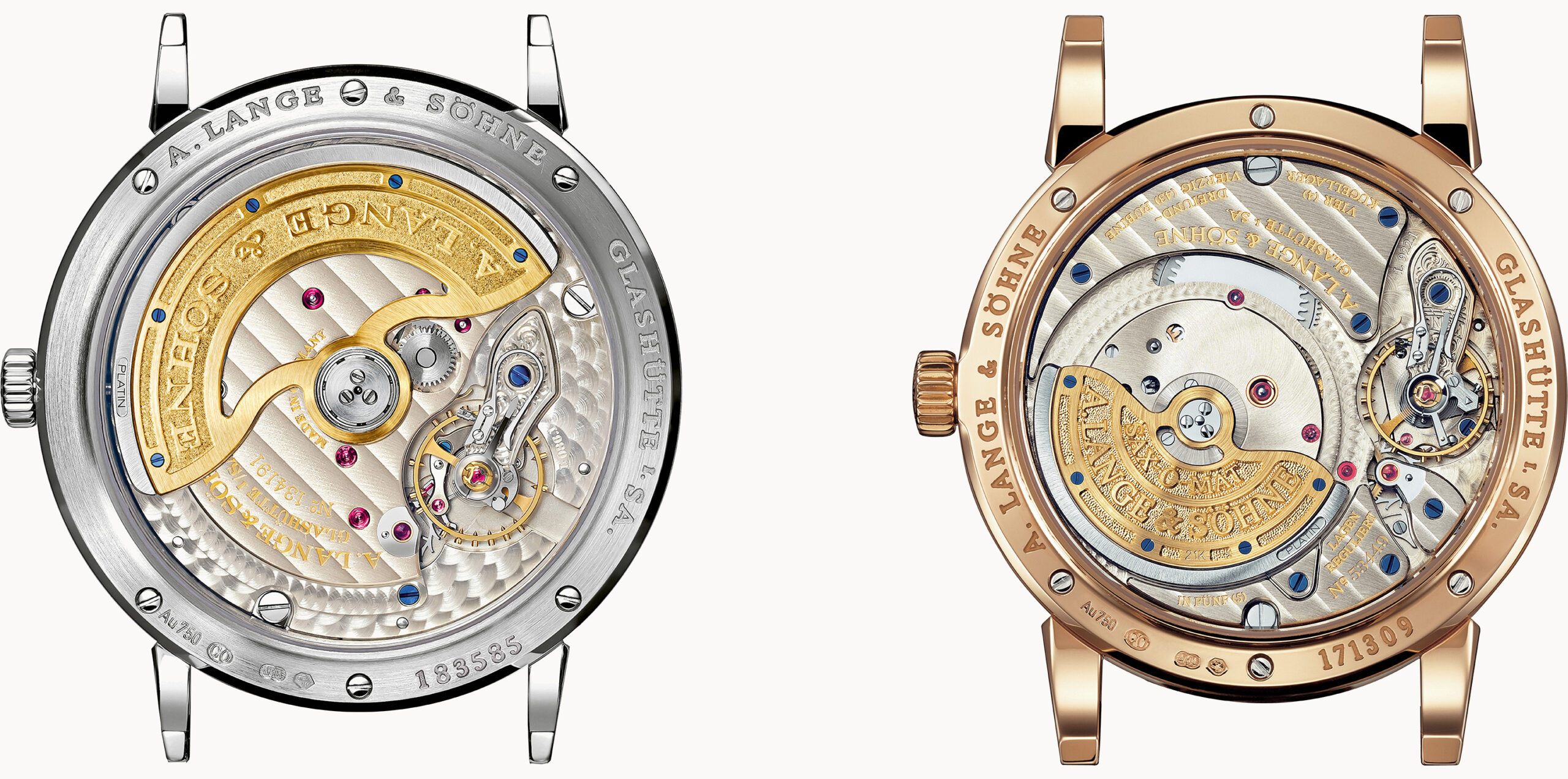
L086.1 of the new generation (left) and L921
To be clear: by industry standards, the L086.1 is a “good” movement. It is well above average. However, when you set the bar at the level of the Sax-0-Mat, you cannot pull it down without facing scrutiny. Many reviewers / watch journalists claim it “retains exceptional Lange quality,” but I am bewildered by such praise. What, exactly, is exceptional here?
The rotor is based on ARCAP, and gold-plated. As it is rather thin, the engraving does not shine like the solid-gold rotor of the Sax-0-Mat. The finish is almost invisible. While the anglage is consistent throughout, the area to observe is so short, it becomes almost insignificant. Further, the caliber L086 is the first Lange movement without a gold chaton. And my biggest pet-peeve is that the caliber does not actually measure 30.7 mm. It sits in the center, surrounder by a massive perlage-finished movement ring to fill the caseback. Unfortunately, the ring drastically fades against the German silver under natural light, leaving a bland view.
You might rightfully ask; Why did they develop this then?
According to A. Lange & Söhne the main motivation was to bring a thin, automatic movement with 72 hours of power reserve; and it was impossible to improve the L921.2’s power reserve (from 46 hours) without increasing its thickness. Same reason also applies to the use of a gold-plated rotor; as a solid gold would have been unstable with such thin dimensions. You might also ask; Why there is no gold-chaton? A. Lange & Söhne says; There was simply no place.
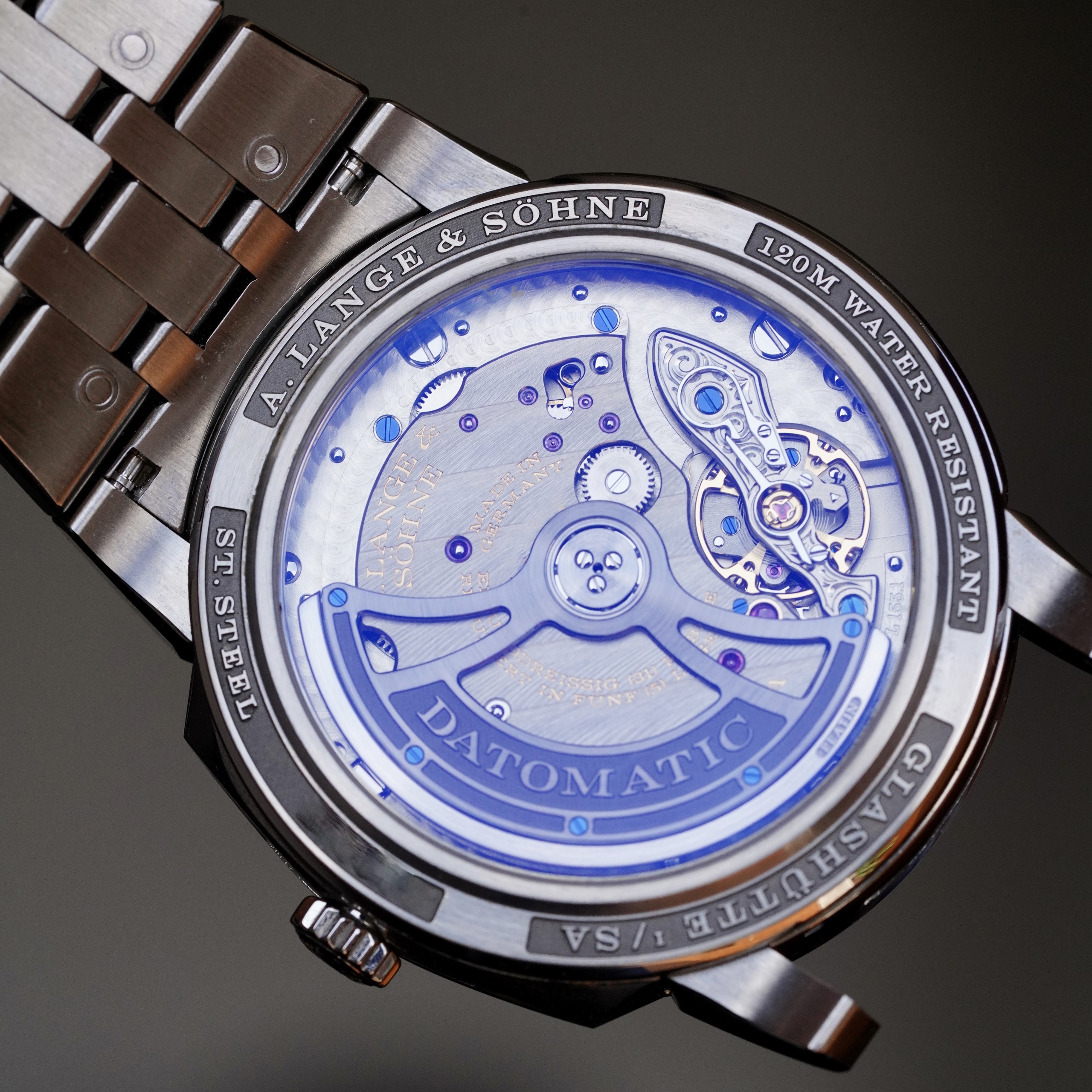
What I can recommend here to you is to take these answers with a grain of salt. One example I can give is: Well-known now that the Odysseus’ caliber L155.1 is based on L086.1 and it has a gold-chaton on the escape wheel cap – I assume simply because the brand took a lesson from the collectors’ critiques; not due to “technical” reasons.
All in all, the reason I am so critical towards L086 series is because I know the pathway that led to its creation and the missing Lange design hallmarks. It is still a good looking, average high-end movement and has no technical flaws whatsoever; but it does not inspire as others – as a Lange caliber should. As these watches are mostly marketed as heirloom pieces, as an avid enthusiast, I do not want to see such inconsistency from my favorite manufacturé which gave us much better pieces.
From 2011 to early 2020s, A. Lange & Söhne kept the reference 380.xxx, Saxonia Automatic without the big date, in the catalogue.
2015 - Saxonia Outsized Date
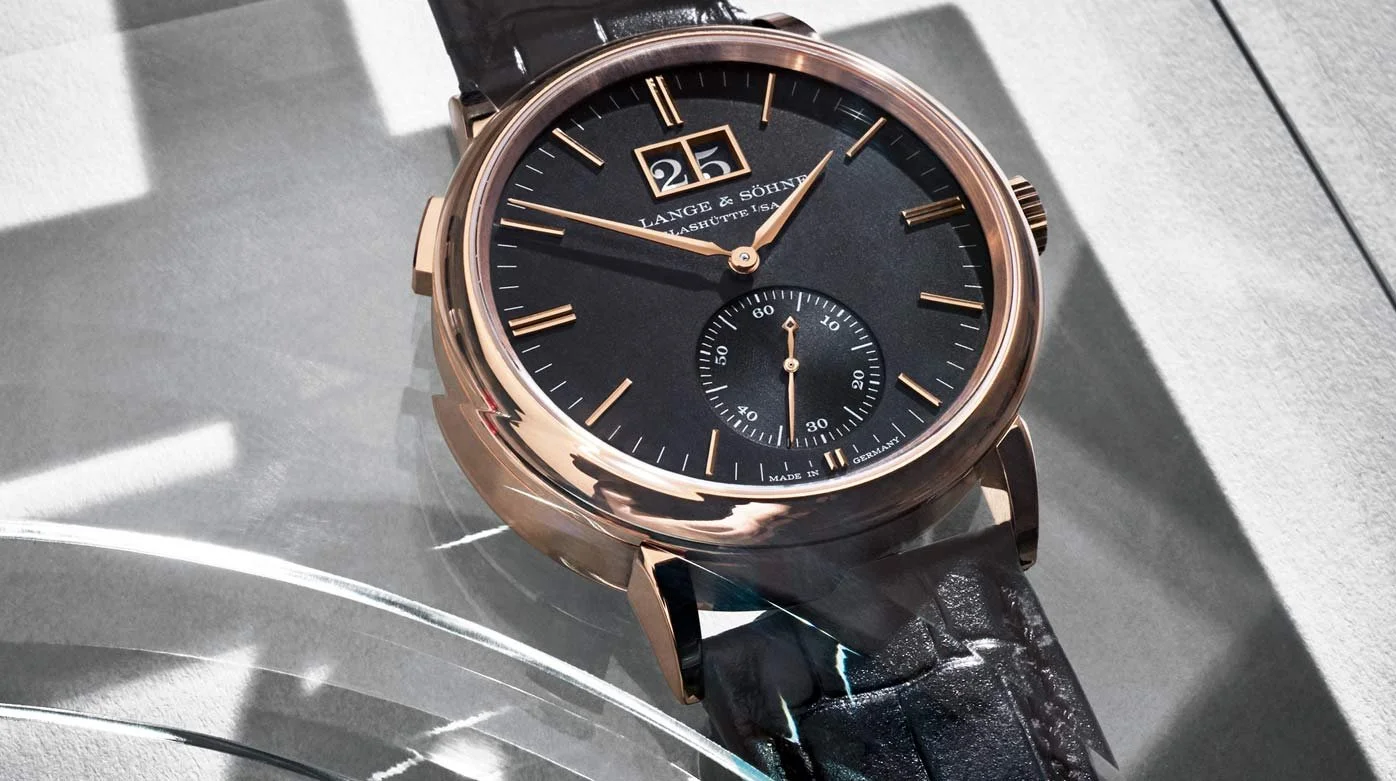
In 2018, A. Lange & Söhne brought back the outsized date to Saxonia collection with the introduction of white (381.029) and pink gold (381.031) versions with black dial and black date discs. The design template got even closer to early Langematik Big Date pieces, which is certainly for the better of the collection.
Saxonia Outsize Date is simplicity done extremely well. Both pieces measure at 38.5 mms in diameter, and exude absolute class in every angle. It is surely one of the best three-hand + date watches A. Lange & Söhne has ever made from the front. Again, the Langematik inspiration is quite obvious.
The post 2011 Saxonia Automatic collection is as follows:
- 380.026 – White gold/silver dial (2011 – 2017)
- 380.032 – Pink gold/silver dial (2011-2017)
- 380.027 – White gold/silver dial, updated version (2015 – 2017)
- 380.032 – Pink gold/silver dial, updated version (2015 – 2017)
- 380.042 – Pink gold/brown dial, Ginza BTQ special edition (2016 – )
- 380.044 – White gold/brown dial, Ginza BTQ special edition (2016 – )
- 381.029 – White gold/black dial, outsize date (2018 – )
- 381.031 – Pink gold/black dial, outsize date (2018 – )
- 381.026 – White gold/silver dial, outsize date (2020 – )
- 381.032 – Pink gold/silver dial, outsize date (2020 – )
Concluding Thoughts
The Saxonia collection has stood as a central pillar of A. Lange & Söhne since the brand’s rebirth in 1994. Though it was brought to life through a “betrayal” of the brand’s founding principles, hiding its borrowed movement behind a solid gold wall, the collection quickly found its own voice. It eventually sailed out on its own adventure with a character defined by confidence and, as case backs turned to sapphire, nothing left to hide.
Having navigated three decades of change, I remain a firm believer that the pre-2007 manual Saxonia collection (the more exotic the better!) offers tremendous value. I would say the same for the 1997–2007 Langematik era; those pieces remain utterly unique and characteristic, powered by stellar movements that reflect the very best of A. Lange & Söhne. They represent an era where no corners were cut, where the engineering was consistently ahead of the curve and genuinely inspiring.
Admittedly, the post-2007 lines feel somewhat muted, a composition that has lost some of its daring “leitmotifs” in favor of expected harmony. However, as a long-time observer of the manufacture, my hope remains that Lange will return to the bold, uncompromising design language that put Glashütte back on the map. I believe the path is already being paved for a return to that daring spirit. E.g. 34mm 1815 Collection.
Thank you for joining me on this walkthrough of one of A. Lange & Söhne’s most understated, yet deeply complex, collections.