When one utters the words “Pour le Mérite,” a Lange enthusiast either falls silent or lets out a wohoo. It is the shiver-down-the-spine meme made real: the arm and neck hairs rise, the blood starts pumping with the anticipation of guessing which one it is. Over its 36 years of modern history, A. Lange & Söhne has introduced only five “Pour le Mérite” pieces: the Tourbillon (1994), the Tourbograph (2005), the Richard Lange (2009), the Richard Lange Tourbillon (2011) and the Tourbograph Perpetual (2017). It is a designation the manufacture reserves for its fusée-and-chain watches, borrowed from the Prussian order of merit. The first of them re-defined the young brand’s path on technical innovation, and its success opened the way for everything technically ambitious that followed. In a span of ten years, from 1994 to 2004, we saw the Tourbillon “Pour le Mérite,” the Datograph and the Double Split. By 2005 the modern Saxon was already a tour de force, but that never stopped Blümlein, nor the brand, from reaching higher. Already before his passing, Mr. Blümlein had drafted one more Pour le Mérite. This one, in a way, is in his honour: the Tourbograph “Pour le Mérite.”
The second of its line, the Tourbograph builds on top of the ground-breaking Tourbillon “Pour le Mérite” to become the world’s first split-seconds tourbillon with fusée-and-chain transmission. It must have been very interesting to launch this gem right after the world’s first double split-seconds wristwatch. “Oh yeah, that was very cool. Here, check this out, we thought it would be cool to add a split-seconds chronograph to a tourbillon with fusée and chain. Just because..”
Well, in fact, the story goes like this: Blümlein wanted the Tourbograph for the launch in 1994. Just like the Tourbillon “Pour le Mérite,” it was conceptualised in partnership with Renaud & Papi, Reinhard Meis and the Blümlein team. Alas, four years was simply too short a time to make it to 1994, hence the project was shelved and the watch was introduced “just” with the tourbillon and fusée and chain. Must’ve been a relief. Blümlein, however, did not let it go, and the Tourbograph was already planned before his unfortunate passing in 2001. An interesting tidbit is that at its launch in 2005, A. Lange & Söhne introduced and thanked Renaud & Papi for their help in developing this magnificent piece. A very rare occurrence today, a manufacture giving accolades to a third party and openly acknowledging its involvement. That shows self-confidence and respect. Of course, Tony de Haas’ involvement in the Tourbograph project from his days at R&P, along with his recent (2004) appointment as director of product development at Lange, also plays a role in this.
The Tourbograph is therefore A. Lange & Söhne’s first attempt at a revival within the revival: a project drawn up at the very beginning, only to be brought to life fifteen years later, from the vision of Günter Blümlein.
The Tourbograph was made in 101 pieces in total. The platinum reference 702.025 came first in 2005, limited to 51 pieces, and a gold one followed with 50 pieces. That gold one arrived in honey gold in 2010, for the celebrations of the 165th anniversary of F. A. Lange’s manufacture: reference 712.050, limited to 50 pieces. Apart from these two, A. Lange & Söhne also produced a full-baguette diamond variant in 2009, for the opening of the Dubail boutique in Paris. Albeit the piece has a colourful ownership history, with a rumoured royal buyer who later changed his mind, the number 50/51 is now with a great collector.
Tourbograph Case
One would not expect restraint from an A. Lange & Söhne case. Even when you strap on a Lange 1 in platinum, or a Langematik, or even a Saxonia, that chunk of metal is going to make itself felt on your wrist. As Blümlein often described it, and as he is often quoted, it is like the way a Mercedes’ doors close, imagine a W124, that full, buph sound. An A. Lange & Söhne case feels exactly like that. And at this level of complexity, the Tourbograph takes it a few steps further. Measuring 41.2 × 14.3 mm, it is a hefty platinum block that can only be balanced with the help of a full deployant buckle.

The Tourbograph’s case is a classic “complicated” A. Lange & Söhne. It is constructed in three steps: a rather thick, polished bezel, a brushed caseband and a narrowing caseback ring to house the movement. The rattrapante hands, stacked on each other, rise quite a bit, which forces the dial to sit deeper than usual, deeper than, say, a Datograph. Thus the main dial and the tourbillon cage sit considerably below the highest point of the dial, forcing a thicker bezel and a more angled minute track.
The protruding caseback portion sits about 2 mm inside the outermost part of the case and extends for about 2.3 mm, reminding one of the Double Split. The catch with such a structure, however, is that the watch tends to get wobbly on the wrist, especially if the size is right on the edge for your wrist. The lugs are further curved to compensate for the structure and to properly hug the wrist, hence the Tourbograph requires a proper strapping! The lugs are soldered to the caseband and notched at the base, beautifully sculpted. The three-pusher rattrapante system, again, reminisces the Double Split from 2004. The caseback is relief-engraved with the individual limitation number.
Tourbograph Dial
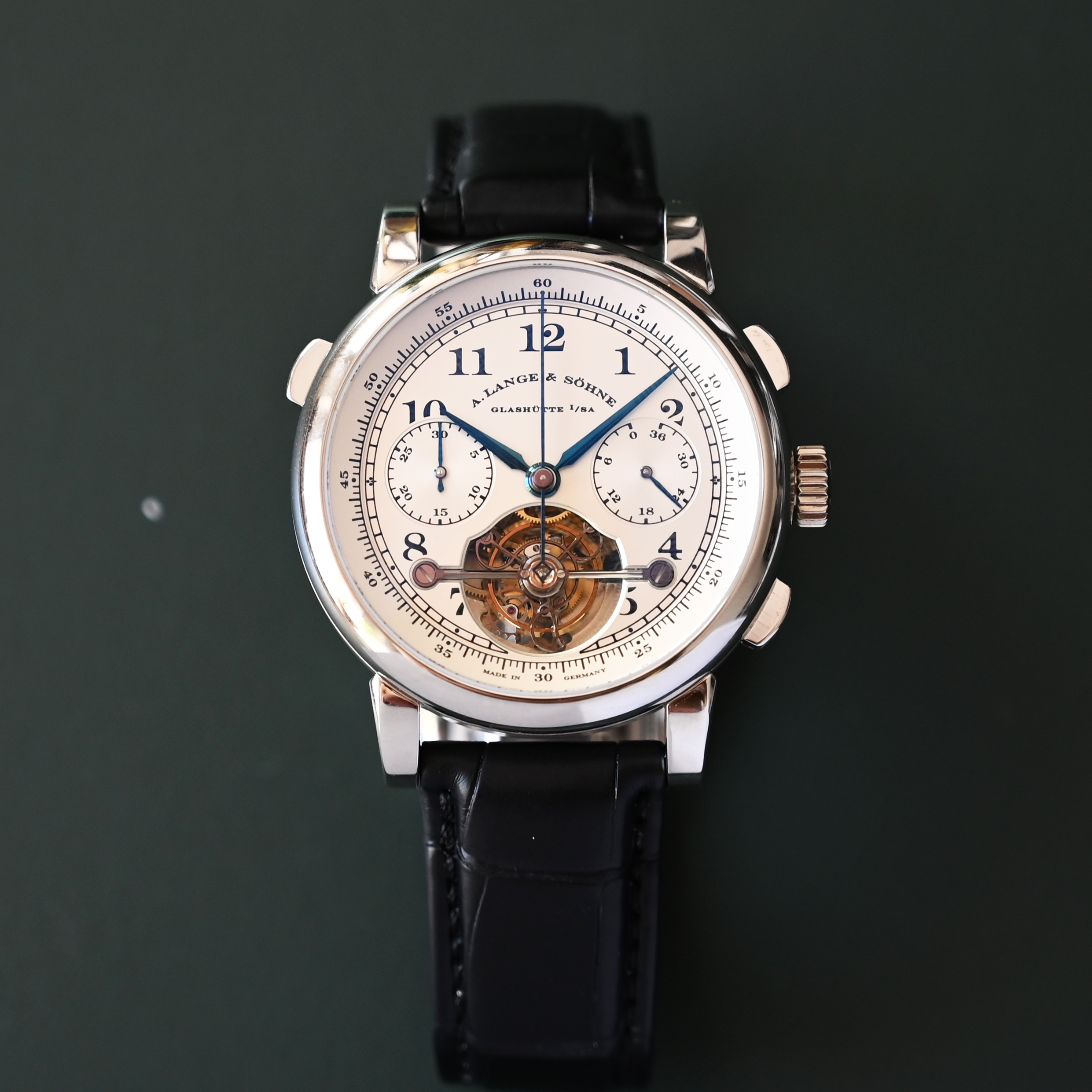
The Tourbograph 712.025 continues the tradition forged by its ancestor, the platinum Tourbillon “Pour le Mérite” 701.005, and merges the platinum case with a silver dial. At times, whenever I handle a Tourbillon “Pour le Mérite,” I do feel that the tourbillon opening is perhaps too broad, too strong for a watch of its size (38.5 mm), especially given its dial. The Tourbograph, however, with a much more complex and broader dial, puts the tourbillon cage and the black-polished bridge at exactly the right proportions, without overpowering the rest of the dial.

The centre portion is exactly as its predecessor’s, adorned with Arabic numerals, a railway minute track and three dots at each quarter marker, reminiscing the 19th- and 20th-century pocket watches of A. Lange & Söhne. The two subdials show the elapsed minutes for the chronograph on the left and the power reserve on the right. The curved A. Lange & Söhne logo beautifully balances the tourbillon opening at 6 o’clock, without disturbing the overall layout. The minute track is exclusively utilised by the minute hand; the outer chapter, however, is reserved for the blued-steel and gold-plated chronograph and rattrapante hands, perfectly matching the beat rate for precise reading.
I just love the colour configuration on the Tourbograph. The austerity, matched with the heavy use of blued steel and a bit of gold, is a brilliant merge. Then, on top of course, we have the tourbillon. The black-polished, three-faceted bridge holds it in place, and a brilliant-cut diamond centres the whirlwind, as per Lange tradition for 150 years. The three-armed, closed tourbillon carriage again salutes tradition, with exemplary craftsmanship. The chamfered edge of the tourbillon cage measures 73 mm in total, cut from a block and hand-shaped and hardened. Then another day passes to prepare it for assembly. Then another day or two to masterfully finish the cage. A free-sprung balance and overcoiled hairspring complete the ensemble, leaving the owner only to admire. The whole cage comprises 84 parts and weighs 0.25 grams. The numbers alone give you a headache, but the view of it is like an aspirin.


The honey gold Tourbograph separates itself from the original platinum run both with its case and with the centre guilloché on its dial. On the movement side, too, instead of the striping we see a solarisation technique. Apart from these, the honey gold Tourbograph is identical to the original platinum version.
Tourbograph Caliber l903.0
The calibre L903.0 (another indication that it comes from the ’90s) measures 30 mm in diameter and 8.9 mm in thickness. At its time it was the most complicated movement of the brand, and it stayed that way until about 2013 and the arrival of the Grand Complication. It houses a fusée-and-chain transmission, a split-seconds chronograph and a tourbillon, reaching 1,097 parts in total, of which 636 belong to the chain alone.
The Tourbograph’s calibre is constructed in several layers. The top layer houses the split-seconds chronograph, which can be observed from the caseback. Further down we have the fusée and chain, the planetary gearing system, the tourbillon, and then of course the dial side. Albeit the Tourbograph is the first watch ever to combine a fusée and chain with a split-seconds chronograph and a tourbillon, the individual mechanisms are constructed in an entirely traditional manner and simply stacked on top of each other.

The Split-Seconds Chronograph
The split-seconds chronograph mechanism comprises 136 parts in total. Its construction bears a striking resemblance to those built by Habring (who worked with Blümlein’s group at IWC and Lange) over the Valjoux 7750. Like Habring’s construction, the Tourbograph’s chronograph mechanism is operated via three pushers instead of the more traditional crown-based system.
The heart of the Tourbograph, like almost any chronograph for that matter, is the column wheel. When the user presses the start button, the column wheel rotates forward and pushes the tail of the clutch lever between the pillars. This action causes the clutch wheel to move horizontally and engage with the chronograph wheel. To stop, pressing the button again causes the clutch lever to disengage from the chronograph mechanism and return to its position between the pillars.
The Tourbograph features two hands positioned on interlocking shafts. In simple terms, activating the rattrapante while the chronograph is running blocks the rattrapante gear. Upon release, similar to the flyback function, the rattrapante wheel spins to rejoin the main chronograph hand and aligns on top of it. When the rattrapante pusher is activated, the column wheel responsible for the clamp rotates one step, closing the clamp and halting the rattrapante centre wheel. Pressing the pusher again opens the rattrapante clamp, allowing the rattrapante hand to instantly synchronise with the running chronograph hand.

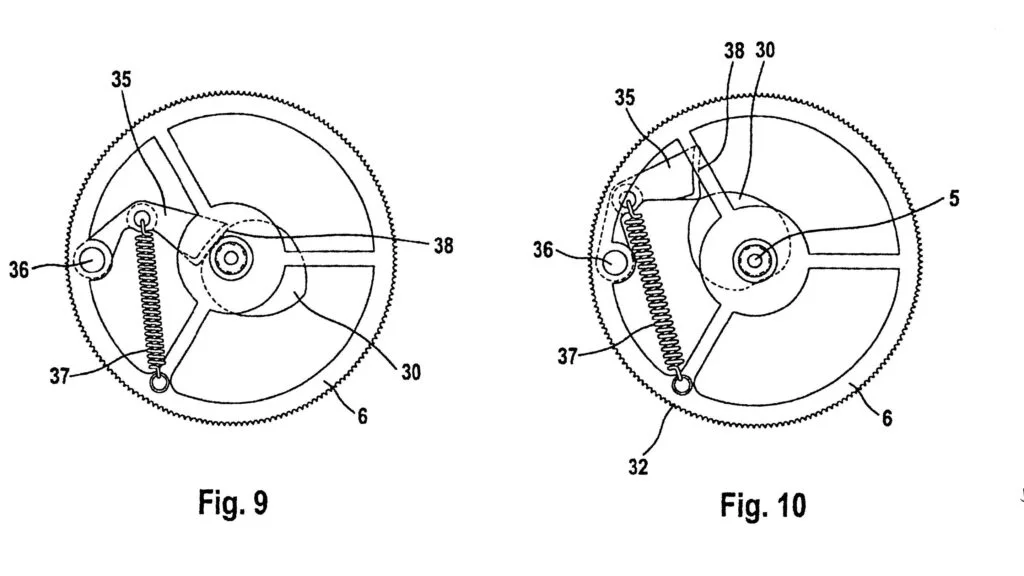
So what does the spring in this very much high-end Tourbograph caliber do?
When the rattrapante wheel (6) is free to rotate (gripper arms disengaged), the tension spring (37) forces the rattrapante heart-cam lever (35) against the heart cam (30). This coupling ensures synchronised movement of the rattrapante and chronograph hands.
When the gripper arms engage the rattrapante wheel to stop the rattrapante hand, the spring (37) allows the lever to pivot slightly. This ensures that the heart cam (30) remains engaged without obstructing the mechanism. Further, when the reset button is pressed, the spring (37) helps guide the lever (35) along the heart cam (30), ensuring the rattrapante and chronograph hands return to their zero positions precisely.
It is a rather archaic solution compared to what the Double Split, or other modern split-seconds movements, offer with the isolator mechanism. However, it surely helps with the thickness and reduces the overall complexity of the calibre L903.0. Indeed, if there is one thing that the Tourbograph can benefit from, it is surely less complexity!
With its rather flat construction, the Tourbograph’s chronograph section is far from the depth we are used to from Lange, but it is built for exactly this purpose. All 136 parts are efficiently arranged so they stay as thin as possible. Still, the movement bridges made of German silver are ribbed, the gold chatons and blued screws dance with each other, and the hand engraving is ever-present over the tourbillon bridge. The active chronograph parts are satin-brushed against the flat-polished two column wheels.
The Fusée & Chain
A level below, we have the fusée-and-chain mechanism with its planetary gearing system. The excerpt below is taken from Lange Uhren GmbH’s technical supplement:
This mechanism relies on the principle of levers formulated by Archimedes. When the mainspring is fully wound and thus exerts the greatest force, the chain pulls at the smaller radius of the fusée, which is equivalent to the smaller lever. When the tension of the mainspring is nearly depleted, the chain pulls at the larger radius of the fusée, the longer lever. The result is constant torque at the fusée’s arbor and therefore constant amplitude of the balance.
Traditional fusée mechanisms are linked directly to the gear train and mainspring and stop the system during winding. Giulio Papi decided that the benefit of a fusée mechanism in terms of timekeeping would be entirely lost if the movement stopped every time the watch was wound. So he introduced a complex set of planetary gears within the fusée cone, to allow the movement to run during winding.


The planetary gearing system is, in fact, what made the development of both the Tourbillon “Pour le Mérite” and the Tourbograph possible. One of the peculiarities of the fusée-and-chain transmission is that the fusée moves forward while the watch is running but rotates backwards while the mainspring is being wound. Therefore, the fusée-and-chain transmission needs a construction that ensures the transmission does not stop while the watch is being wound. A complex planetary gearing inside the fusée preserves the power flow from the fusée to the movement during the winding phase. It consists of 38 tiny parts that the watchmaker must integrate into the fusée, a hollow cone with an inside diameter of 8.6 millimetres.
The chain mechanism also houses two blocking mechanisms, both to prevent the chain from being overly wound and from being entirely unwound, which are two different problems. Overwinding might break the chain, whereas complete unwinding might require rewinding the chain around the cone each time. Thus the 36-hour power reserve works as a prevention mechanism and halts the unwinding action.
Too bad that all this ingenuity is not visible at all. You can understand what is going on inside while winding the watch, and you know that such a masterpiece is sandwiched between the layers. Alas, it is not there for you to enjoy the movement of the chain the way you can on the Richard Lange “Pour le Mérite.” Still, those who need to know, know, and that is only you and the fellow enthusiasts who know what this watch represents. It is a marvel of modern watchmaking and craftsmanship, housing more than a thousand parts working in harmony, made for a revived brand’s 15th birthday.
The Honeygold 712.050 Tourbograph
The honey gold Tourbograph separates itself from the original platinum run both with its case and with the centre guilloché on its dial. On the movement side, too, instead of the striping we see a solarisation technique. Apart from these, the honey gold Tourbograph is identical to the original platinum version.
That same trio of mechanisms, fusée and chain, split-seconds chronograph and tourbillon, returned twelve years later in the Tourbograph Perpetual “Pour le Mérite” of 2017, this time with a perpetual calendar stacked on top. Hence the borrowed diagram above. And hence, too, a watch that pushes the wearability of the concept well past the line its ancestor managed to hold.
Buying an A. Lange & Söhne Tourbograph
Those enthusiasts, of course, have their own collecting verticals within A. Lange & Söhne, and they get nerdier and nerdier… Some collect the Lumen, some collect only the Langematik on Wellendorff bracelets, and some collect the “Pour le Mérite.” It is an endeavour to collect the PLM pieces. They are very rare by nature, quite expensive, and some are just almost unwearable as a wristwatch, e.g. the Tourbograph Perpetual. But they symbolise this great dynasty’s watchmaking echelon, and the connection is now so strong that A. Lange & Söhne can almost call the fusée and chain theirs in modern watchmaking.
The Tourbograph sits at the sweet spot of utmost complexity and wearability. Despite everything stacked inside it, layer over layer, it manages to stay at 41.2 × 14.3 mm, not bigger than a certain Rolex, while boasting a million times more craft, individuality and identity.
With the recent surge of interest in early A. Lange & Söhne pieces, the Tourbograph has got its share of the attention. Once the brand’s most complicated wristwatch, and limited to 51 (702.025) and 50 pieces (712.050), the Tourbograph is very rare and limited in each variant. As collectors look at the apex pieces, they naturally gravitate towards this gem.

When introduced in 2005, the Tourbograph in platinum was priced at $460,000. Its first auction appearance arrived three years later, at the 2008 Sotheby’s Hong Kong auction, where the first example sold for a record $761,000 including the premium. Up until 2011, auction prices floated around the $400,000–$450,000 range. Then, along with the rest of the Lange market, the prices also dipped. Ever since 2013 and to this day, the average auction result for both the platinum and the honey gold variants is a mere $319,000. Today, however, this figure is mostly irrelevant, due to the recent surge explained above.
The Tourbograph is one of those apex pieces of A. Lange & Söhne and part of an exceptionally important collection. It is a watch that should be on the radar of any serious Lange collector.